
OOBThaiAmulets
Lp Toon - Wat Kao Noi
Lp Toon - Wat Kao Noi
Couldn't load pickup availability
MS6
Phra Khun Paen
LP Toon Kantasilo • Wat Khao Noi Khiriwan, Chonburi
B.E. 2547 (2004)
6cm
Mainstream Artifact
Sacred Craftsmanship
This Phra Khun Paen Roon Raek, Pim Yai belongs to the important B.E. 2547 series created by LP Toon Kantasilo of Wat Khao Noi Khiriwan, Ban Bueng, Chonburi.
Each amulet was individually pressed and finished from prepared sacred powders, with the placement of gilding, Yant, embedded materials and Takrut naturally varying from piece to piece. Such differences are part of the handmade character of the B.E. 2547 series.
Personal Experiences Shared by Luksits
Among collectors familiar with LP Toon's works, his powder amulets are particularly sought after for the combination of Metta Maha Niyom, saneh, commercial favour and protection traditionally attributed to his lineage.
Long-term owners frequently regard his Khun Paen differently from pieces made purely around attraction. The appeal lies in the broader combination of interpersonal influence and Buddhist Baramee: being received favourably by others, improving relationships, gaining customer support and navigating difficult social circumstances more smoothly.
Collectors who are familiar with LP Toon's Plai Guman works also place considerable importance upon their relationship with the tradition surrounding LP Tim of Wat Lahan Rai. The inclusion of old Phong Plai Guman material gives the B.E. 2547 Khun Paen an especially interesting place within this eastern Thai tradition.
Summary
The B.E. 2547 Phra Khun Paen Roon Raek, Pim Yai is an important powder amulet of LP Toon, combining older sacred materials with a particularly elaborate construction.
Its body incorporates sacred powders traditionally recorded as including fragments of Somdej Bang Khun Prom, Phong Plai Guman associated with LP Tim and various Phong Phutthakhun.
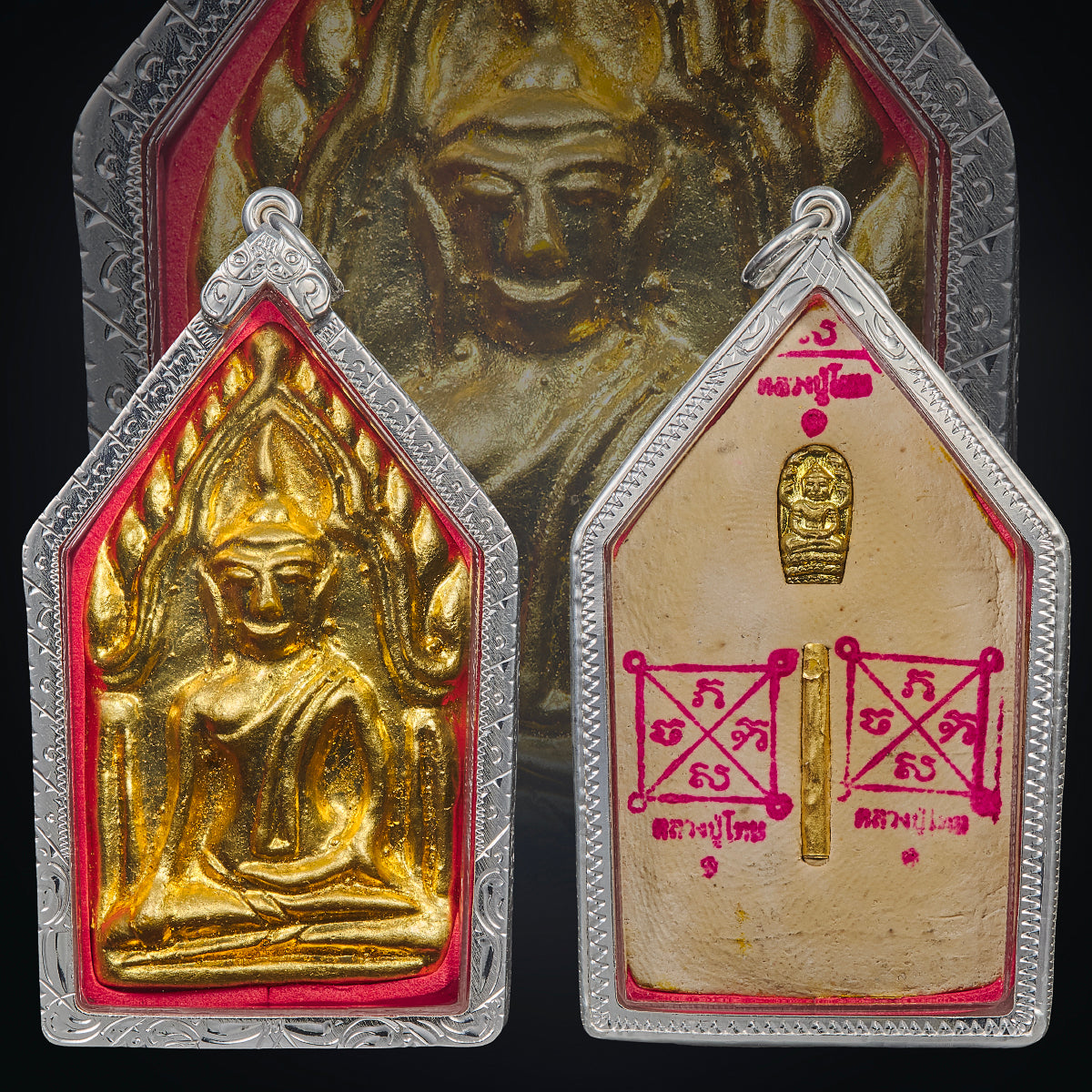
The reverse is especially distinctive: two red sacred Yant, a gold Takrut, and a gelaithong Phra Naprok Bai Makham are incorporated directly into the amulet.
Within traditional use, the series is principally associated with Metta Maha Niyom, saneh, Chok Lap, business and customer attraction, personal influence, protection and Baramee.
Historical Background
LP Toon Kantasilo was a respected monk associated with Wat Khao Noi Khiriwan in Ban Bueng District, Chonburi Province.
Biographical accounts give his birth as 2 July B.E. 2466 (1923) and record his ordination in B.E. 2495 (1952) at Wat Noen Sang Srittharam, with LP Thongyip of Wat Bot, Phanat Nikhom, serving as his preceptor.
LP Toon became associated with several areas of traditional knowledge, including Buddhist consecration, meditation and chanting, protective wicha, sacred oils, traditional healing practices and the development of Wat Khao Noi Khiriwan.
Accounts surrounding his life also describe periods of thudong pilgrimage through northern Thailand and Burma.
Of particular importance to collectors is his relationship with LP Tim of Wat Lahan Rai.
Within the lineage history, the two masters maintained a close spiritual association, and LP Toon became connected with the body of knowledge surrounding sacred powders and Plai Guman practices for which LP Tim's amulets later became especially famous.
This background helps explain why the materials incorporated into LP Toon's B.E. 2547 Khun Paen are so important to collectors today.
Origins of the Materials
The powder body was prepared from a combination of older sacred substances rather than a single type of powder.
Among the most significant were fragments attributed to Somdej Bang Khun Prom. In Thai amulet practice, fragments from damaged or incomplete older sacred images were often carefully retained and incorporated into later creations, allowing the consecrated material to continue within a new generation of amulets.
The mixture also incorporated Phong Plai Guman associated with LP Tim of Wat Lahan Rai.
This material is especially significant within the eastern Thai amulet tradition because LP Tim's Phong Plai Guman became closely associated with his celebrated Khun Paen lineage. Its inclusion links LP Toon's amulet materially as well as traditionally with this wider school of practice.
Various forms of Phong Phutthakhun completed the powder foundation, providing the Buddhist sacred-powder component upon which the finished Khun Paen was constructed.
The reverse was then further strengthened through its physical inserts: the gelaithong Phra Naprok and the central gold Takrut.
Ritual
LP Toon's approach brought Buddhist consecration together with the specialised sacred-material traditions he had acquired during his years of practice.
The prepared powders were first combined to create the body of the Khun Paen. The Buddha image and surrounding Ruen Kaew were then formed through the Pim Yai mould before the surface was finished with gilding.
The reverse received additional ritual attention.
Sacred Yant were applied in red, preserving the names and lineage associations of LP Toon and LP Tim. The Phra Naprok was incorporated above the centre, while the gold Takrut formed a vertical ritual axis beneath it.
The completed pieces were then subjected to chanting and consecration according to LP Toon's wicha.
For collectors, this combination is important because the power of the piece was not understood as coming from one ingredient alone. Its character derives from the interaction between old sacred powders, Buddhist imagery, Yant, Takrut and consecration.
Blessings and Effects
The B.E. 2547 Khun Paen is traditionally associated with a broad range of qualities rather than saneh alone.
Metta Maha Niyom concerns goodwill, favourable reception and assistance from others, while saneh relates more specifically to personal attraction, charisma and interpersonal magnetism.
Its Khun Paen character has consequently made it popular among people whose livelihoods depend heavily upon human relationships — particularly business owners, salespeople and those regularly dealing with customers.
The old sacred powders and Phra Naprok additionally introduce a stronger Buddhist and protective dimension. Phra Naprok, depicting the Buddha sheltered by the Naga Mucalinda, has traditionally carried associations with steadfastness and protection during adversity.
The gold Takrut adds another concentrated element of wicha to the reverse.
Taken together, followers traditionally seek this piece for Metta Maha Niyom, saneh, customer attraction, Chok Lap, prosperity, personal influence, harmonious relationships, protection and Baramee.
Modern Application
This Khun Paen is particularly suitable for collectors who prefer a piece in which saneh and Metta are balanced by Buddhist Baramee and protective qualities.
For business owners, its traditional emphasis on goodwill and customer relationships makes it especially relevant to retail, sales, negotiation and professions where trust and communication are important.
For personal use, it may be carried when seeking greater harmony in relationships, increased confidence when dealing with others or stronger personal presence.
From a collecting perspective, however, the attraction extends beyond its intended spiritual applications. The combination of historically important powders, LP Toon's lineage, the LP Tim connection, reverse Yant, gold Takrut and miniature Naprok makes the B.E. 2547 Pim Yai a particularly elaborate example of his sacred craftsmanship.
Physical Details
This is the Pim Yai, or large mould, of the B.E. 2547 first-batch Khun Paen. The front depicts the seated Buddha beneath an ornate Ruen Kaew and has been richly gilded.
The reverse retains its natural light sacred-powder surface and bears two prominent red Yant. A miniature Phra Naprok Bai Makham is embedded in the upper centre, while a gold Takrut is positioned vertically beneath it. The amulet is housed in a custom engraved 925 silver casing.
Recommended Pairing
Because this Khun Paen already combines Buddhist sacred powders, Phra Naprok symbolism, Metta, saneh and a gold Takrut, it is a relatively complete piece when worn alone.
For those wishing to emphasise Buddhist Baramee, it may be paired with a respected Phra Somdej, particularly fitting given the inclusion of old Somdej Bang Khun Prom fragments within its material tradition.
For livelihood and financial opportunities, Phra Sivali provides a complementary pairing, shifting the emphasis towards sustenance, abundance and ease in earning.
Collectors interested specifically in the eastern Thai lineage may instead pair it with an authenticated amulet of LP Tim of Wat Lahan Rai, creating a meaningful connection between the master whose Phong Plai Guman forms part of the material tradition and LP Toon's own B.E. 2547 work.
-
Free Shipping for Singapore| $15 Worldwide | $60 USA For Items Below $350