
OOBThaiAmulets
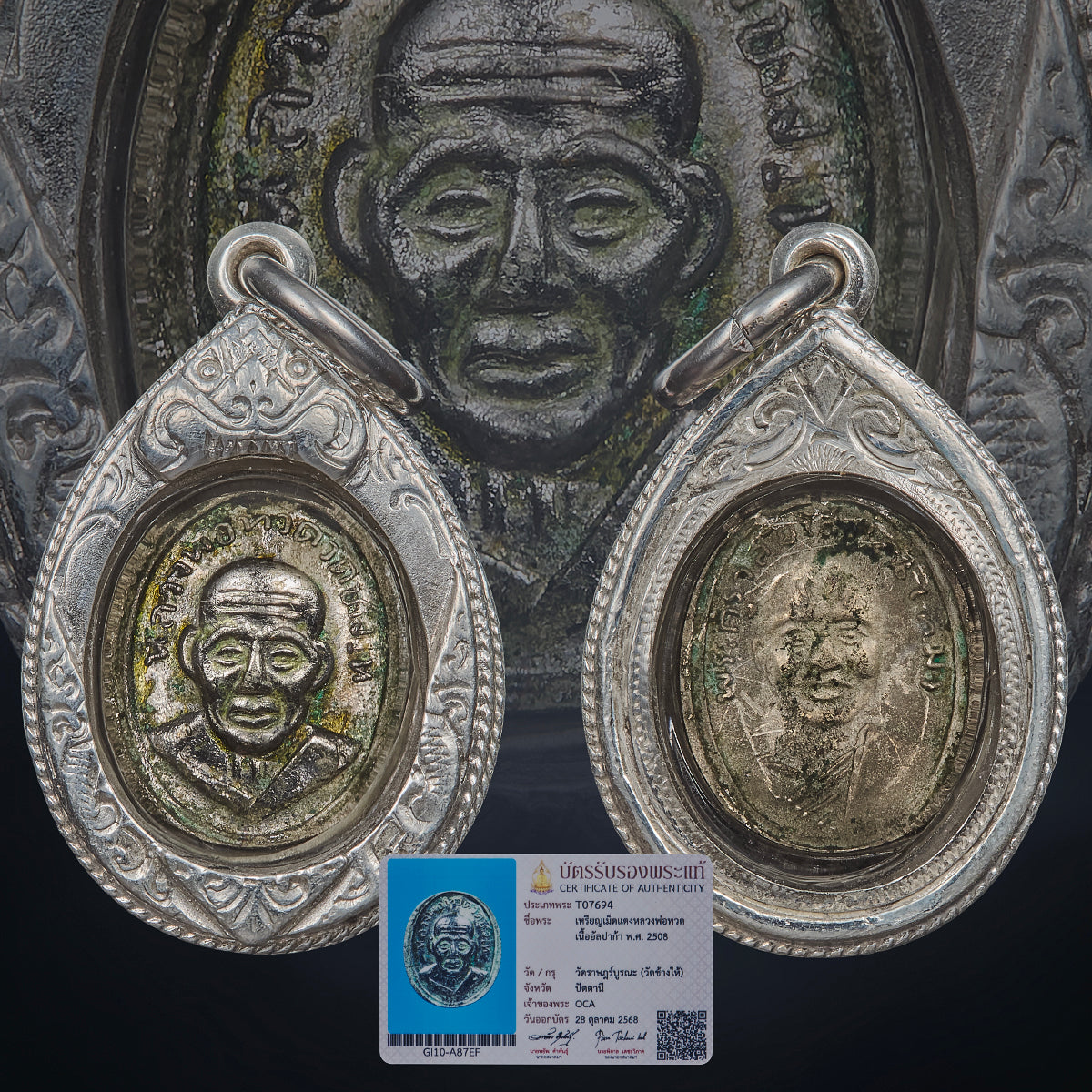
Lp Tim Wat Chang Hai 2508
Lp Tim Wat Chang Hai 2508
Couldn't load pickup availability
MS1
This piece is in wearing condition and thus very much affordable the ones that are in perfect condition are valued at $1800 for just the amulet alone at time of this post
Summary
The “Med Tang” coin series of Luang Pu Thuat from Wat Chang Hai remains one of the most respected and recognisable miniature amulet lines ever created within Thai amulet history. Despite the small “melon seed” size, these coins developed a reputation throughout Thailand for protection, survival, safe travel, obstacle removal, and blessings of progress.
Among long-time Thai collectors and dealers, the Med Tang is considered one of the essential classic carry pieces. It is extremely common to see older Thai amulet dealers wearing one around the neck or keeping one inside their loupe pouch beside their 10x magnification lens while grading amulets. For many collectors, a good Med Tang is viewed almost like a daily companion piece that stays close for decades.
The “Cracked Na, Lettering Beyond Ear” block from the BE 2508 series later became one of the most studied and recognised die variations due to the cracked character together with the lettering extending beyond the ear area of the mould.
Historical Background
The Med Tang series was officially created under Ajarn Tim, former abbot of Wat Chang Hai in Pattani Province. Ajarn Tim played a major role in preserving and spreading the spiritual lineage of Luang Pu Thuat throughout modern Thailand.
The Med Tang coins were created during BE 2506 and BE 2508 as smaller-format amulets that devotees could easily wear daily. Due to the compact shape resembling a melon seed, collectors eventually nicknamed them “Med Tang.”
The first BE 2506 release appeared as the 3 forehead line version with lettering extending beyond the ear and 5 neck lines. Production numbers were relatively limited and the amulets were distributed rapidly from the temple due to strong demand from Southern Thai devotees.
Several months later, Ajarn Tim arranged a second BE 2506 production using a revised mould. This became the famous 4 forehead line version with lettering extending beyond the ear. This generation was produced in larger quantities and eventually became one of the most popular Med Tang moulds within the Thai collecting scene.
By BE 2508, the Med Tang line expanded further into numerous recognised die variations. Collectors later classified them according to forehead structure, cracked characters, script placement, eye dots, ear markings, border forms, and tone mark positions.
Over time, the Med Tang series became one of the most studied miniature amulet categories in Thailand.
Origins of the Materials
The Med Tang series was primarily produced using alpaca alloy with nickel plating. Smaller quantities were also created in silver, gold-plated, and gold versions.
Alpaca was highly valued during that period because it preserved striking detail well while maintaining durability through daily wear. Due to the tiny dimensions of the coin, achieving strong definition required careful striking and clean mould preparation.
Older unworn examples still retaining sharp surfaces, clear lettering, and original temple skin remain highly sought after today.
The famous 4 forehead line “lettering beyond ear” version from BE 2506 is also recognised by collectors as belonging to the “crow-wing forehead” structure family.
Ritual and Spiritual Tradition
Within Southern Thai Buddhist belief, Luang Pu Thuat amulets became deeply associated with survival and miraculous protection. Devotees carried these amulets during long-distance travel, military deployment, jungle work, fishing voyages, and periods of uncertainty.
The Med Tang format became especially practical because of its small size. Many women, children, traders, drivers, and working-class devotees wore them continuously due to how easy they were to carry daily.
There is also an older belief among Thai collectors that smaller Luang Pu Thuat amulets slowly develop a personal spiritual connection with the wearer through repeated prayer and years of close contact.
Many devotees traditionally pray while making wishes for protection, smooth passage, stability, and progress in life.
Blessings and Effects
Most people first encounter Luang Pu Thuat through stories of protection and miraculous escape from danger. That was also my own understanding for many years. I never took Luang Pu Thuat too seriously beyond the reputation for safety and protection until one of my Thai friends corrected me directly.
He explained that among many older Thai devotees, Luang Pu Thuat was also strongly connected to stability, wealth retention, smooth livelihood, and the ability to continue surviving and progressing through difficult phases of life. The blessing was not viewed only as dramatic protection from accidents. It was also about maintaining one’s life path steadily over decades.
After hearing this, I began observing the people around me more carefully.
One of my local friends wears almost nothing except a Med Tang piece. He retired at around 45 years old and today, at about 60, he still comfortably travels, eats well, and lives peacefully without appearing financially burdened. He rarely changes amulets and continues carrying the same Luang Pu Thuat piece daily.
Experiences like this slowly changed my own understanding of the Med Tang tradition.
Among Thai dealers, especially older ones, many quietly believe the Med Tang helps stabilise fortune, preserve one’s pathway in life, reduce heavy obstacles, and keep situations from collapsing during difficult periods.
Physical Details
The Med Tang format measures roughly around 1 centimetre wide, making it one of the smallest classic Thai amulet coin formats ever produced.
Authentic examples are traditionally studied through natural die characteristics and strike details.
The famous 4 forehead line version is recognised by:
-
Four clear forehead lines
-
Lettering extending beyond the ear
-
Raised eye dots
-
Sharp nose structure
-
Double border
-
Thick eyebrow formation
-
Tone marks touching the border
-
Deep robe folds
-
Distinct ear depth
-
Natural machine-strike flow lines across the surface
Collectors also separate the moulds into shifted-die and non-shifted-die versions together with additional minor block variations.
The “Cracked Na, Lettering Beyond Ear” mould from BE 2508 later became one of the classic die studies within the Med Tang family due to the cracked character and extended script formation.
Collector Importance
Today, the Med Tang remains one of the most heavily collected miniature amulet series in Thailand.
Its popularity has continued across multiple generations because it combines historical importance, strong spiritual reputation, portability, and extensive die variation study.
For many Thai collectors, the Med Tang is not simply an old amulet. It is viewed as a lifelong companion piece connected to safety, stability, and the quiet continuity of life itself.
Among veteran dealers in Thailand, it is still common to see a Med Tang worn daily even alongside collections worth millions of baht.
-
Free Shipping for Singapore| $15 Worldwide | $100 USA All products