
OOBThaiAmulets
LP Pring Wat Bang Pakok
LP Pring Wat Bang Pakok
Couldn't load pickup availability
MS06
Phra Somdej
LP Pring · Wat Bang Pakok · Thonburi
B.E 2450-2480
1.5 Inches
Manistream Artifact
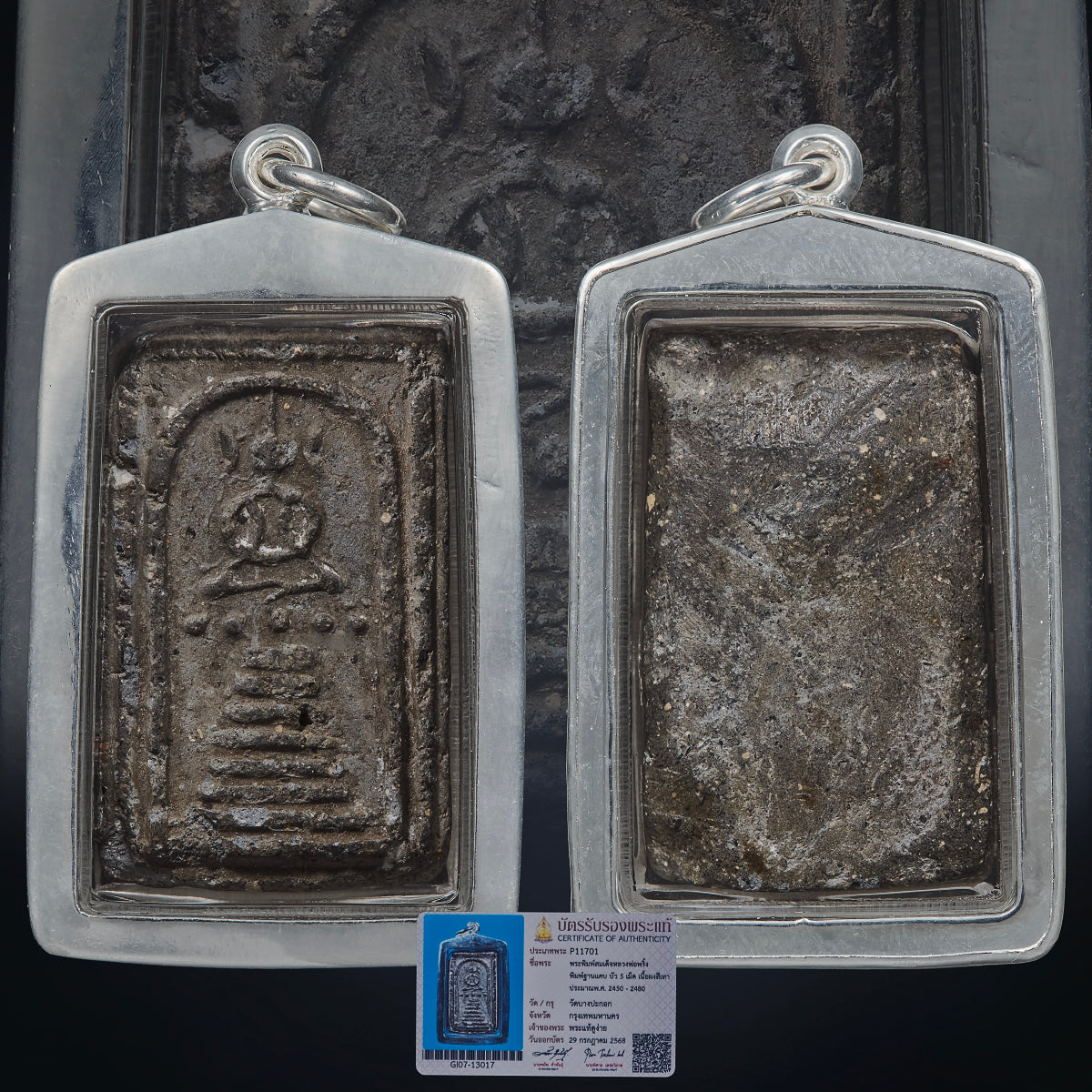
Samakom Certification Card (GI07-13017)
Sacred Craftsmanship
Each artifact was individually pressed from prepared sacred powder compounds. Variations in mixture, mould pressure, drying, ageing and surface wear naturally distinguish one surviving example from another.
Personal Experiences Shared by Luksits
Among older devotees, LP Pring's amulets developed a reputation for being particularly balanced pieces — combining Metta Maha Niyom, protection and Kong Krapan rather than concentrating upon only one quality.
Business owners and working people have traditionally valued his Somdej for a quieter form of prosperity: receiving cooperation, meeting helpful people, maintaining stable relationships and finding opportunities through one's own work.
Many collectors describe this quality through the concept of Baramee. Rather than wealth arriving simply through chance, the wearer is believed to develop the respect, confidence and favourable relationships that allow opportunities to be sustained.
This is one reason LP Pring's powder amulets remain attractive to those who prefer old-school Buddhist pieces associated with both meditative practice and traditional wicha.
Summary
This is a Phra Somdej by LP Pring of Wat Bang Pakok, identifiable as the Than Chet Chan Bua Ha Jud pattern — a Buddha seated above a seven-tiered base with five characteristic lotus points.
It represents an interesting part of LP Pring's sacred powder tradition. His powder amulets were produced in many moulds and mixtures, ranging from interpretations of established older forms to designs particular to Wat Bang Pakok.
LP Pring himself was regarded as one of the important old masters of the Thonburi area. His reputation extended beyond amulet making into Vipassana meditation, traditional wicha and herbal medicine, and his disciples came from widely differing levels of Thai society.
His amulets consequently developed longstanding reputations for Metta, protection, Kong Krapan and Baramee.
Historical Background
LP Pring, formally known as Phra Khru Wisut Silachan, was born Pring Iamthet in B.E. 2412 (1869) in the Bang Pakok area of Thonburi.
He entered religious education as a novice at Wat Ratchasittharam, traditionally known as Wat Phlap, and at the age of twenty was ordained as a monk at Wat Thong Nopphakhun. He later resided at Wat Bang Pakok and eventually became its abbot, remaining closely associated with the temple until his passing.
LP Pring became accomplished in Thai and Pali studies but was particularly devoted to Vipassana meditation. Alongside Buddhist practice, he studied traditional wicha under several teachers and also acquired knowledge of traditional medicine, which he used in assisting local people.
His reputation eventually extended well beyond Bang Pakok.
One of the most prominent figures traditionally associated with him was Prince Abhakara Kiartivongse, Prince of Chumphon, remembered popularly in Thailand as Sadej Tia. The Prince is recorded in traditional accounts as having regarded LP Pring as one of his teachers.
Origins of the Materials
The material composition is one of the most interesting aspects of LP Pring's powder amulets.
Different production periods can display different textures, yet recurring characteristics are found throughout the tradition. These include white sacred-powder particles of varying fineness, black carbonaceous material, mineral particles, small reddish or orange-brown inclusions, sand and fine gravel.
Some collectors identify occasional reflective mineral particles as Koh Larn mineral, traditionally regarded as a naturally efficacious Thonsit material.
LP Pring's sacred powders are also traditionally associated with accumulated ritual materials from his religious practice and ceremonies. These were incorporated into prepared compounds before individual Buddha images were pressed.
The resulting material was never intended to appear perfectly uniform. Its heterogeneous structure — clearly visible on many surviving pieces — is part of the character of an old hand-prepared sacred powder amulet.
Ritual
LP Pring's standing as a ritual master was considerable during his lifetime, and he was regularly invited to participate in important consecration ceremonies.
One famous account concerns a major casting and consecration ceremony for a Phra Kring associated with Somdej Phra Sangharaja Pae of Wat Suthat.
According to the traditional story, LP Pring inscribed a sacred metal yantra plate that was subsequently placed into the crucible together with plates prepared by other masters. During melting, LP Pring's plate reportedly remained intact despite the heat.
LP Pring was called back to recite the appropriate katha over it, after which the metal finally melted into the sacred alloy.
Whether approached as miracle tradition or temple history, the story illustrates the unusually high regard in which LP Pring's wicha was held by his contemporaries.
Blessings and Effects
LP Pring's Somdej amulets are traditionally associated with a broad spectrum of Buddhist blessings.
Metta Maha Niyom concerns goodwill, harmonious relationships and receiving favourable treatment from others.
Baramee concerns personal standing and accumulated spiritual presence — particularly relevant to leadership, career development and gaining the confidence of others.
Kong Krapan reflects LP Pring's strong traditional reputation for protection and resilience against physical danger.
Klaew Klad concerns avoiding accidents, dangerous circumstances and unexpected harm.
Prosperity is also associated with these Somdej amulets, although traditionally it is understood as prosperity supported through opportunity, favourable relationships, sound judgement and sustained livelihood, rather than wealth through chance alone.
Modern Application
The balanced character of this Somdej makes it particularly suitable as an everyday principal amulet.
For those involved in business or sales, its Metta tradition concerns customer relationships, negotiation and being remembered favourably.
For professionals and managers, the emphasis upon Baramee corresponds naturally with confidence, recognition, leadership and gaining support from colleagues and superiors.
For those travelling or working in unpredictable environments, LP Pring's traditional protective reputation adds another important dimension.
It is therefore an old-style Somdej whose qualities remain straightforwardly relevant: good human relationships, personal authority, protection and stability of livelihood.
Physical Details
The front presents a seated Buddha beneath a simple arch, elevated upon the distinctive seven-tiered base. Five small lotus points form an identifying feature of the Pim.
The reverse is plain and exposes the heterogeneous character of the sacred powder compound particularly clearly.
The photographed example shows considerable natural ageing, including surface oxidation, embedded particles, mineral deposits and wear consistent with an old powder artifact.
Maker: LP Pring
Temple: Wat Bang Pakok, Thonburi
Type: Phra Somdej
Pim: Than Chet Chan Bua Ha Jud
Material: Sacred powder compound
Recommended Pairing
This Somdej is already traditionally regarded as a broad and balanced amulet and can comfortably be worn alone.
For business purposes, it may be paired with Nang Kwak to place greater emphasis upon customers and commercial activity.
A Singha complements the Somdej for wearers requiring greater authority and leadership, while an established protective takrut can strengthen the traditional Kong Krapan and Klaew Klad direction.
For most wearers, however, the Somdej itself remains a complete principal Buddha image.
Personal Notes
LP Pring occupies an interesting position among the old Thonburi masters because his reputation was not built upon amulet production alone.
Traditional accounts portray a monk equally respected for meditation, wicha, healing and compassionate assistance to ordinary people. Those seeking his help were said to receive the same attention regardless of social standing.
His reputation for protection became particularly prominent during the Indochina War and Second World War period, when local residents used Wat Bang Pakok as a place of refuge during Allied bombing around nearby military and industrial targets. Local tradition credited LP Pring's protective rites with the temple and surrounding community escaping direct bombing.
The extraordinary variety of powder amulets he produced also makes collecting his work particularly interesting. Different batches and even examples from related moulds can show considerable variation in sacred material, texture and ageing.
The Than Chet Chan Bua Ha Jud is a fine expression of that tradition — an old sacred-powder Somdej representing the combination for which LP Pring became remembered: Samadhi, Metta, Baramee and protection.
-
Free Shipping for Singapore| $15 Worldwide | $100 USA All products