
OOBThaiAmulets
Lp Pring Wat Bang Pakok
Lp Pring Wat Bang Pakok
Couldn't load pickup availability
Stockbox: MS1
Summary
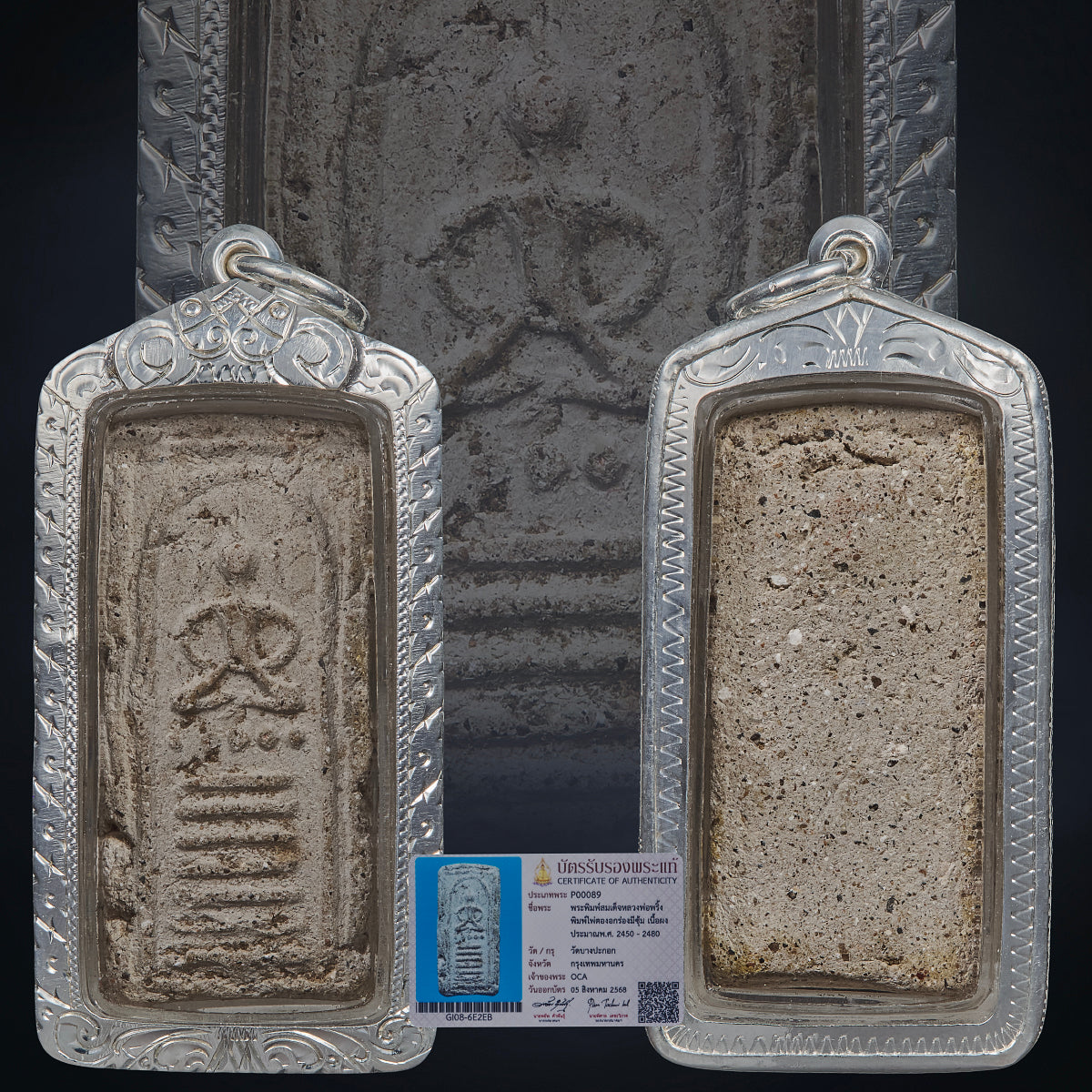
Phra Somdej Pai Tong by Luang Phor Pring of Wat Bang Pakok is one of the defining Bangkok wartime-era powder amulets of the early Buddhist century 2500 period. This first batch, created in B.E. 2483, carries the classic Pai Tong mold with the five-dot lotus base and seven-tier foundation, a format highly recognized among old-school Bangkok collectors and naval families connected to the temple lineage.
Among serious students of old Thai amulets, Luang Phor Pring is remembered as one of the great “bun rit” masters — monks whose amulets were believed to carry power born from deep samadhi and high-level meditation attainment. His pieces were heavily relied upon during the uncertainty of World War II, when civilians, businessmen, and military officers sought spiritual protection, stability, and blessings for survival.
This is also one of those old Bangkok amulets where experienced collectors often study the texture and raw material structure as much as the mold itself. The dry sacred powder body, mineral inclusions, cement-like binders, grey tonal variations, and rough natural aging all form part of the identity of authentic Wat Bang Pakok pieces from this era.
Historical Background
During the World War II period, Thailand entered one of the most unstable chapters in modern history. Bombings, economic hardship, military mobilization, and uncertainty affected everyday life across the country. In this era, great monk masters became spiritual anchors for the public.
Many legendary names emerged from this period — Luang Phor Jad, Luang Phor Jong, Luang Phor Kong, Luang Phor Ee, Luang Phor Rung, Luang Phor Poom, Luang Phor Pan, Luang Phor Phueak, and many others who became deeply respected for protective wiccha and meditation attainments.
Among them stood Luang Phor Pring of Wat Bang Pakok.
His reputation extended beyond ordinary temple circles. Major consecration ceremonies across Thailand consistently invited him to participate. Senior monks and temple committees regarded his presence as spiritually important during empowerment rites.
Records from the famous B.E. 2481 casting ceremony for the statue of Somdet Phra Sangharaj Chao Krom Luang Chinavorn Sirivattana at Wat Ratchabophit specifically noted that Luang Phor Pring arrived in time to participate in the chanting and empowerment ceremony. Even in the highly respected Phra Kring ceremonies of Wat Suthat Thepwararam under Somdet Phra Sangharaj Pae, Luang Phor Pring was repeatedly invited to join the consecrations.
Within old amulet circles, this period represented a golden era where senior masters from different lineages still gathered physically together for large ceremonies. Amulets from monks who consistently appeared in these rituals naturally gained immense trust from devotees.
Connection to Prince Chumphon and the Royal Navy
One of the most important parts of Luang Phor Pring’s legacy was his connection to Prince Chumphon, the revered father of the Royal Thai Navy.
Despite already studying extensively under the legendary Luang Pu Suk of Wat Pak Khlong Makham Thao, Prince Chumphon still sought additional spiritual teachings and occult knowledge from Luang Phor Pring. The respect was so deep that the prince entrusted his sons to ordain and remain under Luang Phor Pring’s supervision at Wat Bang Pakok.
Because of this relationship, naval officers and military men developed strong faith in him. Many original Luang Phor Pring amulets circulating today trace back to old naval families and retired servicemen.
Among older Thai collectors, there has long been a belief that amulets favored by military officers during wartime often carried practical field-tested reputation. Luang Phor Pring’s pieces became heavily associated with survival, protection, authority, and stability during dangerous periods of life.
Origins of the Pai Tong Somdej
The Phra Somdej Pai Tong first batch was created in B.E. 2483.
The mold is recognized by its Pai Tong format, five-dot lotus section, and seven-tier base structure. Old collectors often classify it among the important early Bangkok wartime Somdej amulets due to both historical timing and the monk behind the creation.
What makes these pieces particularly respected is not only age, but the identity of the sacred material body itself.
Luang Phor Pring experimented heavily with sacred powder compositions. Even within the same mold, collectors encounter differences in texture, density, and coloration. This reflects the reality that many old temple batches were handmade in stages over long periods using available sacred materials.
The amulets commonly contain white sacred powders ranging from fine to coarse texture, black charcoal-like particles, reddish-orange granules, crushed mineral fragments, sand, and small gravel inclusions.
Knowledgeable senior collectors have long believed some sparkling mineral particles found inside these amulets are sacred “Koh Larn ore,” considered a naturally empowered mineral substance in older Thai occult traditions.
Material Structure and Sacred Powder Composition
One of the most unique aspects of Luang Phor Pring amulets is the body texture.
His powder amulets rarely possess the soft oily richness commonly associated with later commercial Somdej production. Instead, many Wat Bang Pakok pieces appear dry, porous, grainy, and naturally aged.
Experienced collectors often immediately recognize the raw structure of authentic pieces because of this distinctive composition.
Most examples display tones of grey — light grey, dark grey, grey-green, or occasionally grey with pinkish undertones. Some batches contain bai lan ash mixtures blended with lacquer substances, creating darker surfaces with rich mineral depth.
Some examples are filled with reflective mineral particles that produce a shimmering appearance under light. Others reveal visible white sacred powder granules throughout the body.
Luang Phor Pring constantly experimented with binders and sacred formulations. Many researchers believe he frequently used cement-like materials as a primary structural binder. This gave the amulets a dry and stable body after curing.
Some pieces were additionally coated with shellac or natural tree resins to strengthen the surface. Other batches incorporated lacquer, soot compounds, beeswax, or clay blended with sacred substances.
Within the Luang Phor Pring collecting community, these natural variations are considered part of the charm and authenticity of the lineage.
Ritual and Consecration Tradition
Luang Phor Pring belonged to an older generation of monk masters where empowerment rituals relied heavily upon long meditation sessions, handwritten yantra work, chanting discipline, and direct consecration through samadhi.
His reputation during life was immense enough that large ceremonies across Thailand specifically invited him for empowerment participation.
The atmosphere surrounding wartime consecration ceremonies differed greatly from modern commercial releases. People during that era genuinely believed these sacred objects were necessary spiritual support during periods of instability and danger.
Stories from older generations mention that during World War II, devotees flooded Wat Bang Pakok requesting sacred items faster than the temple could produce them. At one point, Luang Phor Pring reportedly blessed ordinary gravel stones from the temple grounds and distributed them as protective objects because sacred powder amulets and luk om could no longer be produced quickly enough.
Among older Thai devotees, this story became symbolic of the monk’s spiritual attainment — the belief that true empowerment came from cultivated mind power and merit, not material luxury.
Personal Observations and Collector Experience
Over the years, I’ve noticed older Bangkok wartime amulets like this carry a very different feeling compared to later commercial-era productions.
The first thing serious collectors usually study is not beauty, but material honesty. On authentic Luang Phor Pring pieces, the body often feels ancient immediately upon handling — dry surfaces, uneven mineral distribution, rough aging, and naturally settled sacred powder structure.
Many pieces coming from older naval families or long-time household altars also tend to show deep devotional wear. These were often genuinely used for decades through working life, business, military service, and family protection.
Among senior collectors in Thailand, Luang Phor Pring remains one of those names consistently respected quietly without needing excessive promotion. His reputation has already been established across generations through surviving devotees and old temple history.
Blessings and Effects
The spiritual reputation of Luang Phor Pring amulets centers heavily around “bun rit” — blessings generated through meditation attainment and accumulated merit power.
Devotees traditionally revere these amulets for:
-
Maha chok and maha lap
-
Wealth and financial opportunities
-
Smooth career progression
-
Protection during travel and dangerous situations
-
Stability during unstable life periods
-
Metta and social harmony
-
Authority and respect
-
Family well-being
-
Safe passage through hardships
Among businessmen and older-generation wearers, many believed the amulets helped stabilize life during periods where external conditions felt uncertain or chaotic.
Modern Application
In modern times, many collectors continue wearing Luang Phor Pring amulets as everyday protection pieces, especially individuals dealing with stressful environments, business uncertainty, leadership responsibilities, or frequent travel.
The wartime background behind these amulets gives them a psychological and spiritual identity strongly connected to resilience, survival, and maintaining stability under pressure.
Older Bangkok sacred powder amulets also carry a certain depth that many long-term collectors appreciate over time. The more one studies the materials, temple history, and lineage connections, the more these pieces reveal their character.
Biography of Luang Phor Pring
Luang Phor Pring, formally known as Phra Kru Prasat Sikkhakij, was born in B.E. 2412 (1869) in Bang Pakok.
His birth name was Pring Iamthos.
As a young novice, he studied at Wat Ratchasittharam under Phra Sangvaranuwong (Mek), where he learned scriptural education and Buddhist occult sciences from an early age.
He later ordained fully at Wat Bang Pakok in B.E. 2435. After briefly residing at Wat Thong Noppakhun, he returned to Wat Bang Pakok and eventually became abbot in B.E. 2438.
In B.E. 2479, he received the royal ecclesiastical title “Phra Kru Prasat Sikkhakij.”
He peacefully passed away at Wat Bang Pakok in B.E. 2490.
Today, he remains one of the defining wartime monk masters of Bangkok Buddhist amulet history.
Physical Details
Model: Phra Somdej Pai Tong
Temple: Wat Bang Pakok
Master: Luang Phor Pring (Pring Inthachoti)
Year: B.E. 2483
Structure: Five-dot lotus section with seven-tier base
Material Group: Sacred powder composite with mineral inclusions and traditional wartime sacred substances
Era: World War II period Bangkok Buddhist amulet generation
Recommended Pairing
Many older collectors traditionally paired Luang Phor Pring amulets with protective takrut or old Bangkok metta pieces from the same wartime generation.
For modern wearers, this Pai Tong Somdej works especially well as a primary daily amulet focused on stability, protection, authority, and sustaining smooth life momentum across career and family matters.
-
Free Shipping for Singapore| $15 Worldwide | $100 USA All products