
OOBThaiAmulets
LP Prasan Sumano - Wat Pa Nong Khrai
LP Prasan Sumano - Wat Pa Nong Khrai
Couldn't load pickup availability
MS07
LP Prasan Sumano – Roon Setthi 83 (Millionaire 83)
LP Prasan Sumano • Wat Pa Nong Khrai, Yasothon
B.E. 2556 (2013) • 83rd Birthday Commemorative Batch
2 Inches
Mainstream Artifact
Sacred Craftsmanship
The Roon Setthi 83 is a commemorative medal issued in B.E. 2556 (2013) in honour of the 83rd birthday anniversary of LP Prasan Sumano, the respected Thai Forest Tradition monk of Wat Pa Nong Khrai, Yasothon Province.
Exact pc in photo will be sent
Each medal is individually produced from prepared metal, with natural variations in casting texture, surface patina, colour and finishing contributing to its individual character. Such characteristics are particularly relevant when examining preliminary test mould examples.
Personal Experiences Shared by Luksits
The Quiet Influence of LP Prasan's Teachings
Among followers of LP Prasan Sumano, the master's reputation is closely associated with his gentle character, disciplined meditation practice and unwavering commitment to the Buddhist monastic path.
Unlike sacred objects whose reputation is built primarily around dramatic supernatural accounts, amulets associated with senior Forest Tradition monks are often appreciated for the sense of spiritual reassurance they provide.
Devotees commonly regard such pieces as reminders of the master's Dhamma teachings and the importance of maintaining mindfulness in daily life.
The Roon Setthi 83 is particularly meaningful because it commemorates LP Prasan's long life of religious practice.
For followers familiar with his teachings, the medal represents more than an auspicious object associated with prosperity.
It also serves as a reminder that lasting well-being depends upon moral conduct, generosity, patience and wisdom.
Prosperity Through Stability and Right Livelihood
The name Setthi 83 naturally attracts the attention of collectors interested in wealth-related amulets.
Within traditional Thai amulet beliefs, Setthi editions are often associated with Chok Larp, financial opportunities and favourable business circumstances.
However, the interpretation of prosperity among followers of Forest Tradition monks can extend beyond material wealth.
A stable livelihood, freedom from unnecessary financial difficulties and the ability to support one's family are also considered meaningful forms of prosperity.
Some devotees regard carrying such an amulet as a personal reminder to approach financial matters with greater discipline and mindfulness.
Rather than depending solely upon unexpected fortune, the emphasis is placed on making sound decisions, maintaining honest business practices and accumulating merit through generosity.
The Appeal of Test Mould Examples
Among experienced collectors, test mould medals often generate particular interest because of their connection to the early stages of production.
Unlike regular distribution pieces, preliminary examples may preserve characteristics that were subsequently adjusted or refined.
Collectors may examine the sharpness of the portrait, arrangement of inscriptions, metal composition and differences in surface finishing.
For the Roon Setthi 83, the Nur Takua test mould represents an interesting variation within the commemorative release.
Its significance lies in both its association with LP Prasan and its place within the production history of the medal.
Summary
The LP Prasan Sumano Roon Setthi 83, B.E. 2556, is a commemorative medal celebrating the master's 83rd birthday anniversary.
Issued during a significant period of his monastic life, the release reflects both the traditional Thai practice of honouring senior Buddhist monks and the use of sacred objects to support religious merit-making.
The name Setthi associates the medal with prosperity, abundance and favourable financial circumstances.
Its deeper significance, however, rests upon the spiritual reputation of LP Prasan, a senior monk whose life has been closely connected with the Thai Forest Tradition.
This particular example is distinguished by its Nur Takua test mould construction, making it different from regular production medals.
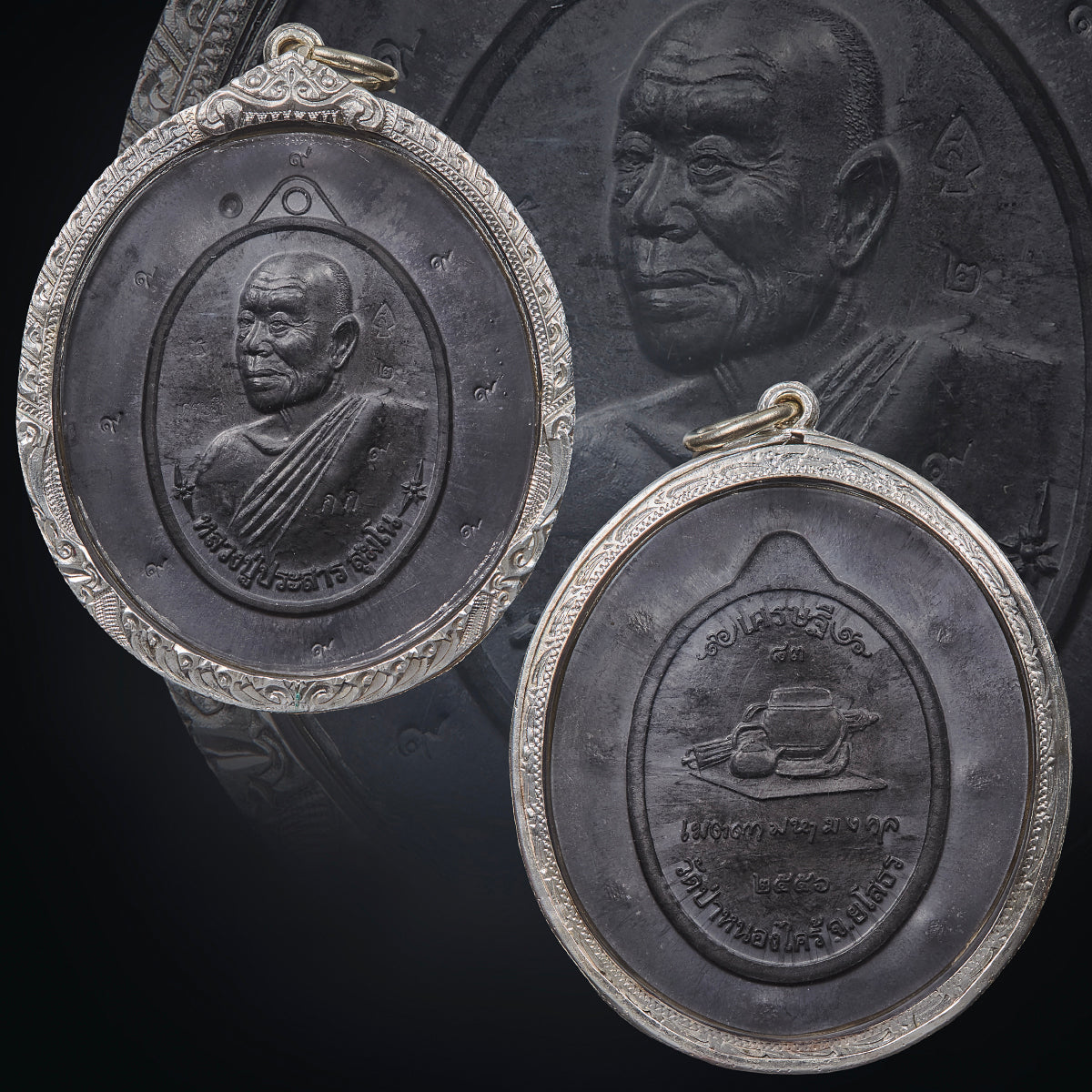
The dark lead surface, raised portrait and traditional monastic imagery give the piece a restrained appearance consistent with its commemorative purpose.
For collectors, the Roon Setthi 83 combines several important qualities: the spiritual lineage of a respected meditation monk, an auspicious prosperity-oriented release, a significant birthday anniversary and the distinctive characteristics of a preliminary test mould.
Historical Background
LP Prasan Sumano – Wat Pa Nong Khrai
LP Prasan Sumano, later honoured with the ecclesiastical title Phra Ratchawachiramongkhon Yan, is a senior Thai Buddhist monk associated with Wat Pa Nong Khrai in Yasothon Province.
He was born on 16 January B.E. 2473 (1930) at Ban Nong Ped, Nong Hin Sub-district, in the area now forming part of Yasothon Province.
At the time of his birth, the locality belonged administratively to Ubon Ratchathani Province.
His birth name was Prasan Phao-phet, later recorded as Phao-phut.
He was born into a modest rural family, the son of Mr Klom and Mrs Khao, and grew up alongside one sibling.
His early education took place at Wat Nong Ped School, where he completed Primary Grade Four.
Like many monks who later entered the Thai Forest Tradition, his early life was shaped by the religious environment of rural northeastern Thailand.
Early Encounter with LP Mun Bhuridatto
One of the most significant accounts associated with LP Prasan's early religious life concerns his encounter with LP Mun Bhuridatto, one of the principal figures of the modern Thai Forest Tradition.
During his younger years as a novice monk, LP Prasan reportedly had the opportunity to travel and pay respects to LP Mun, listening directly to his Dhamma teachings.
For students of Thai Buddhist history, this connection is particularly meaningful.
LP Mun emphasised strict adherence to the Vinaya, disciplined meditation and the direct investigation of the mind.
His teachings influenced generations of Forest Tradition monks throughout Thailand.
The opportunity to encounter such a teacher during one's formative years was regarded as an important spiritual experience.
Higher Ordination
Upon reaching the appropriate age, LP Prasan received full ordination as a Buddhist monk at Wat Phothisomphon, Udon Thani Province.
His preceptor was LP Jum Phanthulo, also known by the ecclesiastical title Phra Dhammachedi.
LP Jum was an important senior monk associated with the Thai Forest Tradition and played a significant role in the ordination of several respected meditation masters.
Through this ordination lineage, LP Prasan became connected to an established tradition of disciplined Buddhist practice.
Tudong Practice and Meditation Training
Following ordination, LP Prasan devoted himself to the study and practice of the Dhamma.
He undertook Tudong journeys, travelling through forests, mountains and remote areas in pursuit of meditation training.
Tudong, derived from the Pali term Dhutanga, refers to ascetic practices intended to encourage simplicity, detachment and disciplined spiritual development.
Forest monks undertaking such journeys traditionally live with few possessions, relying on alms and practising meditation in secluded environments.
LP Prasan's religious training is associated with several respected teachers, including:
- LP Fan Ajaro – Wat Pa Udom Somphon, a highly respected disciple within the LP Mun Forest Tradition.
- LP Fan Paresako, another teacher associated with his meditation training.
Through these experiences, LP Prasan developed a reputation for gentleness, patience and disciplined spiritual conduct.
Followers frequently describe his manner as quiet and composed, reflecting the emphasis on mindfulness and restraint found within the Forest Tradition.
Wat Pa Nong Khrai
LP Prasan became closely associated with Wat Pa Nong Khrai in Yasothon Province.
The monastery serves as an important centre for Buddhist practice and religious activities within the local community.
His long monastic career has also been associated with charitable initiatives, community development and support for healthcare-related causes.
In January 2025, celebrations were held in recognition of his 95th year of life and 75 Vassa, marking an important milestone in his monastic journey.
His ecclesiastical title, Phra Ratchawachiramongkhon Yan, reflects the recognition accorded to his religious service.
The Roon Setthi 83 Commemorative Release
The Roon Setthi 83 was issued in B.E. 2556 (2013), commemorating LP Prasan's 83rd birthday anniversary.
The number 83 refers directly to the master's age during the commemorative year.
The release also served a charitable purpose.
According to the history associated with the batch, proceeds from its distribution contributed towards the maintenance and development of Wat Pa Nong Khrai, together with charitable activities connected to LP Prasan's religious work.
This reflects the longstanding Thai Buddhist tradition of producing commemorative amulets to support temple construction, maintenance and community welfare.
For devotees, participation in such releases represents an opportunity to acquire a sacred object while contributing towards a religious cause.
Origins of the Materials
Nur Takua – Traditional Lead Alloy
The principal material used in this test mould example is Nur Takua (เนื้อตะกั่ว), referring to lead or a lead-based alloy.
Lead has a long history in Thai sacred-object craftsmanship.
Its relatively low melting temperature and workable characteristics make it suitable for producing cast amulets, preliminary mould impressions and certain traditional sacred objects.
Within Thai amulet collecting, Nur Takua is appreciated for its distinctive surface appearance and the patina that can develop with age.
Depending on the alloy composition, manufacturing method and storage conditions, lead surfaces may gradually develop grey, charcoal or darker tones.
The illustrated example displays a predominantly dark grey appearance, with subtle variations across the portrait and surrounding fields.
These characteristics contribute to the medal's individual appearance.
The Significance of a Test Mould
A test mould, commonly referred to in Thai collecting terminology as a preliminary trial piece, is produced during the development of an amulet or commemorative medal.
Such examples may be used to evaluate:
- The clarity and depth of the portrait.
- The positioning and legibility of inscriptions.
- The quality of the mould impression.
- The suitability of the selected metal.
- The overall appearance before regular production.
Not every test mould is necessarily unique, and production quantities can vary between releases.
However, examples associated with preliminary production stages are often of interest because they document aspects of the manufacturing process that may not be visible in regular distribution pieces.
The Nur Takua construction of this particular Roon Setthi 83 is therefore an important identifying characteristic.
Its designation as a test mould should be considered alongside the physical features of the piece and any available provenance or production records.
The Monastic Requisites Motif
The reverse of the medal features a traditional arrangement of objects associated with Buddhist monastic life.
The design appears to depict a monk's requisites, including a bowl and related implements.
Such imagery carries particular significance within the Thai Forest Tradition.
Forest monks are traditionally encouraged to maintain a simple lifestyle, possessing only what is necessary for religious practice.
The alms bowl is especially important.
It represents dependence upon the generosity of lay supporters, the practice of humility and the relationship between the Sangha and the wider Buddhist community.
Its inclusion on the reverse provides a meaningful contrast to the prosperity-oriented name of the release.
While Setthi refers to material wealth, the monastic requisites symbolise simplicity, restraint and freedom from unnecessary attachment.
Ritual
The Roon Setthi 83 was produced as a commemorative release honouring LP Prasan's 83rd birthday anniversary.
Its consecration is associated with the master's Buddhist practice and the traditional blessing of sacred objects within the Thai Forest Tradition.
Unlike certain ritual lineages that place particular emphasis on elaborate magical procedures, Forest Tradition monks generally centre their religious practice on meditation, mindfulness, moral discipline and the cultivation of wisdom.
The spiritual significance of amulets associated with such masters is therefore often understood through their accumulated Baramee and lifelong commitment to the Dhamma.
Meditation and Baramee
LP Prasan's long experience in Vipassana meditation forms an important part of the devotional understanding surrounding his amulets.
Within Buddhist practice, Vipassana concerns the development of insight into the nature of experience, particularly impermanence, unsatisfactoriness and non-self.
For devotees, a sacred object blessed by a respected meditation monk may serve as a reminder of the qualities cultivated through such practice.
These include patience, mindfulness, compassion and mental stability.
The Setthi Blessing
The name Setthi associates the release with prosperity and abundance.
Within Thai sacred traditions, prosperity-oriented amulets are commonly connected with blessings for favourable opportunities, stable livelihood and freedom from unnecessary financial hardship.
However, the Buddhist understanding of prosperity also includes the accumulation of merit through generosity and ethical conduct.
This broader interpretation is particularly relevant to an amulet associated with a senior Forest Tradition monk.
The precise duration, recitations and ceremonial sequence used during the consecration of this batch have not been established from the information available.
Blessings and Effects
1. Chok Larp – Fortune and Financial Opportunities
The Roon Setthi 83 is traditionally associated with Chok Larp through its Millionaire designation.
Practitioners may regard the medal as an auspicious object supporting favourable financial circumstances, business opportunities and improvements in livelihood.
The emphasis is on prosperity accompanied by stability and responsible conduct.
2. Maha Pokasap – Wealth and Abundance
Maha Pokasap refers to the accumulation of wealth, possessions and material resources.
Within traditional belief, prosperity-oriented medals may be carried by individuals seeking to maintain sufficient resources for themselves and their families.
For business owners, this symbolism is associated with steady income, sustainable growth and the preservation of accumulated wealth.
3. Baramee – Spiritual Authority and Personal Stability
The spiritual reputation of LP Prasan forms an important aspect of the medal's appeal.
His long monastic career and dedication to meditation are traditionally understood as expressions of cultivated Baramee.
Devotees may carry the medal as a reminder of the master's discipline and spiritual example.
4. Klaew Klaad – Protection from Misfortune
Amulets associated with respected meditation monks are commonly kept for protection and reassurance.
Klaew Klaad refers to the traditional belief in avoiding danger or escaping unfavourable circumstances.
For followers, this protective symbolism may encourage greater mindfulness and caution in daily life.
5. Metta – Goodwill and Harmonious Relationships
The gentle character attributed to LP Prasan is reflected in the devotional significance of his sacred objects.
Metta concerns loving-kindness, goodwill and compassionate conduct.
The medal may serve as a reminder to maintain patience, understanding and harmonious relationships with others.
6. Boon Baramee – Merit and Spiritual Development
Beyond material prosperity, the Roon Setthi 83 is associated with the Buddhist practice of accumulating merit.
Its connection to temple maintenance and charitable activities reinforces this aspect.
For devotees, the medal represents the relationship between generosity, ethical conduct and spiritual well-being.
These qualities reflect traditional religious beliefs rather than guaranteed supernatural outcomes.
Modern Application
The Roon Setthi 83 is suitable for collectors and devotees who appreciate sacred objects associated with respected meditation masters.
Business Owners and Entrepreneurs
The Setthi designation makes the medal meaningful to individuals seeking financial stability, favourable business opportunities and sustainable commercial growth.
Working Professionals
Those pursuing career development may appreciate the medal's symbolic emphasis on perseverance, discipline and the gradual accumulation of prosperity.
Individuals Facing Financial Uncertainty
The medal may serve as a personal reminder to approach financial difficulties with patience, careful planning and mindfulness.
Devotees of the Thai Forest Tradition
For followers of LP Mun's spiritual lineage, the medal represents a connection to a senior monk whose life has been devoted to meditation and disciplined Buddhist practice.
Collectors of Test Mould Medals
The Nur Takua test mould construction makes this example particularly interesting to collectors who study variations within commemorative releases.
Its preliminary production characteristics distinguish it from standard examples of the Roon Setthi 83.
Physical Details
This LP Prasan Sumano Roon Setthi 83, B.E. 2556, is a Nur Takua test mould medal featuring a dark grey lead surface with natural variations in patina and texture. The obverse displays a raised oval portrait of LP Prasan in monastic robes, surrounded by small sacred characters and Thai inscriptions. The reverse features a central oval panel containing traditional monastic requisites, commemorative inscriptions and the B.E. 2556 date. The medal is housed within an ornate silver-coloured protective casing with engraved decorative patterns and a suspension loop. Its overall appearance is restrained, with the dark metal contrasting against the brighter protective casing.
Recommended Pairing
The Roon Setthi 83 may be paired with other traditional Thai amulets whose spiritual associations complement its emphasis on prosperity, protection and Buddhist merit.
Phra Somdej – Protection and Spiritual Stability
Phra Somdej is commonly associated with Buddhist merit, protection and personal well-being.
This pairing may appeal to devotees who appreciate the balance between material prosperity and spiritual practice.
LP Mun Bhuridatto Amulets – Forest Tradition Lineage
An amulet associated with LP Mun Bhuridatto offers a meaningful connection to the wider Thai Forest Tradition.
Given LP Prasan's early encounter with LP Mun and his subsequent meditation training, this pairing carries particular historical and devotional significance.
LP Fan Ajaro Amulets – Meditation and Baramee
LP Fan Ajaro was an important figure within the Thai Forest Tradition and is associated with LP Prasan's religious training.
Pairing amulets connected to these two masters symbolically reflects the relationship between teacher, disciple and the transmission of Buddhist practice.
Personal Notes
The Roon Setthi 83 of LP Prasan Sumano is particularly interesting because it brings together two ideas that may initially appear contradictory.
The name Setthi refers to wealth and material prosperity.
Yet the master associated with the release devoted his life to a monastic tradition that emphasises simplicity, restraint and freedom from attachment.
This contrast gives the medal a deeper meaning.
Within Buddhist teachings, material wealth is not necessarily regarded as something negative. Its significance depends upon how it is acquired, maintained and used.
Wealth obtained through honest livelihood and shared through generosity can support both personal well-being and the wider community.
The Roon Setthi 83 reflects this understanding through its association with temple maintenance and charitable activities.
Another important aspect is the age of LP Prasan at the time of the release.
By B.E. 2556, he had already spent many decades practising and teaching within the Thai Forest Tradition.
His religious background includes an early encounter with LP Mun Bhuridatto, ordination under LP Jum Phanthulo and meditation training associated with respected Forest Tradition masters.
These connections give the medal historical significance beyond its commemorative title.
For collectors, the Nur Takua test mould is another distinguishing feature.
Preliminary production examples often attract interest because they represent an earlier stage in the creation of a commemorative medal.
The dark lead surface, restrained portrait and traditional monastic imagery contribute to the character of this particular example.
The reverse is especially meaningful.
While the release carries the name Millionaire 83, the reverse depicts objects associated with the simple daily life of a Buddhist monk.
This creates a quiet reminder that material prosperity and spiritual contentment are not necessarily the same.
One concerns the possession of resources.
The other concerns the ability to live peacefully without being controlled by them.
For collectors who appreciate senior Forest Tradition monks, commemorative birthday releases and unusual production variations, the Roon Setthi 83 Nur Takua test mould represents a meaningful combination of religious history, traditional prosperity symbolism and Thai sacred craftsmanship.
-
Free Shipping for Singapore| $15 Worldwide | $60 USA For Items Below $350