


OOBThaiAmulets
LP Pinut - Wat Sanam Lao
LP Pinut - Wat Sanam Lao
Couldn't load pickup availability
MS07
Utt Ding
LP Pinut | Wat Sanam Lao
B.E. 252x (1977–1986)
3.5cm
Barang Artifact
Sacred Craftsmanship
The Utt Ding is a traditional Northern Thai and Shan sacred talisman, particularly associated with Metta Maha Niyom, Maha Saneh, commercial prosperity and the attraction of goodwill.
This particular batch was passed down by LP Pinut of Wat Sanam Lao, a master whose sacred objects are appreciated by followers of traditional Thai occult Wicha.
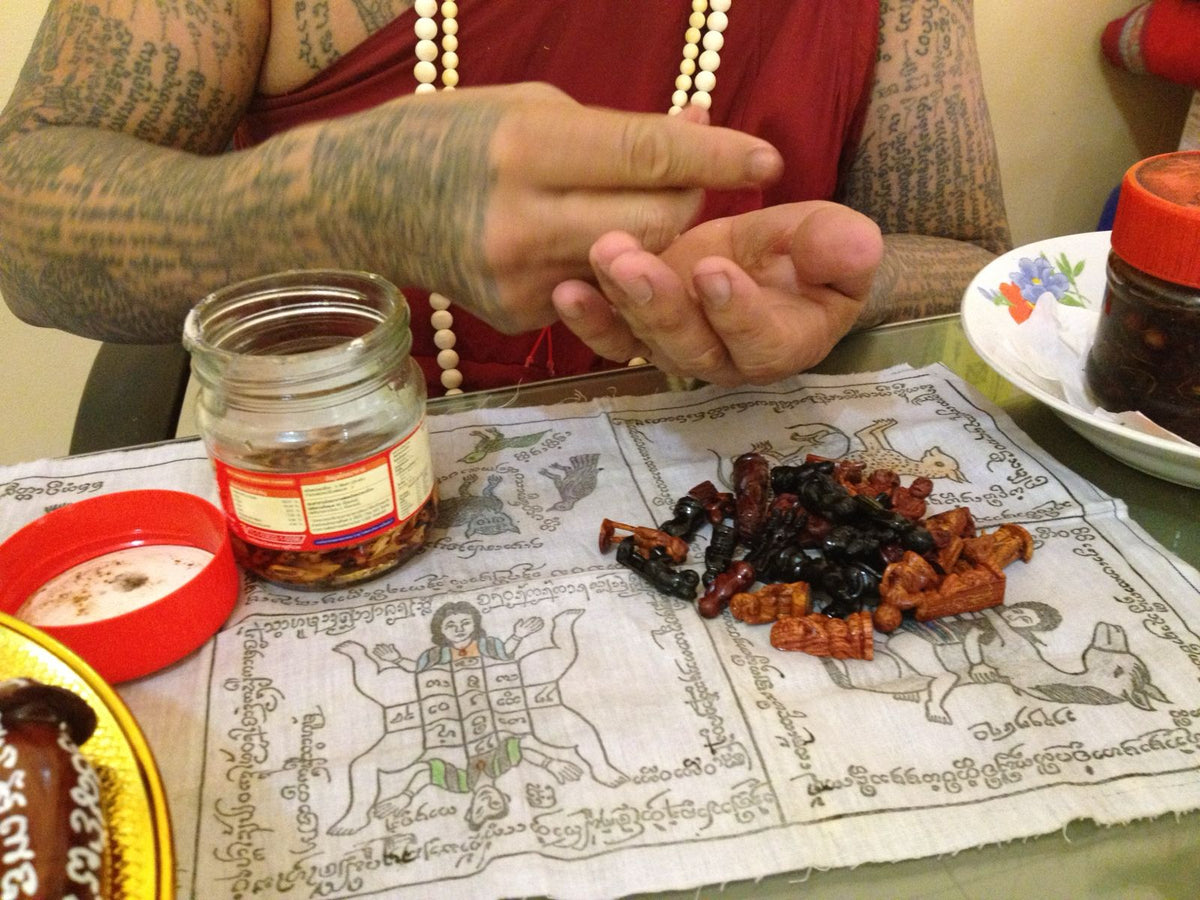
Each artifact was individually prepared using traditional methods, and natural variations in texture, colour, form and handwritten yantras make every piece unique.
Exact piece will be given.
Personal Experiences Shared by Luksits
The Utt Ding has traditionally been favoured by merchants, traders and individuals whose livelihoods depend upon communication, personal relationships and the willingness of others to engage with them.
Among collectors familiar with Northern Thai and Shan sacred objects, the musician-on-elephant form is particularly associated with attracting customers and improving commercial interactions.
One frequently described type of experience concerns business owners who find that previously quiet periods begin to improve through renewed enquiries and returning customers.
For example, a small trader may experience several days of slow business before an unexpected customer arrives, makes a substantial purchase and subsequently introduces others to the shop.
Salespeople describe similar experiences involving conversations that begin casually but develop into useful business opportunities.
Another traditional association concerns personal charm.
A person who previously struggled to gain attention during conversations may find that others become more willing to listen, respond favourably or offer assistance.
Within the Utt Ding tradition, these experiences are understood as expressions of Metta Maha Niyom, where the owner's presence encourages goodwill and a favourable reception.
The addition of Nam Man Prai to this particular batch gives it a further association with Maha Saneh, traditionally sought for personal attraction and stronger interpersonal connections.
Summary
This Utt Ding represents an interesting combination of Northern Thai–Shan sacred traditions and the ritual inheritance of LP Pinut.
The amulet's principal significance lies in its musician-on-elephant imagery, a form traditionally associated with trade, popularity, charm and the attraction of favourable opportunities.
Its provenance adds another dimension.
Originally passed down by LP Pinut, the batch was preserved by his Luksit, AC Toh, who had studied Wicha under several respected masters.
The additional preparation involving Nam Man Prai and individually handwritten yantras distinguishes these examples from more conventional Utt Ding talismans.
Rather than focusing solely on romantic attraction, this form is especially meaningful for those seeking business opportunities, persuasive communication, popularity and the ability to establish beneficial relationships.
Historical Background
Origins of Utt Ding in Northern Thai and Shan Traditions
The Utt Ding, also known as U Ting or occasionally U Teng, belongs to a family of traditional talismans associated with the Lanna region of Northern Thailand and the Shan communities of Myanmar.
These neighbouring cultures have shared religious practices, trade networks and spiritual traditions for centuries.
Long before modern national borders were established, merchants, monks, craftsmen and ritual practitioners travelled between the Shan States and the northern Thai kingdoms.
Through these exchanges, numerous forms of sacred objects became part of the wider Lanna occult tradition.
Utt Ding is one such example.
Unlike a single fixed deity or image, Utt Ding appears in several traditional forms.
Recorded variations include a figure seated upon an elephant, two riders sharing an elephant, embracing couples and musicians playing instruments while riding.
Although these variations share certain associations with Metta and Saneh, their intended applications may differ.
The musician-on-elephant form is particularly associated with merchants, traders and people involved in selling goods.
The Significance of the Musician
In traditional Southeast Asian culture, music has long been associated with attraction, celebration and the gathering of people.
A musician naturally draws an audience.
People stop to listen, approach the performer and become receptive to the sounds being played.
Within the symbolic interpretation of Utt Ding, this quality becomes a representation of personal magnetism.
The wearer seeks to attract attention without confrontation, encourage favourable conversations and make others more willing to listen.
For merchants, such qualities were particularly valuable.
A trader who could attract customers, establish trust and communicate persuasively possessed an important advantage in business.
The musician therefore represents more than entertainment.
It symbolises the ability to draw people towards oneself through charm, communication and favourable influence.
The Elephant in Lanna Sacred Symbolism
The elephant occupies a distinguished position in Thai and wider Southeast Asian culture.
Historically associated with kingship, strength, authority and auspicious power, the elephant also appears frequently in Buddhist and regional sacred imagery.
Within Utt Ding, the elephant provides a complementary quality to the musician.
Where the musician represents attraction and goodwill, the elephant symbolises strength, stability and influence.
Together, the two figures express a balance between gentle persuasion and personal authority.
This combination is especially appropriate for commercial activities, where success often depends upon both popularity and the confidence to negotiate.
Origins of the Materials
The photographed Utt Ding displays a dark, almost black surface with a compact three-dimensional form.
Traditional Utt Ding amulets may be produced from different materials, including sacred wood and mixed-metal alloys.
The exact composition of this particular batch has not been independently established.
Its significance is therefore better understood through its documented collection history and ritual preparation rather than an assumed material formula.
According to the information passed down with the pieces, the batch originated from LP Pinut and was subsequently kept by AC Toh.
The amulets were soaked in Nam Man Prai, a ritual substance traditionally associated with Saneh, attraction and certain spirit-related branches of Thai occult practice.
Each example also received individually handwritten yantras.
These additions were intended to strengthen the original Utt Ding's association with personal charm, commercial success and favourable human relationships.
Ritual
The ritual preparation of this batch reflects the combination of an established Northern talismanic form with additional traditional Wicha.
The Utt Ding images were originally associated with LP Pinut of Wat Sanam Lao.
The pieces were later preserved by AC Toh, who had studied sacred knowledge from several monks and ritual practitioners, including Lersi Ling Dam.
According to the accompanying account, the batch underwent preparation involving Nam Man Prai.
Within traditional Thai occult practice, such oils are employed in certain forms of Maha Saneh and Metta Wicha, where their purpose is understood as encouraging attraction and strengthening personal influence.
The pieces were also individually hand-yanted.
Handwritten yantras occupy an important place in Thai sacred-object traditions because the inscription is regarded as a physical expression of the practitioner's mantra and ritual knowledge.
Rather than being merely decorative, each inscription is intended to reinforce the purpose of the sacred object.
For this batch, the combined preparation is traditionally associated with:
- Metta Maha Niyom and favourable reception.
- Maha Saneh and personal attraction.
- Commercial prosperity and customer attraction.
- Persuasive communication and social influence.
- Strengthening beneficial relationships.
Blessings and Effects
The Utt Ding is traditionally associated with several complementary qualities.
1. Metta Maha Niyom – Popularity and Goodwill
One of its principal purposes is to encourage others to respond favourably towards the wearer.
This includes gaining acceptance, receiving assistance and developing harmonious relationships.
For those working in environments where personal interaction is important, Metta is regarded as a valuable spiritual quality.
2. Maha Saneh – Personal Charm and Attraction
The musician imagery represents the ability to attract attention and encourage others to approach.
The Nam Man Prai preparation gives this particular batch an additional association with traditional Saneh Wicha.
Collectors seek such qualities for improved social relationships, personal appeal and favourable interactions.
3. Kha Khai – Trade and Commercial Success
The musician-on-elephant Utt Ding is particularly associated with commerce.
Its traditional purpose is to encourage customer interest, improve business interactions and create opportunities through personal connections.
Rather than representing wealth appearing without effort, it symbolises the attraction of people and circumstances that may lead to financial opportunities.
4. Persuasive Communication
The musician's ability to capture an audience provides a natural association with effective communication.
This makes the Utt Ding particularly meaningful for people involved in sales, negotiations, presentations and other professions requiring persuasive speech.
5. Baramee – Presence and Influence
The elephant contributes a traditional association with dignity, strength and authority.
Combined with the musician's charm, this represents the ability to gain respect while maintaining an approachable and agreeable manner.
Modern Application
Although the Utt Ding originates from older Northern Thai and Shan traditions, its symbolism remains relevant to modern commercial and social life.
Business continues to depend upon attracting attention, establishing trust and maintaining beneficial relationships.
A salesperson may possess excellent products but struggle to gain customers' interest.
A business owner may offer good services but find it difficult to attract new enquiries.
A professional may have valuable ideas but lack the personal influence needed to communicate them effectively.
These are precisely the circumstances in which Utt Ding's traditional qualities are considered meaningful.
The amulet is particularly suitable for:
- Business owners and merchants seeking customer attraction and steady commercial activity.
- Sales professionals and property agents whose income depends upon communication and successful negotiations.
- Customer-facing employees wishing to encourage goodwill and favourable interactions.
- Entrepreneurs and traders seeking opportunities through new contacts and business relationships.
- Individuals seeking Metta and Saneh for greater confidence, personal appeal and harmonious relationships.
Its compact size allows it to be worn as a pendant or carried discreetly.
Physical Details
The photographed Utt Ding is a small, dark-coloured three-dimensional talisman depicting a seated figure upon an elephant. The figure appears to hold an object consistent with the traditional musician form. The elephant's rounded body and four legs form the lower portion of the amulet, while the rider sits above its back.
The surface has a dark, slightly reflective finish, with visible variations in texture and hand-finished details. The amulet is housed within a transparent protective casing fitted with a metal suspension ring.
Its compact construction makes it suitable for everyday carrying.
Recommended Pairing
Phra Sivali – Traditionally associated with prosperity, abundance and favourable opportunities. A complementary pairing for business owners and merchants.
Salika – Particularly suitable for strengthening persuasive communication, Metta Maha Niyom and favourable reception during conversations.
Palakit – Traditionally associated with protection, personal vitality, attraction and commercial fortune.
Takrut Chok Larp – A suitable pairing for those seeking additional support in commercial opportunities and financial fortune.
The Utt Ding may also be carried independently, as its traditional symbolism already combines charm, influence and commercial attraction.
Personal Notes
This particular batch holds additional interest because of its provenance.
The pieces were collected directly from AC Toh, a Luksit of LP Pinut, rather than acquired through an ordinary commercial source.
AC Toh had studied traditional Wicha under several masters and monks, including Lersi Ling Dam, giving him familiarity with different branches of Thai sacred practice.
According to the information accompanying the collection, these Utt Ding amulets had been passed down by LP Pinut and preserved in Nam Man Prai, with each piece individually hand-yanted.
For collectors, this history is an important part of the artifact's identity.
The appeal lies not only in the unusual musician-on-elephant form, but also in its connection to LP Pinut, its preservation by a practising Luksit and the additional ritual preparation associated with the batch.
It is a traditional Utt Ding intended to attract people before attracting opportunity — a principle that remains closely connected with the realities of trade, business and human relationships.


-
Free Shipping for Singapore| $15 Worldwide | $60 USA For Items Below $350