
OOBThaiAmulets
LP Parn - Wat Bang Nom Kho
LP Parn - Wat Bang Nom Kho
Couldn't load pickup availability
MS06
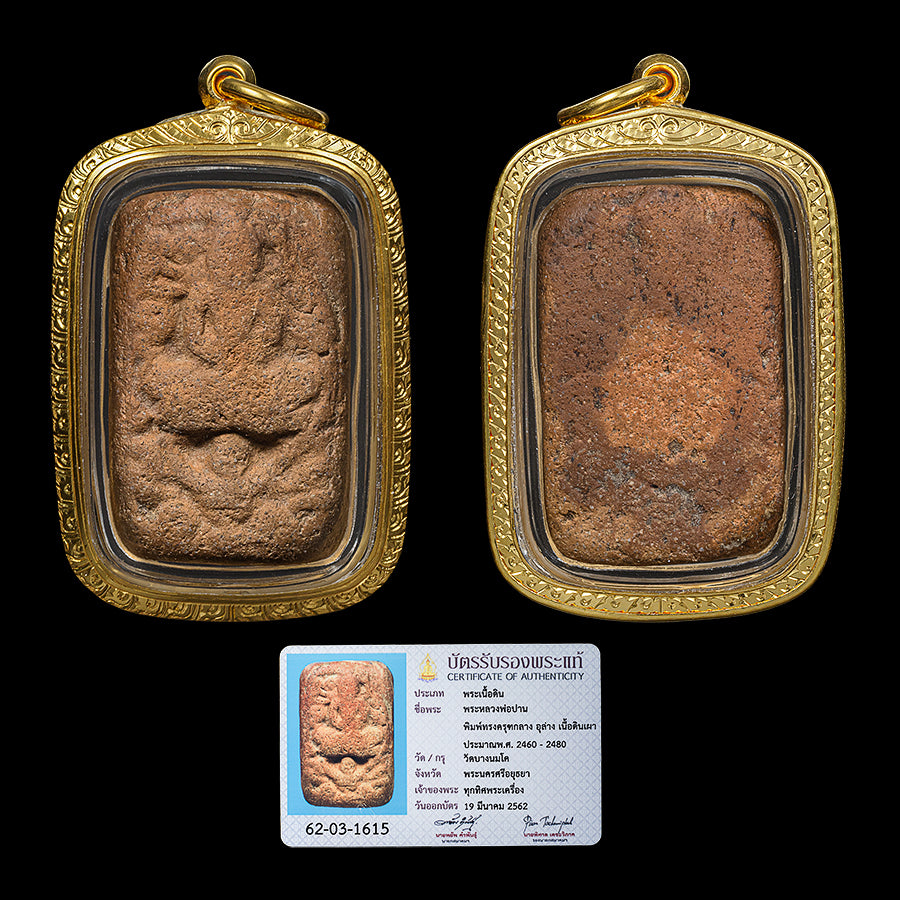
Phra Somdej Kee Krut
LP Parn Sonantho · Wat Bang Nom Kho · Ayutthaya
Approx. B.E. 2460–2480
3cm
Mainstream Artifact
Samakom Certification Card (62-03-1615)
Individual Craftsmanship
Each artifact was individually pressed, fired and prepared from naturally variable materials, so differences in colour, granulation, surface texture and definition are expected from piece to piece.
Personal Experiences Shared by Luksits
LP Parn's amulets have remained popular for generations partly because different animal forms became associated with different practical aspects of everyday life.
Among them, the Garuda has traditionally been favoured for Baramee and Maha Amnat — prestige, authority and commanding presence.
Older collectors often recommended the Garuda form to people carrying responsibility: business owners, senior managers, officials, community leaders and those whose work requires them to make decisions and have others take those decisions seriously.
Luksits commonly describe its character not simply as making someone appear powerful, but as helping them become more composed and authoritative when dealing with people.
For business owners, this can be interpreted through negotiations, managing employees and gaining confidence from customers. For those working within larger organisations, the traditional emphasis is on recognition, promotion, support from superiors and greater responsibility.
This is one reason the Garuda mould continues to occupy a distinctive place within LP Parn's famous animal series.
Summary
The Phra LP Parn Garuda Song Klang, U-Lang mould belongs to one of the most recognisable families of old Thai clay amulets.
Created at Wat Bang Nom Kho in Ayutthaya, these amulets combine Buddhist imagery with six celebrated animal forms traditionally associated with different qualities: Garuda, Hanuman, rooster, bird, fish and porcupine.
This example carries the Garuda, traditionally associated with Maha Amnat, Baramee, leadership, protection and advancement in positions of responsibility.
Its importance, however, extends beyond the mould itself.
At the heart of LP Parn's amulet tradition are the sacred powders inserted into the pieces — particularly the three principal groups of sacred powder that distinguish the construction of these amulets.
Historical Background
LP Parn Sonantho was born in Ayutthaya in B.E. 2418 and became one of the province's most respected monk masters of the early twentieth century.
His reputation extended beyond sacred-object making. He was remembered for Buddhist practice and teaching, traditional wicha and extensive work supporting temples and local communities.
LP Parn's baked-clay amulets became his most recognisable sacred objects.
Traditional accounts describe villagers contributing materials while craftsmen assisted in preparing the moulds. The finished pieces were distributed among devotees and supporters rather than conceived simply as commercial collectibles.
The principal standard production is commonly associated with the period beginning around B.E. 2460, during LP Parn's lifetime. The broader B.E. 2460–2480 range is also encountered in collector cataloguing.
LP Parn passed away in B.E. 2481.
Origins of the Materials
The physical foundation is baked clay, traditionally prepared from selected local soils together with sacred materials gathered for the production.
Collector traditions describe the clay as incorporating fine field earth together with naturally occurring sand and mineral particles. This helps explain the distinctive granular character visible on genuine old surfaces.
More important spiritually were the three principal sacred powder formulas placed within LP Parn's amulets.
The first was Phong Wiset Hua Jai Sat — Sacred Animal-Heart Powder. Its preparation was related to the particular animal represented on the amulet, establishing the symbolic character of each mould.
The second was sacred powder associated with Yant Kro Phet — the Diamond Armour Yantra, traditionally connected with protection, resilience and the avoidance of danger.
The third consisted of the Five Sacred Powders:
Phong Itthije · Phong Pathamang · Phong Maharaj · Phong Trinisinghe · Phong Phra Phutthakhun
Together they encompass old Thai sacred-powder traditions associated with Buddhist virtues, Metta, authority, protection and auspicious support.
This combination of an animal-specific formula with broader protective and Buddhist powders is one of the most important features of LP Parn's amulet-making tradition.
Ritual
The making of these artifacts involved considerably more than pressing an image into clay.
The clay and sacred ingredients were prepared before being individually pressed into the appropriate mould. After drying, the pieces were fired using traditional methods.
The sacred powders formed the inner ritual component of the artifact, while the animal image provided its outward symbolic identity.
For the Garuda mould, the wicha emphasises the qualities traditionally represented by Garuda: authority, command, dignity and the ability to rise above opposition.
The Buddhist image remains central. The animal does not replace the Buddha but functions within the sacred composition beneath it.
This balance between Phutthakhun — Buddhist sacred qualities — and the specialised animal wicha is fundamental to understanding LP Parn's amulets.
Blessings and Effects
The Garuda mould is particularly associated with Maha Amnat — authority and the ability to command respect.
Closely connected is Baramee, referring here to personal standing, dignity and the influence that develops when others recognise one's position and character.
For career matters, devotees traditionally associate the Garuda with advancement, promotion, leadership and recognition from people in authority. It has consequently long appealed to senior officials, administrators, managers and business owners.
There is also an important protective aspect. Garuda symbolism traditionally carries the idea of overcoming hostile forces and rising above opposition, complementing the protective character attributed to the Kro Phet sacred powder.
For business, these qualities translate naturally into stronger negotiation, confidence when meeting important people and the ability to maintain authority while managing staff or difficult situations.
These are traditional devotional associations surrounding the amulet rather than guaranteed outcomes.
Modern Application
The Garuda is particularly appropriate for someone whose progress depends not only upon attracting opportunities but upon having the Baramee to hold responsibility once those opportunities arrive.
For a business owner, it suits leadership, negotiations and managing people.
For an executive or professional, its traditional themes align with recognition, promotion and increased responsibility.
For someone working in government, uniformed service or an organisation with a defined hierarchy, the old association between Garuda and Maha Amnat makes this one of the more relevant LP Parn moulds.
At the same time, it remains fundamentally a Buddha amulet and can simply be worn as an old devotional artifact of one of Ayutthaya's most important monk lineages.
Physical Details
This is a rectangular baked-clay Phra LP Parn, identified as the Garuda Song Klang, U-Lang mould. The front carries the seated Buddha above the Garuda, while the clay retains the naturally granular, porous character expected from traditional preparation and firing. The reverse is plain and shows the aged earthen surface clearly. The piece displays an old brown to reddish-earth tone with scattered darker mineral grains and natural surface variation. It is presently protected within a custom 90% gold wrap, allowing the original clay body to remain visible from both sides.
Recommended Pairing
The Garuda already provides a strong foundation for Baramee, authority and protection, so it pairs particularly well with an artifact emphasising Metta Maha Niyom or wealth.
A Metta-oriented piece softens the commanding nature of the Garuda with approachability and goodwill — useful for someone who must lead while maintaining strong relationships with customers, colleagues or employees.
A wealth-oriented artifact creates another practical combination: Garuda for position and authority, wealth wicha for financial movement and opportunity.
For a more traditional Buddhist arrangement, it can simply be paired with the Roop Lor or image of another respected monk master.
Personal Notes
LP Parn's animal-form amulets are interesting because collectors are not merely choosing between different moulds of the same Buddha image. Each animal carries its own established character within the lineage.
For me, the Garuda is one of the clearest examples.
Its appeal is not centred purely on wealth or attraction. It represents position, Baramee and the ability to carry authority — qualities that become increasingly important as someone moves from doing the work personally to managing a business, organisation or group of people.
The sacred-powder construction makes these artifacts even more interesting. Beneath what appears to be a relatively simple old clay Buddha is a sophisticated combination of animal-specific powder, Kro Phet protective wicha and the Five Sacred Powders.
This particular example also retains the understated appearance I like in old LP Parn pieces: naturally aged clay, softened mould definition and visible mineral texture, now protected within a 90% gold wrap.
It is a classic old Ayutthaya artifact whose importance lies as much inside the clay as in the image visible on its surface.
-
Free Shipping for Singapore| $15 Worldwide | $60 USA For Items Below $350