
OOBThaiAmulets
Lp Opasi Wat Ratchabophit
Lp Opasi Wat Ratchabophit
Couldn't load pickup availability
MS06
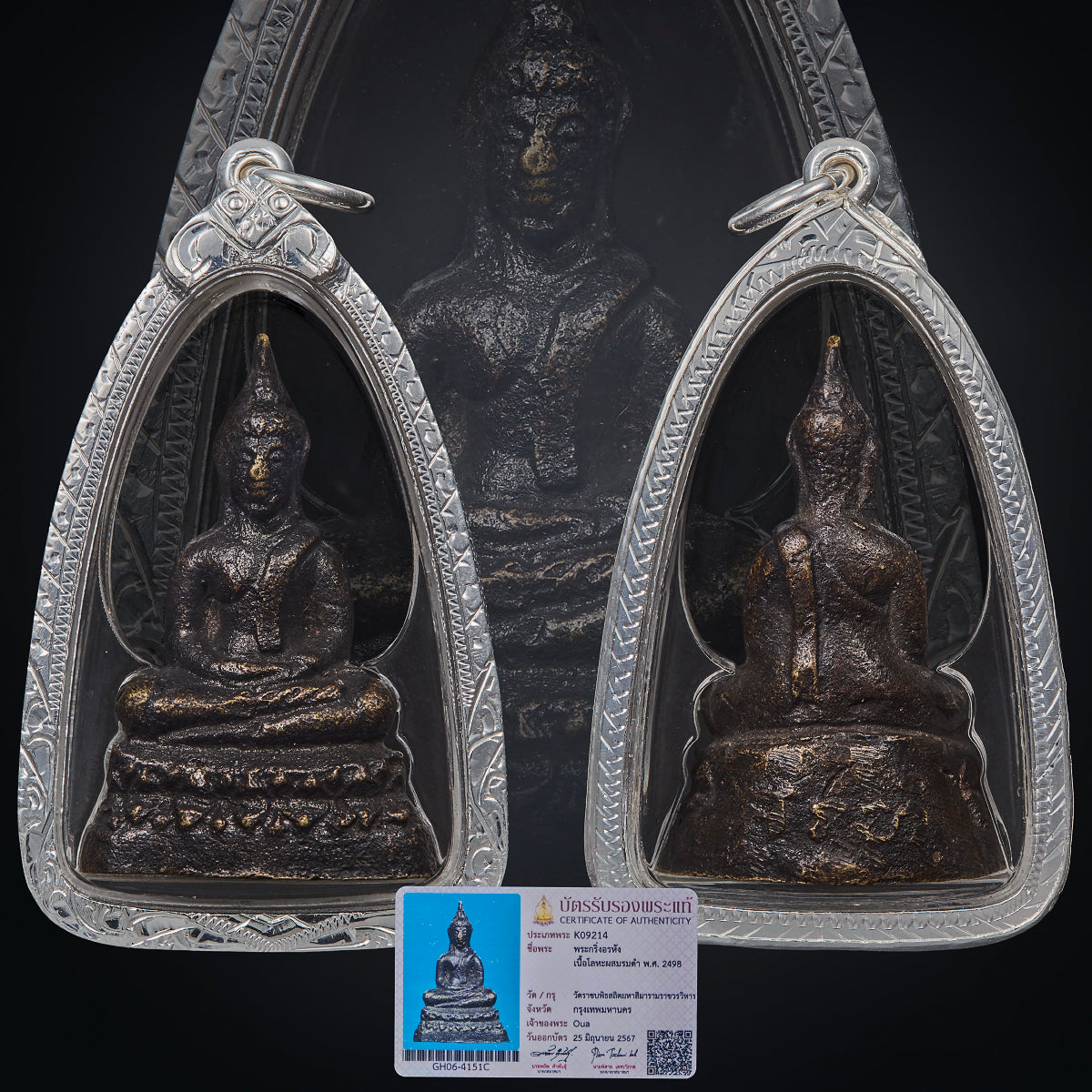
Phra Kring Arahant
Lp Opasi, Wat Ratchabophit · Bangkok
B.E. 2498
4cm height
Mainstream Artifact
Samakom Certification Card (GH06-4151C)
Sacred Craftsmanship
The casting work was carried out by the respected Ban Chang Lor artisan tradition, under the team associated with Master Fung. Each piece was individually cast and finished, resulting in natural differences in surface texture, casting depth, lacquer wear and exposed metal tones.
Personal Experiences Shared by Luksits
For collectors who study mainstream Bangkok amulets carefully, this is one of those pieces whose historical depth can appear disproportionate to its present market level.
Its strength does not depend on a single famous master. It combines Wat Ratchabophit, LP Opasi's sacred metal, a major national-level ceremony, yantra-inscribed metals from leading monks throughout Thailand, and an unusually strong group of meditation masters participating in the consecration.
Many devotees traditionally regard the batch as a strong all-round amulet for protection, authority, business progress, financial stability and overcoming obstacles.
LP Opasi's own lineage adds another dimension. His practice was strongly associated with Fire Wicha, and devotees traditionally believe that his sacred objects help burn away adverse influences, misfortune and obstruction so that circumstances can gradually open in a more favourable direction.
Businessmen have therefore long been among those attracted to amulets connected with LP Opasi, particularly when seeking smoother negotiations, stronger confidence, fewer unnecessary disruptions and sustained prosperity.
Another reason this particular batch deserves careful attention is authenticity. Phra Kring Arahant has been reproduced many times, and convincing later copies do exist. An original example with clear characteristics, natural ageing and recognised certification is therefore increasingly desirable.
Summary
The Phra Kring Arahant B.E. 2498 is one of the important Bangkok Phra Kring issues of the mid-twentieth century.
It was created at Wat Ratchabophit Sathit Mahasimaram in connection with a major merit-making project initiated by Field Marshal Sarit Thanarat, then Commander-in-Chief of the Royal Thai Army, to commemorate his 48th birthday.
The amulet was modelled after Phra Buddha Angkiras, the principal Buddha image within Wat Ratchabophit's ordination hall.
A total of approximately 10,009 standard Phra Kring Arahant were produced, together with approximately 100 special double-sided Phra Kring pieces.
Its reputation rests upon an unusually complete combination of historical patronage, respected craftsmanship, consecrated sacred metal and participation by many of Thailand's leading monks of the period.
Historical Background
In B.E. 2498, Field Marshal Sarit Thanarat reached the age of 48 years, completing four traditional twelve-year cycles.
To mark the occasion, he wished to create lasting Buddhist merit.
At that time, Wat Suwan Chindaram in Lat Lum Kaeo, Pathum Thani, was constructing a new ordination hall but lacked a principal Buddha image. Sarit therefore undertook the creation of a large Sukhothai-style Buddha image for the temple.
He consulted senior monks connected with Wat Ratchabophit, including senior ecclesiastical figures whom he personally respected.
The resulting principal Buddha image was ceremonially cast at Wat Ratchabophit on 14 November B.E. 2498 and received the name:
Phra Phuttha Sayam Phu Phan Phichit
At the same time, the committee created the smaller Phra Kring Arahant amulets.
Their form was based upon Phra Buddha Angkiras, one of the most important sacred images of Wat Ratchabophit itself.
Origins of the Materials
The alloy was deliberately prepared from numerous sacred metals.
Sheets of gold, silver, copper and brass were inscribed with sacred characters and yantras by respected monks from different regions of Thailand.
Traditional records describe more than 108 consecrated metal sheets being incorporated.
Among the most important contributions was the sacred metal provided by LP Opasi of Bang Mod.
LP Opasi was deeply respected by Field Marshal Sarit, who was known to have maintained personal faith in him. The old metal supplied for the project had already been ritually prepared by LP Opasi before being delivered for inclusion in the casting.
This is why the issue later became widely known among collectors as:
Phra Kring LP Opasi
even though the formal creation and consecration were conducted at Wat Ratchabophit.
Ritual
The major casting and consecration ceremony took place at Wat Ratchabophit on 14 November B.E. 2498.
The auspicious starting time was recorded as 9:25 a.m., with ceremonies continuing through the day and into the following morning.
The event brought together an exceptional group of senior monks and meditation masters.
Among those associated with the sacred metal inscriptions or the consecration were:
Somdej Phra Wachirayanwong, Supreme Patriarch of Wat Bowonniwet; Somdej Phra Wanrat of Wat Benjamabophit; LP Sodh of Wat Paknam; LP Toh of Wat Pradoochimplee; Ajarn Tim of Wat Chang Hai; LP Daeng of Wat Khao Bandai It; LP Chong of Wat Na Tang Nok; LP Pring of Wat Bang Pakok; LP Noi of Wat Thammasala; LP Ngern of Wat Don Yai Hom; LP Tae of Wat Sam Ngam; LP Phuak of Wat King Kaew; Than Por Lee of Wat Asokaram; LP Sud of Wat Ka Long; Chao Khun Phon of Wat Nang; LP Khom of Wat Phai Rong Wua, and many others.
Traditionally the ceremony is described as involving approximately 108 revered monks.
An important historical clarification must be preserved: although LP Opasi was invited to participate personally, he passed away on 31 October B.E. 2498, sixteen days before the ceremony.
He therefore did not physically sit in the final consecration.
His direct connection comes instead through the sacred old metal that he had personally blessed beforehand and contributed to the casting mixture.
Blessings and Effects
Traditional interpretations of the Phra Kring Arahant divide its qualities into two complementary aspects.
Phra Dech refers to commanding and protective power. It is traditionally associated with Kong Kraphan, Klaew Klad, protection from weapons, resistance to danger and the dispersal of harmful influences.
Phra Khun refers to constructive and benevolent qualities. It is associated with Metta Mahaniyom, prosperity, good fortune, support, success and favourable circumstances.
Together these qualities give the amulet its reputation as a particularly complete mainstream protective piece.
The connection with LP Opasi further contributes beliefs concerning removing misfortune, clearing obstacles and encouraging prosperity through his Fire Wicha tradition.
These remain traditional devotional beliefs rather than guaranteed outcomes.
Modern Application
For modern wearers, Phra Kring Arahant is particularly suitable as an all-round daily amulet.
Its protective qualities naturally appeal to people who travel frequently or work in unpredictable environments.
The Phra Khun side of the lineage makes it equally relevant to business owners, managers, sales professionals and people responsible for leadership or negotiation.
Its association with Field Marshal Sarit and senior military figures also gives it a natural connection with authority, decisiveness and command.
For collectors who prefer mainstream pieces with verifiable historical context, this issue is especially attractive because its significance does not rest solely on later market storytelling. The project itself was large, documented and connected with figures of national importance.
Physical Details
This example measures approximately 1 inch and is cast in Loha Pasom, or mixed metal.
The surface retains the characteristic dark Rom Dam finish, now naturally worn across higher points to reveal warm bronze and golden-brown tones beneath.
The Buddha is seated upon a multi-tiered base with the elongated flame-like ushnisha characteristic of the design derived from Phra Buddha Angkiras.
The reverse retains the sculptural form of the seated Buddha and lower pedestal rather than a flat back.
The piece is housed in a silver casing and accompanied by Samakom certification.
Original dark surface, natural age and clear casting characteristics are particularly useful on this issue because later reproductions are common.
Recommended Pairing
Because Phra Kring Arahant already covers a wide range of traditional qualities, it works very well as a principal everyday amulet.
For stronger Baramee and senior support, it may be paired with a traditional Phra Somdej.
For stronger financial emphasis, a Phra Sivali or Phra Sangkatchai can complement its prosperity aspect.
Those who specifically value LP Opasi's tradition may instead pair it with another recognised LP Opasi artifact, creating a stronger connection to his Fire Wicha lineage.
Personal Notes
If I were assessing this piece purely from its history, materials and ceremony, I would place its significance considerably above what its current market price often suggests.
It combines almost everything one could reasonably look for in a serious mainstream Thai amulet: a royal temple, an important historical patron, respected traditional casting, sacred metals from across Thailand, direct material connection with LP Opasi and participation by an extraordinary generation of masters.
What makes the history particularly interesting is that the LP Opasi connection is often simplified. He did not personally attend the final ceremony because he had passed away shortly beforehand. Yet his contribution was still direct: the sacred metal incorporated into every casting had already been prepared and blessed by him.
For me, that distinction makes the story stronger rather than weaker because it gives the lineage a clear and historically understandable foundation.
The number of reproductions now found in the market also means that an original, easy-to-study example with Samakom certification and convincing natural Rom Dam ageing is becoming increasingly worthwhile.
For someone looking for a powerful mainstream Bangkok artifact without immediately entering the highest-priced categories, the Phra Kring Arahant B.E. 2498 remains one of the more compelling historical choices.
-
Free Shipping for Singapore| $15 Worldwide | $100 USA All products