
OOBThaiAmulets
LP Noi - Wat Thammasala
LP Noi - Wat Thammasala
Couldn't load pickup availability
MS06
LP Noi Roop Lor
LP Noi Inthasaro · Wat Thammasala · Nakhon Pathom
B.E. 2505 (1962)
3cm
Mainstream Artifact
Samakom Certification Card (GH10-785D6)
Individual Craftsmanship
Each artifact was individually cast and finished, so natural differences in metal tone, surface, patina and casting detail give every surviving piece its own character.
Personal Experiences Shared by Luksits
Among older Nakhon Pathom collectors, LP Noi's artifacts have long carried a particularly strong reputation for protection, klaew klad and khong kraphan.
Luksits often speak of his pieces as practical everyday amulets — something carried when travelling, working in demanding surroundings or facing situations where an additional sense of confidence and protection was valued.
At the same time, LP Noi himself was remembered as a restrained and compassionate monk. This gives his Roop Lor a somewhat different character from the powerful tiger imagery found on his famous Suea Na Seua pieces.
The Roop Lor represents the master directly.
For many devotees, carrying his image is therefore connected not only with protection but also with Metta, baramee, calmness under pressure and the confidence to remain steady when circumstances become uncertain.
Summary
The LP Noi Roop Lor Roon Raek, B.E. 2505 is an early three-dimensional portrait associated with LP Noi Inthasaro of Wat Thammasala, Nakhon Pathom.
LP Noi was an important local monk master whose reputation became particularly closely associated with powerful protective wicha. Among collectors, his famous cast tiger-face medals remain some of the most recognisable sacred objects of the Wat Thammasala lineage.
This Roop Lor presents another side of that tradition.
Rather than symbolic tiger imagery, it places LP Noi himself at the centre, seated quietly in meditation.
Traditionally, his artifacts are associated with khong kraphan, protection, klaew klad, baramee and Metta Maha Niyom.
Historical Background
LP Noi, monastic name Inthasaro, was born in the Thammasala area of Nakhon Pathom in B.E. 2426 (1883).
From an early age, accounts of his life describe his study of Thai, Khom and Buddhist learning under teachers in the surrounding area. He ordained at Wat Thammasala in B.E. 2446 (1903) and subsequently devoted himself to Buddhist practice, meditation and the traditional knowledge for which he later became respected.
LP Noi was remembered as a monk of quiet and restrained character. He lived simply, was compassionate towards both people and animals, and became widely respected among the surrounding communities.
His reputation in sacred-object collecting developed strongly around his protective lineage. Among his best-known creations are the famous Suea Na Seua cast medals, together with other traditional amulets and talismans associated with Wat Thammasala.
He remained closely connected with the temple until his passing in B.E. 2513 (1970).
Origins of the Materials
The B.E. 2505 Roop Lor is known in several traditional metal compositions.
Thong Phasom, or mixed metal, forms the more familiar group and can develop deep brown, bronze and almost black surfaces with age.
Nuea Satang examples can display a wider range of metallic tones depending upon the composition of the old coin metal used.
The much scarcer Nuea Rae has a different character and is traditionally described as more brittle. This characteristic is also given as the reason that these examples generally do not carry the stamped name at the front of the base.
These differences are important because the batch should not be judged simply by colour. Casting texture, surface ageing, finishing, base characteristics and provenance all form part of the identity of an old Roop Lor.
Ritual
The B.E. 2505 Roop Lor was created while LP Noi was still alive and actively leading the Wat Thammasala lineage.
The traditional Roop Lor format was especially appropriate for his luksits because it allowed them to carry a small three-dimensional representation of their teacher rather than a symbolic image alone.
After casting, individual pieces required finishing by hand. Evidence of this older production method can remain visible through casting texture, filing and irregularities around the base and body.
Within devotional practice, the completed portrait became a focus for recollecting LP Noi and the qualities associated with his lineage.
The importance therefore lies not simply in the metal image, but in the connection between teacher, temple and disciple.
Blessings and Effects
LP Noi's name is particularly strongly associated with Khong Kraphan Chatri — traditional invulnerability and resilience.
This is the protective quality for which many collectors first encounter his lineage. Related traditions include klaew klad, or passing safely through danger, and general protection from harmful circumstances.
The Roop Lor also carries the broader qualities associated with the master's image.
Baramee represents dignity, confidence and personal standing, while Metta Maha Niyom concerns goodwill and being favourably received by others.
For everyday life, devotees therefore regard the Roop Lor as a balanced piece for protection, courage, respect and smoother relationships rather than an artifact devoted exclusively to one purpose.
Modern Application
The LP Noi Roop Lor remains particularly suitable as an everyday protective monk image.
For someone who travels frequently or works in uncertain surroundings, its traditional emphasis upon protection and klaew klad is especially relevant.
For managers and business owners, the baramee aspect offers a different interpretation — remaining composed when dealing with pressure, carrying authority without unnecessary aggression and earning respect through consistency.
It can equally be appreciated simply as a devotional image of LP Noi, particularly by collectors who prefer established Nakhon Pathom monk lineages and traditional old cast amulets.
Physical Details
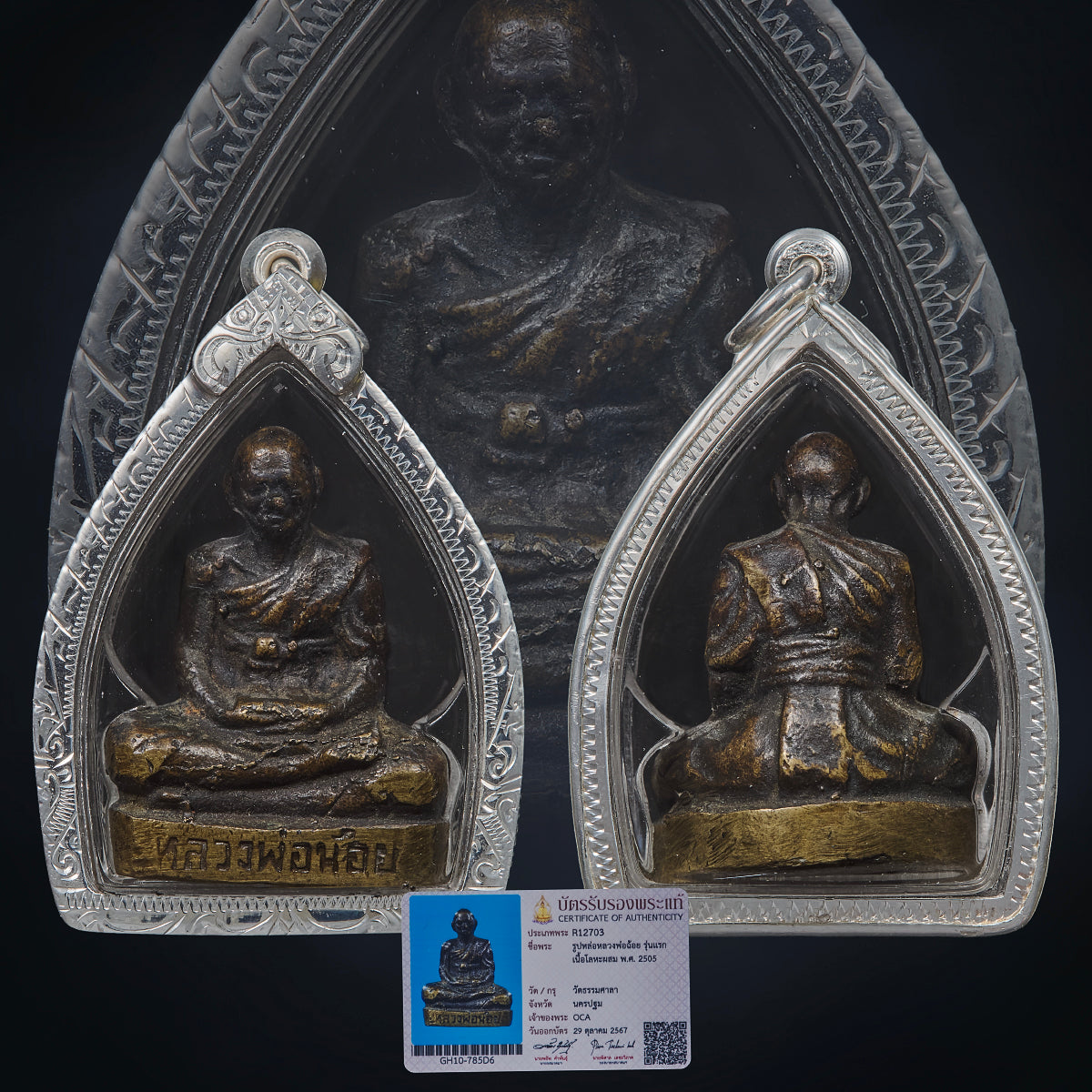
This is a compact traditional Roop Lor of LP Noi, depicting the master seated cross-legged in meditation upon a rectangular base. His robes cross the torso in raised relief, while the reverse continues the full three-dimensional seated form.
The example shown carries a naturally aged dark mixed-metal surface with warmer metallic tones appearing across raised and worn areas. Hand-finishing characteristics remain visible around the casting and base, while the front bears the identifying inscription “LP Noi.”
It is presently protected within a fitted silver casing and accompanied by a Thai authentication card identifying the piece as LP Noi Roop Lor, Roon Raek, B.E. 2505, Wat Thammasala, Nakhon Pathom.
Recommended Pairing
This Roop Lor is sufficiently complete to be worn on its own, particularly when the intention is everyday protection and connection with LP Noi.
For someone wanting to remain entirely within his lineage, it can be alternated with one of LP Noi's recognised Suea Na Seua pieces. The tiger form places greater emphasis upon command, courage and protection, while the Roop Lor provides the quieter presence of the master himself.
It can also pair naturally with a respected Buddha image where a more traditional Buddhist arrangement is preferred.
Personal Notes
What I appreciate about this LP Noi Roop Lor is the contrast between the reputation of his wicha and the character traditionally remembered of the monk himself.
LP Noi became famous for powerful protective artifacts, particularly his tiger-related pieces, yet accounts of him describe a monk who was quiet, modest, restrained and compassionate.
The Roop Lor captures that side particularly well.
There is no tiger, elaborate yantra or aggressive imagery. It is simply LP Noi seated calmly in meditation.
For me, that makes the piece a particularly good representation of traditional baramee: strength does not always need to announce itself.
The protection belongs to the lineage; the calmness belongs to the master.
-
Free Shipping for Singapore| $15 Worldwide | $60 USA For Items Below $350