
OOBThaiAmulets
LP Ngern - Wat Don Yai Hom
LP Ngern - Wat Don Yai Hom
Couldn't load pickup availability
MS06
Phra Sip That
LP Ngern · Wat Don Yai Hom · Nakhon Pathom
B.E. 2496
Nur Mekaphat
2 Inches
Mainstream Artifact
Samakom Certification card (GH10-1085C)
Individual Craftsmanship
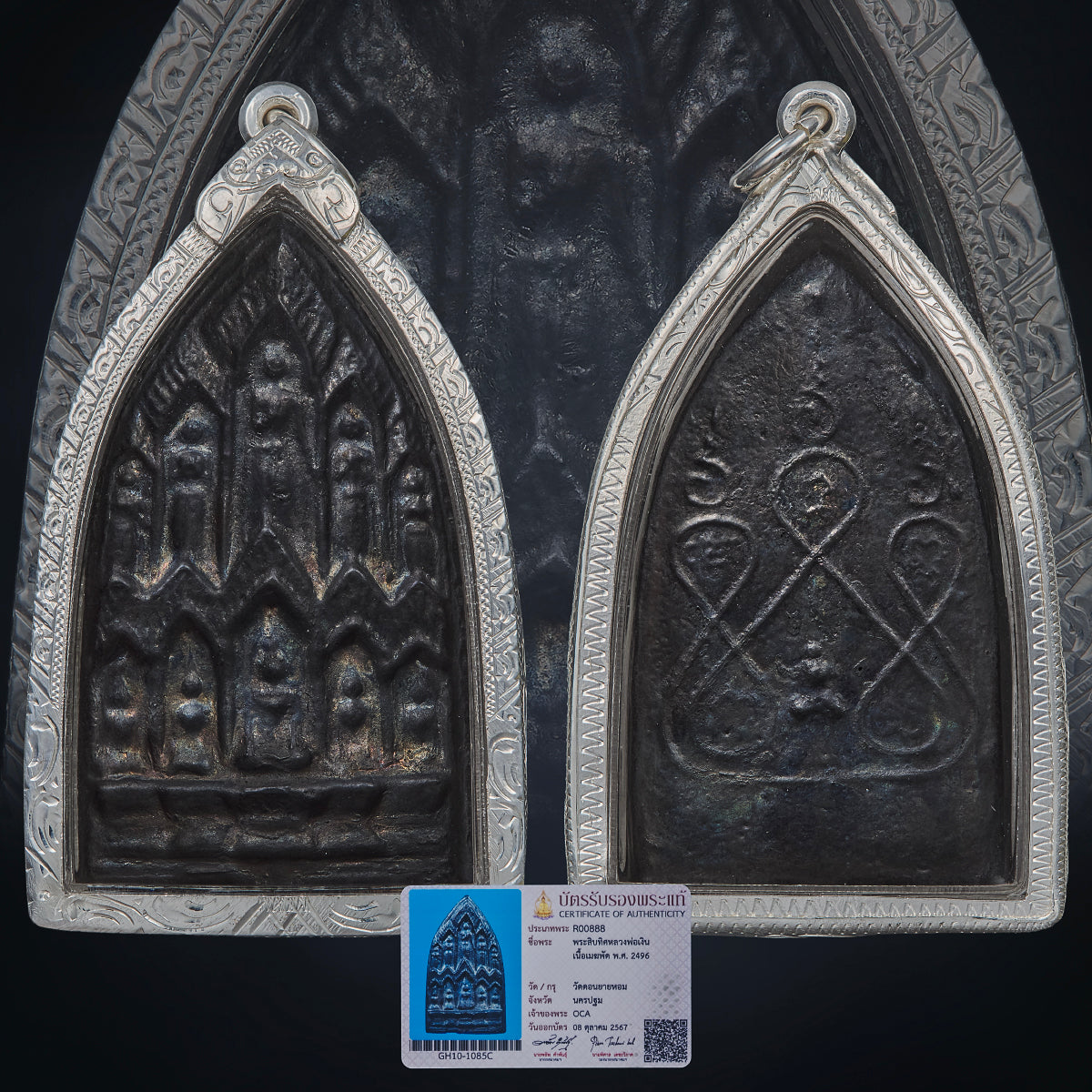
The example shown is preserved in a custom silver casing and accompanied by a Thai authentication card identifying it as Phra Sip That, Mekaphat, B.E. 2496, Wat Don Yai Hom.
Personal Experiences Shared by Luksits
Among collectors of LP Ngern of Wat Don Yai Hom, Phra Sip That has long been appreciated as more than an unusual ten-Buddha design.
Older luksits commonly connect the image with baramee, protection, progress in livelihood and the ability to pass through difficult periods without losing one's direction. For business and working life, it is often carried with the hope that effort will gradually produce recognition, stability and better opportunities.
There is also a particularly grounded character to LP Ngern's artifacts. Many were connected directly with temple construction, education and community projects rather than being created simply as collectible objects. This gives the Phra Sip That an important historical dimension alongside its devotional meaning.
Summary
Phra Sip That is one of the distinctive amulet forms associated with LP Ngern of Wat Don Yai Hom.
Its design traces back to an ancient mould discovered around Khok Yai Hom, also known locally as Noen Phra, an archaeological area near the temple. The recovered mould contained ten Buddha images within a single composition, inspiring LP Ngern to reproduce the form as an amulet.
The earliest Wat Don Yai Hom examples were produced around B.E. 2480, when LP Ngern was constructing the temple's ubosot. The form was subsequently recreated on several important occasions.
This particular example belongs to the B.E. 2496 Nur Mekaphat tradition, a version documented within the collector market as Baramee Sip That, Nur Mekaphat, B.E. 2496.
Historical Background
The history of Phra Sip That begins with Khok Yai Hom, an ancient religious site in the Don Yai Hom area.
During work connected with LP Ngern's construction of the new ubosot in the late B.E. 2470s and around B.E. 2480, old bricks were taken from the archaeological mound. Excavation revealed important remains associated with the area's ancient Buddhist past, including stone architectural elements, a Dharmachakra and other antiquities.
Among the discoveries was an old amulet mould containing ten Buddha figures.
One detailed collector history describes the arrangement as five standing Buddhas above and five seated Buddhas below. LP Ngern was particularly taken with the composition and adopted it for amulets distributed through Wat Don Yai Hom.
From this came the name:
Phra Sip That
The design subsequently became one of the forms most closely connected with LP Ngern and Wat Don Yai Hom.
Origins of the Materials
The present piece is made from Mekaphat, a dark traditional alloy whose aged surface can range from deep grey to almost black.
This gives the amulet a very different appearance from the earlier earthen Phra Sip That. Its heavy dark body allows the ten Buddha figures to emerge strongly from the surface, while ageing and oxidation create considerable variation between individual pieces.
The term Mekaphat is sometimes rendered with different spellings in the collector market. For this piece, Mekaphat is retained as the material designation.
Ritual
The B.E. 2496 period is associated with an important phase in the development of Wat Don Yai Hom.
Around this time, the temple required substantial funds for educational and community projects, including the establishment of a public school and acquisition of additional land. Phra Sip That was among the sacred objects connected with this period of temple fundraising.
This continued a pattern already established by LP Ngern: sacred objects were connected to merit-making and tangible community development. His tenure as abbot, beginning in B.E. 2466, was marked by extensive temple restoration and educational work in the surrounding community.
The amulet was therefore not simply a devotional image. It also represented participation in the continuing development of Wat Don Yai Hom.
Blessings and Effects
The name Sip That became closely associated in collector tradition with the idea of Baramee — accumulated virtue, spiritual authority and strength of character.
The ten Buddha composition naturally lends itself to themes of completeness and sustained cultivation rather than a single narrow blessing.
Traditionally, devotees associate Phra Sip That with baramee and respect, helping the wearer remain composed and recognised by others; Metta Maha Niyom, encouraging goodwill and support; protection and klaew klad, particularly when travelling or facing uncertain situations; and prosperity and progress, supporting livelihood, business and gradual improvement in circumstances.
Its character is therefore broad: protection for the person, stability for one's livelihood and baramee for moving forward in life.
Modern Application
Phra Sip That remains particularly suitable for someone wanting a traditional Buddhist amulet with a balanced purpose rather than an artifact directed towards only one specific result.
For a business owner, its symbolism centres upon stable progress, reputation and continued support.
For someone developing a career, the emphasis is upon baramee, recognition and advancement through sustained effort.
For everyday wear, its combination of Metta, protection and prosperity makes it a straightforward all-round piece.
More importantly, its history connects these ideas with LP Ngern's own emphasis upon temple building, education and practical service to the community.
Physical Details
This is a large, pointed-arch Phra Sip That cast in dark Mekaphat. The front presents the distinctive ten-Buddha composition arranged vertically within the tall frame, with the figures emerging in raised relief from the dark aged surface.
The reverse carries a raised sacred yantra arrangement. Natural casting texture, oxidation and age-related surface variation remain visible across both sides.
The piece is currently protected within an individually made silver casing, while its accompanying authentication card identifies the amulet as Phra Sip That, Mekaphat, B.E. 2496, Wat Don Yai Hom.
Recommended Pairing
Because Phra Sip That already has a broad traditional character, it pairs naturally with a more specialised LP Ngern artifact.
For authority and leadership, a Roop Lor of LP Ngern gives a more direct connection to the master himself.
For wealth and livelihood, it may be worn alongside a Phra Sivali or Nang Kwak piece.
For someone who prefers a simple traditional arrangement, however, the Phra Sip That is sufficiently complete to be worn on its own as an everyday principal amulet.
Personal Notes
What makes Phra Sip That particularly interesting is the continuity behind its design.
It began with the discovery of an ancient mould at Khok Yai Hom, during the period when LP Ngern was developing Wat Don Yai Hom. The form was then adopted by the temple and continued through later periods of construction, education and community fundraising. The earliest examples are recorded from around B.E. 2480, demonstrating that the design predates the B.E. 2496 issue by many years.
This example therefore belongs to an established Wat Don Yai Hom tradition rather than being an isolated design.
Its appeal lies in that combination of old local Buddhist history, LP Ngern's lineage and the unmistakable ten-Buddha composition of Phra Sip That.
-
Free Shipping for Singapore| $15 Worldwide | $60 USA For Items Below $350