
OOBThaiAmulets
Lp Kasem - Wat Susantrilak
Lp Kasem - Wat Susantrilak
Couldn't load pickup availability
MS06
Phra Phong Singha Kesorn
LP Kasem Khemako · Wat Susantrilak
B.E. 2503 (1960)
1.5 Inches
Mainstream Artifact
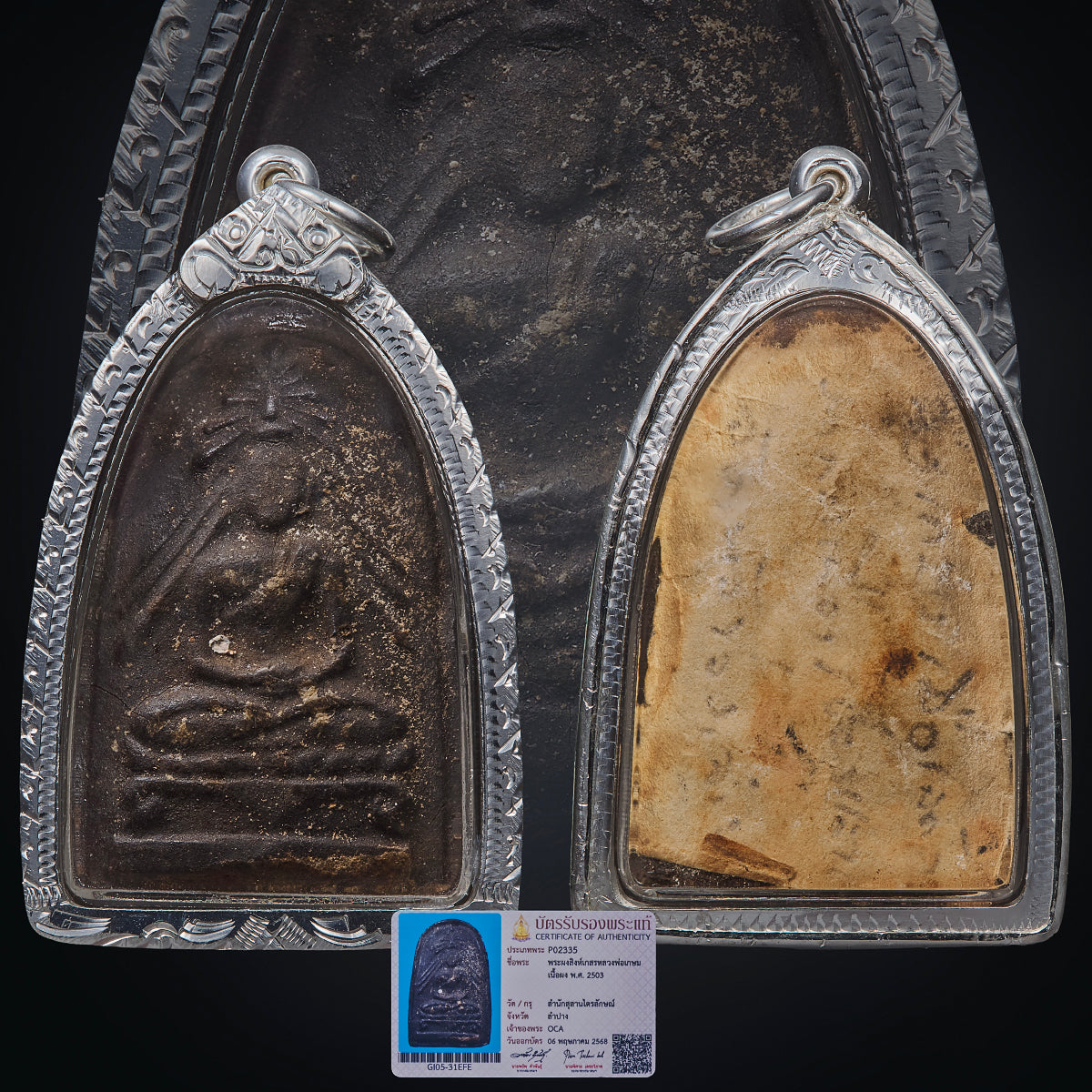
Samakom Certification Card (GI05-31EFE)
Sacred Craftsmanship
Each artifact was individually pressed from hand-prepared sacred materials, resulting in natural differences in colour, texture, surface cracking and mould definition that make every surviving piece unique.
Personal Experiences Shared by Luksits
Among older devotees of LP Kasem, his early sacred-powder amulets developed a reputation for a particularly balanced combination of Metta, Klaew Klad and Baramee.
Owners traditionally speak less about sudden displays of power and more about being carried through difficult circumstances: avoiding serious consequences from an accident, receiving unexpected assistance, remaining composed when others panic, or finding that a troublesome situation gradually resolves itself.
Businesspeople and professionals have also associated LP Kasem's amulets with steady livelihood and support from people, particularly when circumstances require patience rather than immediate results.
The Singha Kesorn has an additional association with courage and personal presence. For those responsible for employees, families or businesses, this has traditionally been interpreted as the ability to remain firm without becoming unnecessarily confrontational.
This particular example also carries an especially interesting history. According to its provenance, it was obtained from an elderly devotee who had personally received the amulet from LP Kasem. He later preserved handwritten information recording whom he had received it from and the circumstances of its acquisition, attaching the old paper to the reverse.
That small handwritten record transforms the piece from simply an early LP Kasem amulet into an artifact with a surviving connection to its original custodian.
Summary
The Phra Phong Singha Kesorn B.E. 2503 is regarded as one of the important early sacred-powder creations associated with LP Kasem Khemako of Lampang.
The project was organised by Phra Khru Sophon Panyakhun, abbot of Wat Hua Khuang, with the proceeds intended for restoration and improvement of religious structures at the temple.
Three principal sizes are traditionally recorded — large, medium and small — together with variations in dark, brown and lighter material.
The front depicts a seated Buddha image, traditionally identified with Phra Buddha Sihing, seated in meditation upon a lotus and tiered base. A radiating aureole rises around the image.
More importantly, the amulet belongs to the formative period in which LP Kasem's reputation as one of Northern Thailand's major meditation masters was becoming increasingly established beyond Lampang.
Historical Background
LP Kasem Khemako was born in Lampang in B.E. 2455 (1912) and came from the old northern aristocratic lineage of the province.
After entering monastic life, he increasingly devoted himself to meditation and austere practice.
He became particularly associated with Susarn Trailaksana, the Tri Laksana Cemetery in Lampang, where his simple life amongst cremation grounds became an important part of his reputation.
Rather than pursuing ecclesiastical position or material comfort, LP Kasem became remembered for discipline, meditation and an unusually austere way of life.
Amulet production was therefore not the central purpose of his practice.
Many early sacred objects connected with him arose because temples, monks and lay committees wished to undertake charitable projects. Objects were prepared for merit-making and fundraising and then brought into ceremonies in which LP Kasem participated or gave his blessing.
The B.E. 2503 Singha Kesorn belongs to this early environment.
Origins of the Materials
Preparation of the Singha Kesorn mixture is traditionally said to have begun around B.E. 2500, approximately three years before the final consecration.
Among the recorded ingredients were:
- soil collected from the Four Buddhist Holy Places in India;
- damaged palm-leaf manuscripts and Khoi-paper texts containing Dhamma, chants and sacred writings, subsequently burned and finely ground;
- flowers, incense and devotional offerings presented to LP Kasem;
- incense remnants and dried flowers used during his own worship and meditation;
- dried rice remaining from LP Kasem's alms bowl;
- sacred powders previously included in other Buddhist consecrations;
- natural binding substances including concentrated sugarcane syrup and tree resins;
- and hair relics from LP Kasem himself.
The materials were separately processed, ground and sieved before being combined into the final pressing mixture.
Production continued only while the accumulated materials remained available. According to the traditional account, once the prepared mixture was exhausted, pressing ceased rather than being extended through the preparation of an additional batch.
This helps explain both the limited survival of these amulets and the considerable variation between individual pieces.
Ritual
After pressing was completed, the amulets entered the B.E. 2503 Phutthaphisek at Wat Hua Khuang in Lampang.
LP Kasem was invited to preside together with a number of respected northern monks.
An enduring account associated with the ceremony concerns heavy rainfall during the chanting.
As water began accumulating around the ritual area, other participants reportedly moved away from the rising water. LP Kasem, however, remained seated on the ground and continued the ceremony without interrupting his meditation and chanting.
Whether remembered as devotional history or oral tradition, the story became characteristic of how his disciples understood him: a monk whose concentration was not easily disturbed by physical discomfort or changing surroundings.
Following the ceremony, the amulets were distributed to those making donations, with proceeds directed towards the restoration of Wat Hua Khuang.
Blessings and Effects
The Singha Kesorn is traditionally regarded as particularly strong in several complementary qualities.
Metta Maha Niyom — goodwill, acceptance and assistance from others.
Klaew Klad — avoiding accidents, danger and situations that could otherwise result in serious consequences.
Baramee — strengthening personal presence, dignity and the respect received from others.
Protection — traditional safeguarding against misfortune and hostile influences.
Courage & Composure — maintaining firmness and clarity when confronted with difficult circumstances.
Livelihood — supporting stable work, business activity and opportunities necessary to sustain oneself and one's family.
The combination makes the Singha Kesorn less narrowly specialised than its name might suggest. It is traditionally regarded as an all-round early LP Kasem amulet suitable for everyday use.
Modern Application
For modern wearers, the qualities associated with this amulet translate particularly well to situations requiring responsibility, composure and steady progress.
Business owners and managers may appreciate its traditional Baramee and Metta qualities, particularly where leadership depends upon earning cooperation rather than forcing it.
Those who travel frequently or work in physically demanding environments may place greater emphasis upon Klaew Klad and protection.
For professionals facing uncertain periods, its symbolism is equally appropriate: remain composed, recognise danger early, make careful decisions and continue forward without allowing circumstances to disturb the mind.
That principle closely reflects the remembered character of LP Kasem himself.
Physical Details
This example is a dark-material Phra Phong Singha Kesorn, B.E. 2503.
The front depicts the seated Buddha beneath radiating lines, resting upon a lotus and tiered pedestal. Despite the naturally difficult material, the facial structure, body and principal mould details remain unusually discernible.
The dark powder has developed scattered lighter brown and yellowish deposits across the surface, characteristic of the ageing seen on some examples of this material.
Many surviving Singha Kesorn pieces display considerable crazing, cracking, warping or loss of mould definition caused by the original material drying over time.
Recommended Pairing
The Singha Kesorn already provides a broad foundation of Metta, Baramee and protection, so it can comfortably be worn alone.
For business use, it pairs naturally with a wealth or Choke Lap artifact, allowing the LP Kasem piece to provide stability and interpersonal support while the companion piece places greater emphasis upon financial opportunity.
For frequent travellers or those in higher-risk occupations, an additional Klaew Klad or Kong Kraphan amulet can strengthen the protective emphasis.
A traditional Phra Somdej also makes an appropriate pairing where the wearer prefers a restrained Buddhist combination centred upon Baramee, stability and protection.
Personal Notes
This particular example stands apart for both condition and provenance.
The B.E. 2503 material is notoriously difficult to find with strong definition. Natural moisture loss caused many examples to develop extensive cracks, distorted bodies and softened facial details. An example retaining a clearly recognisable face and relatively complete mould is consequently much harder to encounter.
More importantly, this piece was acquired from an elderly devotee who was said to have received it personally from LP Kasem.
The old handwritten paper preserved behind the amulet records information concerning its original acquisition. Rather than discarding this seemingly modest piece of paper when the amulet was later cased, it was retained as part of the object's history.
For me, that provenance is particularly meaningful.
The amulet already belongs to the formative period of LP Kasem's sacred-object history, but the surviving handwritten record brings it closer to the generation that actually knew him.
It is therefore more than a well-preserved Phra Phong Singha Kesorn B.E. 2503. It is an early LP Kasem artifact whose physical ageing, original devotional history and chain of ownership have remained together across more than six decades.
-
Free Shipping for Singapore| $15 Worldwide | $100 USA All products