
OOBThaiAmulets
Lp Im Wat Hua Kao
Lp Im Wat Hua Kao
Couldn't load pickup availability
MS06
Nang Kwak
LP Im · Wat Hua Khao · Suphanburi
B.E. 2470–2480 (1927–1937)
1 Inch
Mainstream Artifact
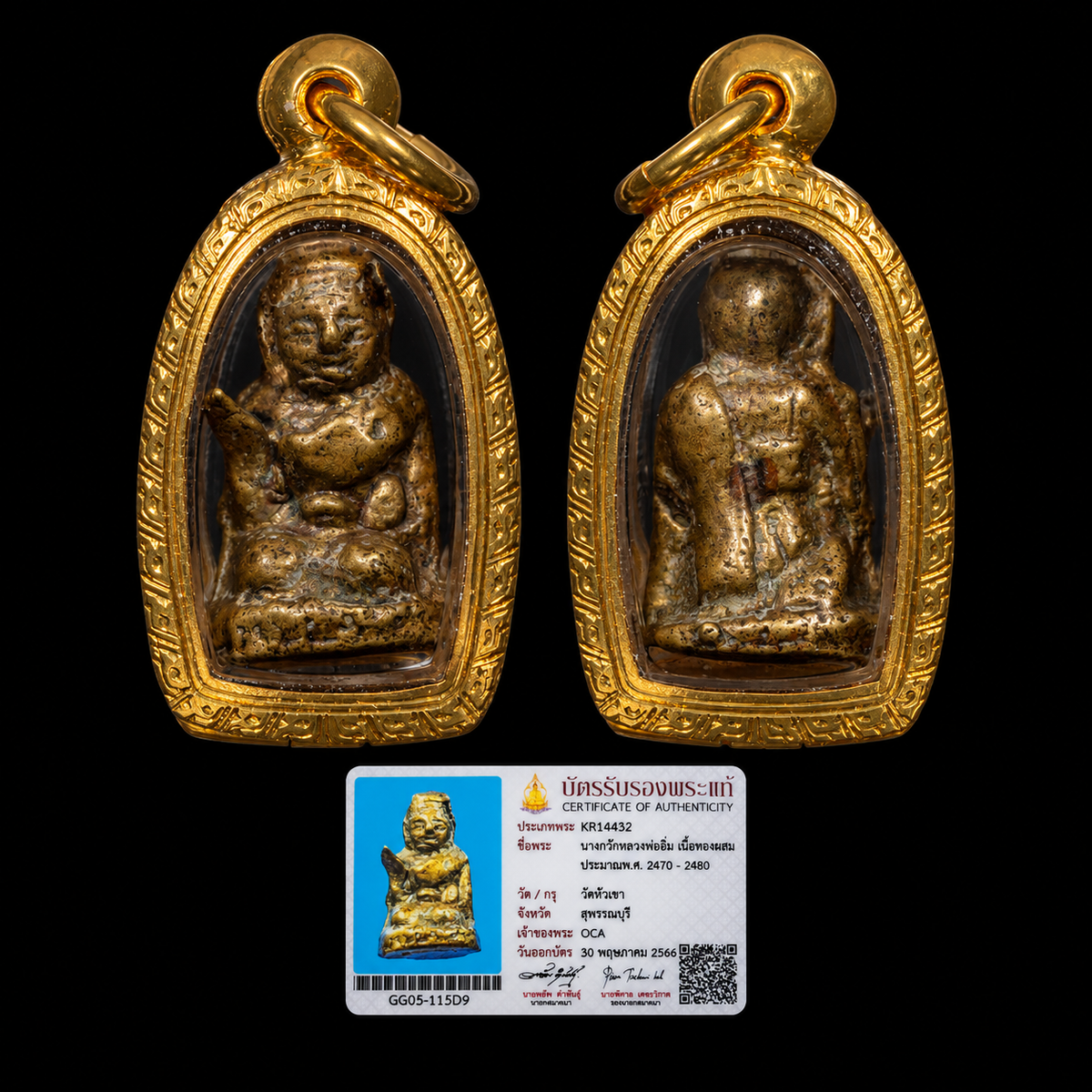
Samakom Certification Card (GG05-115D9)
Individual Craftsmanship
Because the pieces were individually prepared and finished, no two examples are completely identical. Differences in facial detail, proportions, casting texture and surface are part of their individual character.
This example has subsequently been preserved in a gold box, allowing the old surface and three-dimensional form to remain visible while making the piece suitable for wearing.
Personal Experiences Shared by Luksits
Among old Suphanburi collectors, LP Im's Nang Kwak is remembered principally for Metta Maha Niyom and commerce.
Accounts passed down around these pieces commonly concern customers becoming easier to approach, negotiations proceeding more smoothly and the wearer receiving greater goodwill from people in positions of authority.
For those working in sales or business, the emphasis is not simply on sudden money. Nang Kwak represents the conditions that allow business to develop: people coming towards you, returning customers, favourable conversations, introductions and opportunities to trade.
LP Im's lineage also gives the piece another dimension. His sacred objects acquired an old reputation for protection alongside metta, and collectors therefore regard his Nang Kwak as broader in application than a simple shop charm.
Summary
This is an old Nang Kwak cast in mixed metal and attributed to LP Im of Wat Hua Khao, Suphanburi, approximately B.E. 2470–2480.
Nang Kwak is one of Thailand's most recognisable symbols of commerce and prosperity. Her raised hand performs the characteristic beckoning gesture—symbolically calling customers, money, opportunity and supportive people towards the owner.
What distinguishes this example is its association with LP Im, an important old-generation Suphanburi master whose reputation covered both Metta Maha Niyom and protective wicha.
For a collector, it combines an early handmade form, an established Suphanburi lineage and one of the clearest traditional symbols of successful trade.
Historical Background
LP Im of Wat Hua Khao belonged to an earlier generation of Suphanburi masters. Traditional accounts place his birth in B.E. 2406 (1863) and his passing in B.E. 2480 (1937).
His surviving history is drawn partly from local and collector tradition, but he has long been remembered as a monk accomplished in meditation and old sacred practices.
LP Im is also traditionally connected with the lineage of LP Suk of Wat Pak Khlong Makham Thao. His own later influence became important in Suphanburi, with LP Mui of Wat Don Rai and LP Kuay of Wat Kositaramremembered among the masters connected with his transmission of wicha.
This places LP Im within an important period when sacred knowledge was transmitted personally from teacher to student rather than principally through large organised temple releases.
Origins of the Materials
The figure is described as Nuea Thong Phasom, an old mixed-metal alloy. In the language of Thai amulet collecting, this refers to a traditional blend of metals rather than solid gold.
Such material develops considerable individuality with age. Oxidation, darkened recesses, exposed metal and old surface deposits can create a complex appearance that is difficult to separate from the history of the object itself.
The present piece retains this aged character beneath its protective casing and gold box.
Ritual
Nang Kwak occupies a particularly important place in Thai commercial belief. Her characteristic raised hand is understood as a gesture of Kwak—beckoning or calling something towards oneself.
In sacred practice, that symbolism became associated with calling customers into a shop, bringing opportunities towards a trader and encouraging money to circulate back towards the household.
Under LP Im's tradition, these qualities are associated with Metta Maha Niyom, while the reputation of his broader wicha adds the traditional protective qualities for which his sacred objects became known.
Blessings and Effects
The central quality is Metta Maha Niyom—being received with goodwill, kindness and favourable attention. For someone whose livelihood depends upon dealing with people, this naturally connects with sales, negotiation and customer relationships.
Riak Sap and Kha Khai Khlong concern calling wealth and keeping trade moving. Traditionally, this is sought by merchants, business owners, salespeople and those whose income depends upon customers or commissions.
Another traditional application concerns superiors and influential people. The same metta principle is used when approaching a manager, senior person, client or someone whose cooperation may affect one's progress.
LP Im's reputation additionally connects his sacred objects with Klaew Klaad, Kong Grapan and protection, giving this Nang Kwak an unusually broad traditional character.
Modern Application
The symbolism remains particularly relevant for anyone working in business, retail, sales, property, insurance, hospitality or client-facing professions.
Rather than viewing Nang Kwak only as a symbol for bringing cash into a shop, her wider meaning concerns drawing people and opportunities towards oneself.
A returning customer, an unexpected introduction, a supportive superior, a new contract or simply being remembered when an opportunity appears all fit naturally within the traditional Metta and Nang Kwak interpretation.
It can therefore be worn personally or kept close to one's place of work.
Physical Details
A small three-dimensional Nang Kwak Roop Lor individually cast in an old mixed-metal alloy. The front shows Nang Kwak seated with her characteristic raised beckoning hand, while the reverse retains the rounded contours and irregular finish of traditional casting. Considerable age and surface variation remain visible throughout the metal. The artifact is now protected within a clear casing and finished with a gold box for wearing.
Recommended Pairing
For business use, this Nang Kwak pairs naturally with an artifact emphasising wealth and Choke Lap, creating a combination of customer attraction and financial opportunity.
For career use, pairing with a Baramee or authority-oriented amulet adds the themes of recognition, confidence and support from superiors.
It may also be worn with a Buddha or respected monk amulet as the principal devotional piece, with Nang Kwak providing the more specific traditional emphasis on Metta, customers and livelihood.
Personal Notes
Old Nang Kwak pieces like this appeal to me because their character is completely different from modern releases. The uneven casting, aged mixed-metal surface and individually formed features give each one its own identity.
LP Im is also particularly interesting because his lineage connects with several important names in the older Suphanburi tradition. This is therefore not simply a Nang Kwak chosen for its symbolism of wealth and customers, but an old artifact carrying the character of an earlier generation of Thai sacred craftsmanship.
The gold box completes the piece particularly well. It protects the old casting while retaining its traditional appearance and makes an otherwise very old collector's artifact practical to wear today.
-
Free Shipping for Singapore| $15 Worldwide | $60 USA For Items Below $350