
OOBThaiAmulets
Lp Boon Wat Klang Bang Kaew 2444
Lp Boon Wat Klang Bang Kaew 2444
Couldn't load pickup availability
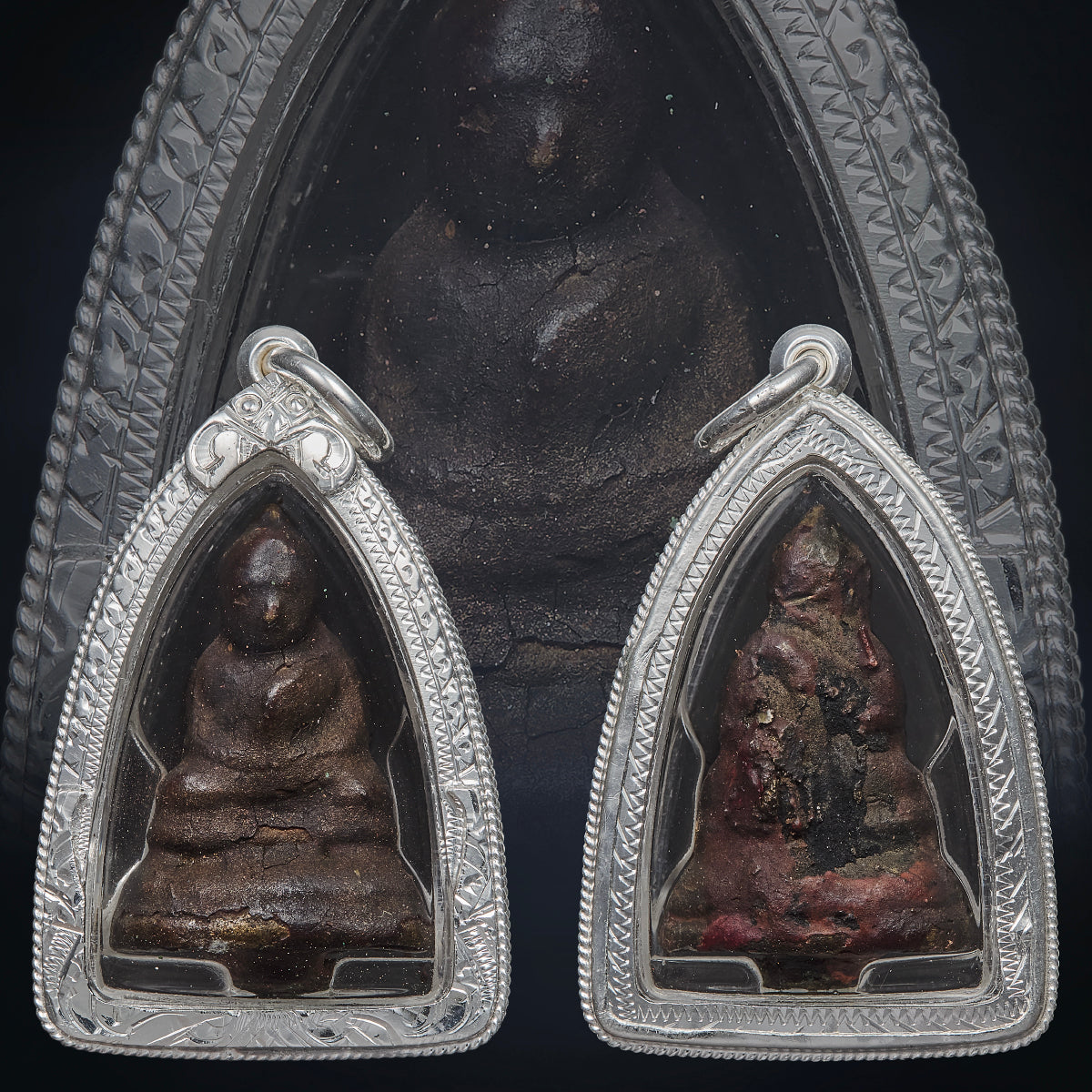
Phra Chaiwat Pim Pom Lek, Luang Pu Boon – Wat Klang Bang Kaew, Nakhon Pathom
Silver Frame Incl
Smakom Competition Winner (Cert provided)
Historical Background
The Phra Chaiwat Pim Pom Lek (small stout mold, high base) of Luang Pu Boon Khantachoto, Wat Klang Bang Kaew, is one of the most respected early cast Buddhist images from the late 19th century. Created (B.E. 2444 / 1901), this batch represents Luang Pu Boon’s mastery of traditional metal casting and his deep understanding of both Dhamma and sacred metallurgy.
During this period, Luang Pu Boon was closely connected with Somdej Phra Sangharaj (Pae), then titled Phra Thep Moli. Records show that Somdej Pae often stayed at Wat Klang Bang Kaew for several nights at a time, and the young novice Boon personally attended to him. It is therefore believed that Somdej Pae may have participated in or influenced the creation of Luang Pu Boon’s early Phra Chaiwat images.
Design and Casting
The Pim Pom Lek model depicts the Buddha seated in full meditation on a two-tier lotus base, with the robe line (sangkhati) extending across the torso down to the hands. The face is soft and subtle; beneath the base lies the remnant of the casting stem and hand-cut marks from separation after casting.
All original pieces are made through ancient cluster casting (lor choh) using a sacred alloy of brass, gold, silver, and copper. The texture appears dry, naturally aged, with soft greenish-yellow hues. Some are coated with lacquer and red resin (chard), others gilded, or layered with yellow orpiment before red lacquer application. Rare pieces found at the tip of the casting cluster (yod cho) often exhibit a darker black surface — the result of heavy gold and silver sediment settling during the pour, as the molten metal flowed downward when inverted for casting.
Distribution and Legacy
Luang Pu Boon initially gave these amulets to close disciples and donors. The remaining pieces were stored above the temple pavilion ceiling until the gruh was opened in B.E. 2516, when the temple released them for public worship at a modest donation of 100–200 baht each. Collectors at the time even used pliers to cut the pieces directly from the original cluster molds.
Today, over 2,000 pieces across all molds of Luang Pu Boon’s Phra Chaiwat series are preserved and displayed at the Phra Phutthawitthiyanayok Museum, Wat Klang Bang Kaew, serving as a complete reference for study and authentication.
Significance and ReverenceThe Phra Chaiwat of Luang Pu Boon is ranked among Thailand’s most revered pre-2500 Buddhist images—alongside those of Somdej Pae (Wat Suthat), Wat Bowonniwet, and Chao Khun Maa (Wat Sam Ploem). Known for their metta (compassion), protection, prosperity, and triumph over adversity, Luang Pu Boon’s Phra Chaiwat remains one of the cornerstones of early Rattanakosin-period Buddhist art and spiritual heritage.
Other Sacred Works by Luang Pu BoonBeyond the Phra Chaiwat series, Luang Pu Boon also created the Rian Chao Sua (Millionaire Coin), Phra Pong Chin Dhamanee, Bia Gae, and other talismans such as the Jindamanee powder set and Phra Phong Naresuan Parab Hong Sawadi. Each piece reflects his deep ritual knowledge and enduring baramee — a testament to his position as one of Nakhon Pathom’s greatest and most respected masters.
-
Free Shipping for Singapore| $15 Worldwide | $100 USA All products