
OOBThaiAmulets
LP Anucha - Wat Pho Ratchaburana
LP Anucha - Wat Pho Ratchaburana
Couldn't load pickup availability
ANU01
Rian Sema Ayu 60 - Lang Yant Mongkut
LP Anucha • Wat Pho Ratchaburana, Ratchaburi
1st Batch • 60th Birthday / 5 Rob Commemorative Issue
B.E. 2568
5cm
Mainstream Artifact
Bio of LP Anucha: click here
Sacred Craftsmanship
The Rian Sema Ayu 60 was created to commemorate an important milestone in the life of LP Anucha of Wat Pho Ratchaburana — his 60th birthday, or 5 Rob.
Within this first issue, the Lang Liap — smooth-back version occupies a particularly personal position.
LP Anucha personally hand-yanted both the front and reverse of each piece.
Each medal was individually produced and subsequently worked upon by hand, so natural variations in surface, tone, inscription and finishing give every piece its own character.
The photographs are representative only. A piece will be selected at random, and the item supplied may differ slightly from the exact piece shown in the images
Personal Experiences Shared by Luksits
Among close followers of LP Anucha, the Lang Liap pieces became particularly desirable because they offered something that a standard production medal could not: an opportunity for the master to work personally upon the individual Rian.
Devotees would collect the smooth-back version and bring it before LP Anucha, asking him to inscribe Yant directly onto the metal. For this reason, many such pieces remained closely held after consecration rather than circulating freely among collectors.
Followers of LP Anucha include shopkeepers, entrepreneurs, salespeople and established business owners. Their accounts commonly concern practical matters: steadier business, improved dealings with customers, greater confidence when making decisions and a sense of protection when encountering difficult situations.
Others value the Rian less for any single reported effect than for the personal connection represented by LP Anucha's handwriting. For them, seeing the irregular hand-drawn lines upon the reverse is a reminder that the medal physically passed through the master's hands and received his individual attention.
Summary
The Rian Sema Ayu 60 brings together three important elements within a single commemorative issue.
It marks LP Anucha's 60th birthday and completion of 5 Rob.
It belongs to his first-batch commemorative Rian.
And unlike the regular struck reverse, the reverse side was intentionally left untouch so that LP Anucha could personally work upon the surface.
LP Anucha personally hand-Yanted the front, with the reverse centred upon Yant Mongkut.
The significance of 5 Rob comes from the traditional twelve-year cycle. Five cycles equal sixty years, making the occasion one of completion and transition into a mature stage of life.
The number five also has an established place within Thai Buddhist sacred symbolism. Most familiar is Na Mo Phut Tha Ya, the five-syllable sacred formula associated in traditional practice with the Five Buddhas. Within the context of a 5 Rob issue, this provides an additional symbolic association between the commemorative age and established Buddhist ritual numerology.
Yet the most individual aspect of this particular medal remains the handwritten Yant.
The mould identifies the batch.
The handwritten Yant identifies the individual piece.
Historical Background
The Sema-shaped medal occupies a familiar place within Thai Buddhist amulet culture. Its outline recalls the form associated with Bai Sema, the boundary stones traditionally connected with the sacred precinct of an ordination hall.
Over time, the Sema outline became an established form for commemorative Rian, particularly issues honouring respected monks and significant anniversaries.
For the Ayu 60 issue, the form is particularly appropriate. The medal is not merely a portrait of LP Anucha but a record of an important stage in his monastic life.
LP Anucha was born on 23 August 1964 in Nakhon Pathom Province. His early exposure to temple practice eventually brought him into the study of traditional Wiccha, with LP Sanga of Wat Nong Muang forming an important part of his early foundation.
He first entered the monkhood in B.E. 2527 (1984). After a period in lay life, he returned to the monkhood at Wat Pho Ratchaburana in B.E. 2552 (2009) and continued both formal Buddhist education and the study of traditional sacred disciplines.
His Wiccha developed through several lines of instruction, including teachings associated with LP Non of Wat Khao Phran Thup, LP Boonkham of Wat Chaiyaphum and LP Od of Wat Bang Muang.
The hand inscription seen upon this medal should therefore be understood within that wider background: it represents the practical continuation of sacred writing and consecration methods learned through years of study.
Origins of the Materials
This example was made from lead, a material with a long history in Thai sacred-object production.
Lead is dense, comparatively soft and highly suitable for receiving both moulded detail and subsequent hand inscription. Its surface can be worked directly with a pointed implement, making it particularly appropriate for a Lang Liap medal intended to receive individually written Yant.
Its appearance is also distinct from copper or brass. Rather than producing a bright warm tone, lead develops shades of grey, charcoal and darker oxidation, lending older pieces a restrained appearance that many collectors associate with traditional ritual objects.
In this Rian, the material serves both structural and ritual purposes.
The moulded front records the commemorative design.
The smooth reverse becomes the field upon which LP Anucha's own Wiccha could be physically written.
Ritual
The Lang Liap version should be understood as more than simply an unfinished reverse.
The absence of a moulded reverse design created space for individual ritual work.
After the medal was produced, LP Anucha personally inscribed sacred characters onto the surface. In this example, the principal reverse composition is Yant Mongkut, surrounded and intersected by additional sacred writing.
Further hand inscription is also present on the obverse.
Within traditional Thai Wiccha, the writing of a Yant is connected with more than the geometry visible to the eye. Its ritual significance also lies in the accompanying Katha, concentration, lineage and blessing of the practitioner who writes it.
The medal was subsequently consecrated as part of LP Anucha's sacred work surrounding the commemorative issue.
For devotees, this creates several connected layers:
5 Rob commemorative intention → sacred Sema form → personal Yant inscription → chanting and consecration.
It is this sequence that gives it examples their particular character.
Blessings and Effects
The principal Yant on the reverse is Yant Mongkut, traditionally understood as an all-round sacred design concerned with protection, favourable standing and the strengthening of the wearer's Baramee.
Its traditional qualities are associated particularly with protection from danger and harmful influences. Within the wider belief surrounding protective Yant, this may include avoidance of accidents, protection while travelling and greater safety when entering uncertain circumstances.
A second important aspect is Metta Maha Niyom — attracting kindness, goodwill and support from others. Rather than aggressive authority, this aspect concerns being received favourably and encountering people willing to cooperate.
Baramee and authority are likewise important. The wearer traditionally seeks greater confidence, respect and standing when dealing with others, particularly where leadership or decision-making is required.
The Rian is also associated with Klaew Klaad, the traditional concept of escaping or avoiding danger before harm can fully develop.
In practical terms, its traditional emphasis may therefore be summarised as:
protection, Metta, authority, favourable opportunity and the ability to pass safely through difficult circumstances.
Modern Application
The Rian Sema Ayu 60 is particularly suitable as a broad everyday amulet.
Business owners may appreciate the combination of Metta and authority when dealing with employees, suppliers and customers. Executives and managers may place greater emphasis upon Baramee, judgement and professional standing.
Those who travel frequently may value the traditional Klaew Klaad and protective aspects of Yant Mongkut.
For a devotee of LP Anucha, however, the medal carries another dimension. The master is not represented only by the portrait on its face; his own handwriting remains physically present upon the object.
This gives the Rian a particularly direct devotional character.
Physical Details
This Rian Sema Ayu 60 measures approximately 5 cm and is made from lead.
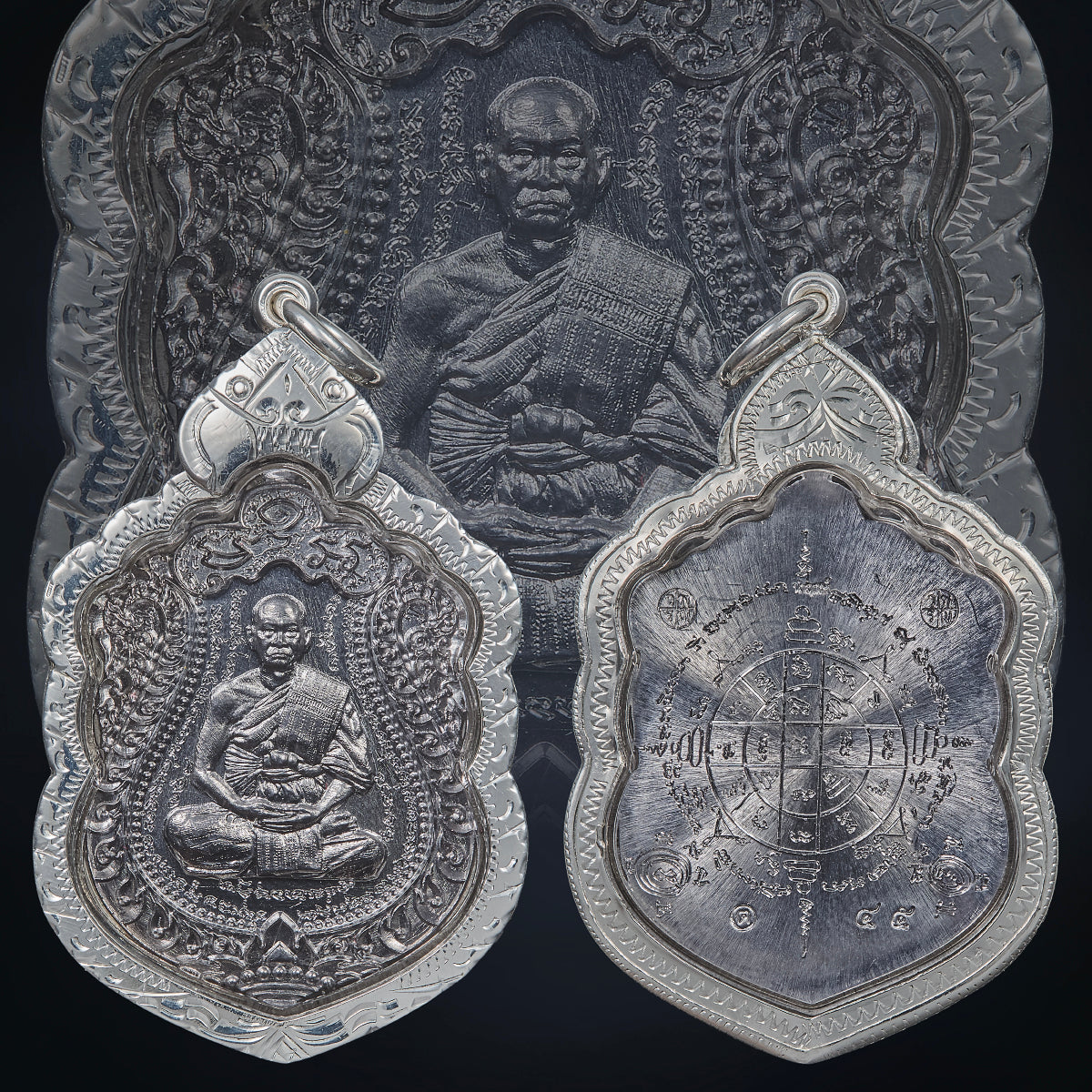
The obverse presents LP Anucha seated cross-legged in meditation, his hands resting centrally before him. The portrait is enclosed within a highly detailed Sema-shaped ornamental composition, with sacred writing and decorative motifs occupying the surrounding field.
The reverse a plain surface, LP Anucha personally inscribed an extensive Yant Mongkut composition. A circular sacred diagram dominates the centre, divided into numerous compartments containing sacred characters, while further inscriptions extend around and beyond the principal geometry.
The irregularity of the hand-drawn lines is significant. They are not intended to possess the mechanical uniformity of a struck reverse; they preserve the movement of the master's hand.
The medal shown has subsequently been fitted into an ornate silver-coloured custom casing, leaving both sides clearly visible while protecting the relatively soft lead surface.
Recommended Pairing
For business and customer-facing work, the Rian pairs naturally with Nang Kwak, combining Yant Mongkut's protective and favourable qualities with Nang Kwak's traditional emphasis upon customer attraction.
For speech, negotiations and sales, Salika provides a complementary emphasis upon communication, persuasion and Metta Maha Niyom.
For livelihood and continuing resources, Phra Sivali is an appropriate companion, particularly for those whose income depends upon trade or movement between different places.
For someone seeking a stronger protective arrangement, a traditional Takrut from LP Anucha's own lineage keeps the pairing within the same body of Wiccha.
Nevertheless, the extensive Yant Mongkut personally inscribed upon this example already gives the medal a broad traditional purpose. It does not require another amulet in order to be regarded as complete.
Personal Notes
The appeal of this Rian lies in the difference between commemoration and personalisation.
The 5 Rob issue commemorates something shared: LP Anucha reaching sixty years of age.
The hand drawn yant records something individual.
Once LP Anucha placed the point of his engraving tool against the smooth lead and began writing, that particular Rian ceased to be completely identical to the others from the batch.
The lines could differ.
The characters could differ.
Their placement could differ.
And the amount of ritual work performed upon each medal could differ according to the individual example.
This is why such pieces deserve to be considered separately from the regular struck-back Rian. Their importance is not merely that the reverse is smooth, but what that smooth surface allowed the master to do.
In this example, the result is particularly expressive: a substantial lead Sema commemorating LP Anucha's 60th birthday and 5 Rob, carrying his portrait on the front and an extensive Yant Mongkut personally written by LP Anucha across the reverse.
It represents both a milestone in the master's life and a piece of his ritual handwriting preserved permanently in metal.
-
Free Shipping for Singapore| $15 Worldwide | $100 USA All products