

OOBThaiAmulets
LP Anucha - Wat Pho Ratchaburana
LP Anucha - Wat Pho Ratchaburana
Couldn't load pickup availability
ANU01
Suer Roop
LP Anucha • Wat Pho Ratchaburana, Ratchaburi
1.5 Inches
Mainstream Artifact
Bio of LP Anucha: click here
Sacred Craftsmanship
This Suer Roop by LP Anucha combines one of the most commanding animals in traditional Thai Wiccha with an equally distinctive organic material: Kao Kwai, water-buffalo horn.
Each Suer was individually carved from natural Kao Kwai and subsequently hand-inscribed. Differences in horn colour, grain, carving, surface markings and Yant placement are natural characteristics of the handmade process, making every piece unique.
Personal Experiences Shared by Luksits
Among LP Anucha's followers, his sacred objects are commonly approached as practical companions for everyday life rather than objects intended merely for collection.
His community includes many entrepreneurs and established business owners around Ratchaburi and neighbouring provinces. Followers have spoken of smoother negotiations, improved client relationships, greater confidence in professional situations and a stronger sense of stability surrounding business and family matters.
One businessman in Thailand's beauty industry, whose father had previously been devoted to LP Deang, described substantial growth in his business after beginning to carry LP Anucha's sacred objects. Other followers similarly speak of financial stability, professional opportunities and confidence when navigating important decisions.
For the Suer, however, such accounts fit naturally with the qualities traditionally attributed to the tiger: maintaining one's position, remaining composed under pressure and carrying sufficient Baramee that unnecessary confrontation can often be avoided.
Summary
The Suer Roop carved from Kao Kwai is fundamentally an artifact of strength.
Its construction brings together two powerful symbols.
Kao Kwai represents endurance, grounded strength, livelihood and resilience.
Suer represents courage, authority, vigilance, protection and commanding Baramee.
LP Anucha further strengthened this combination by personally applying sacred Yant before consecrating the completed artifact through the Wiccha transmitted through his teachers.
Within traditional belief, the result is particularly associated with Maha Amnaj, protection, Kongkraphan, Klaew Klaad, courage and resistance against hostile influences.
It is an artifact intended not simply to make the keeper appear fierce, but to help them remain firm when circumstances become difficult.
Historical Background
LP Anucha and His Wiccha Lineage
LP Anucha Anuchato of Wat Pho Ratchaburana, Ratchaburi, belongs to a contemporary generation of monks who combine formal Buddhist study with inherited traditions of Thai Wiccha.
His early foundation came principally through LP Sanga of Wat Nong Muang.
As a young man, LP Anucha spent time serving at the temple and received instruction in traditional Buddhist mystical knowledge, including sacred Yant, chanting, consecration and protective practices.
His studies subsequently expanded through several other teachers.
LP Non of Wat Khao Phran Thup contributed additional knowledge concerning ritual practice, protection, consecration, Metta and sacred inscriptions.
LP Boonkham of Wat Chaiyaphum provided further instruction concerning Yant, empowerment and traditional consecration methods.
LP Anucha is also reported to have studied with LP Od of Wat Bang Muang, adding another branch of protective Wiccha to his accumulated knowledge.
His path therefore represents a meeting of several teacher-disciple traditions rather than knowledge acquired from a single source.
Suer Wiccha
Within Thai sacred traditions, Suer has long represented considerably more than physical ferocity.
The tiger possesses its own territory.
It moves with awareness.
It does not require constant displays of aggression for other animals to recognise its presence.
These characteristics gave rise to the tiger's association with Maha Amnaj — commanding authority and power.
Suer Wiccha consequently became particularly relevant to people whose lives required courage, leadership, protection and the ability to hold their position against opposition.
Origins of the Materials
Kao Kwai — Water-Buffalo Horn
Kao Kwai occupies an interesting position within older rural sacred craftsmanship because the buffalo was once central to agricultural life.
Before mechanised farming became widespread, the buffalo represented labour, livelihood and household survival.
Its strength cultivated the fields.
Its endurance sustained agricultural work.
For many rural families, the animal was closely connected with the prosperity of the household itself.
This background contributed to the symbolic qualities later associated with Kao Kwai: strength, endurance, resilience and protection.
Horn is also physically different from ordinary wood.
Its dense organic structure is durable and can be polished, carved and inscribed while retaining considerable strength. These practical characteristics made horn suitable for the production of traditional talismans and small sacred objects.
Within older Wiccha traditions, practitioners further regarded natural organic materials as capable of receiving repeated chanting and ritual inscription.
When Kao Kwai is carved into Suer, its symbolism becomes particularly forceful.
The enduring strength of the buffalo becomes the physical vessel for the commanding character of the tiger.
Ritual
The preparation begins by selecting an appropriate section of Kao Kwai.
The horn must first be cut and shaped before the Suer can be individually carved.
The tiger is then established through its characteristic head, mouth, body, legs and tail.
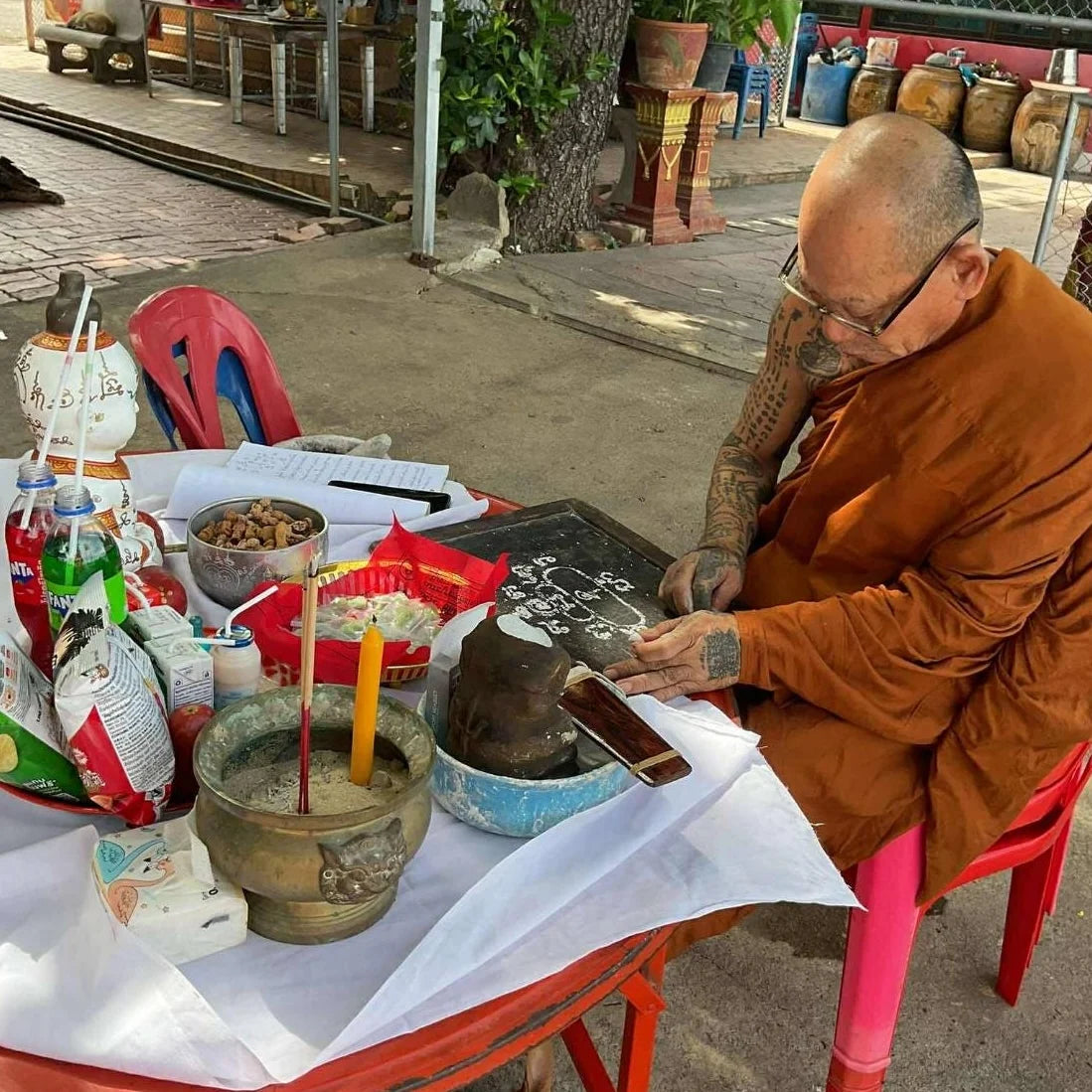
After the physical carving has been completed, LP Anucha applies the Yant by hand.
This stage is clearly visible on this example. Sacred characters and ritual markings extend across the head, body and lower portion of the Suer.
Hand inscription is important within LP Anucha's method because it creates a direct relationship between master and artifact before the final consecration.
The completed Suer is subsequently empowered through chanting, meditation and traditional consecration according to the Wiccha inherited through his teachers.
The process can therefore be understood in stages:
Kao Kwai provides the material.
Suer provides the form.
Yant establishes the Wiccha.
Consecration completes the artifact.
Blessings and Effects
The principal traditional quality of this Suer is Maha Amnaj — authority, commanding presence and the ability to hold one's position.
This makes Suer particularly relevant to leaders, business owners, managers and those who regularly deal with competitive environments.
Kongkraphan concerns bodily protection and resilience against physical harm within traditional Thai belief.
Klaew Klaad represents avoidance — passing around danger, accidents or troublesome situations rather than meeting them directly.
Protection against hostile influences is associated with both Suer Wiccha and the traditional protective character attributed to Kao Kwai.
Courage and confidence reflect the tiger's character. The keeper is encouraged to remain composed rather than becoming intimidated by stronger personalities or difficult circumstances.
Baramee concerns personal presence and the respect that accompanies it.
The Suer is therefore not simply about aggression. Its deeper symbolism is the ability to possess strength without continually having to prove it.
Modern Application
The Suer Roop is particularly appropriate for those whose daily lives involve responsibility, competition or negotiation.
For a business owner, its traditional qualities may be directed towards confidence when making decisions, protecting one's interests and maintaining authority among staff and competitors.
For executives and managers, the emphasis is more naturally upon leadership, credibility and remaining steady under pressure.
Salespeople and negotiators may appreciate the combination of confidence and presence, particularly when dealing with demanding customers or difficult negotiations.
Those who travel frequently may instead approach Suer through its traditional Klaew Klaad and protective qualities.
The Kao Kwai adds another dimension: endurance.
The symbolism is therefore not merely about winning a confrontation. It is equally about having the resilience to continue when circumstances become difficult.
Physical Details
This example is a compact Suer Roop hand-carved from Kao Kwai, displaying the naturally deep brown and near-black tones of aged buffalo horn.
The tiger has a strong folk-art character. Its head is large in relation to the body, with a deeply drilled circular eye, incised mouth, compact legs and a long sweeping line defining the back and tail.
Numerous hand-applied Yant inscriptions can be seen across both sides of the artifact. These vary naturally in position and appearance because they were individually written rather than mechanically reproduced.
The surface retains carving lines, minor irregularities and changes in tone characteristic of natural horn.
The piece is presently protected within a fitted clear casing, allowing the carved profile and extensive sacred inscriptions to remain visible while protecting the original surface.
Recommended Pairing
A Phra Somdej makes a particularly balanced companion. The Suer provides strength and authority, while Phra Somdej provides Buddhist Baramee, mindfulness and spiritual stability.
A Hanuman may further strengthen courage and leadership, although this produces a much more concentrated combination centred upon authority and determination.
Personal Notes
What makes this version particularly interesting is the relationship between Kao Kwai and Suer.
Both represent strength, but they express it differently.
The buffalo represents endurance.
It works, carries weight and continues.
The tiger represents command.
It observes, controls its territory and acts decisively when required.
LP Anucha brings these two qualities together by carving the tiger directly from buffalo horn and then covering the completed form with his own sacred Yant.
The material is therefore not merely a convenient surface for the carving.
It contributes directly to the meaning of the artifact.
For someone who works in business, leadership or another demanding environment, that combination has a particularly clear symbolism:
the endurance to withstand pressure, the courage to face opposition, and the Baramee to command one's position without unnecessary conflict.
That is the character of this Suer — not uncontrolled aggression, but strength held firmly under control.

-
Free Shipping for Singapore| $15 Worldwide | $60 USA For Items Below $350