
OOBThaiAmulets
Lanna - Meed Haek
Lanna - Meed Haek
Couldn't load pickup availability
MS06
Meed Haek Thon Sit
4.5 Inches
Mainstream Artifact
Awarded 3rd placing in Samakom Competition
Individual Craftsmanship
Each piece of horn has its own curvature, grain, colour and density. The carving therefore follows the natural material rather than forcing every example into an identical shape, making each finished artifact individually distinct.
Personal Experiences Shared by Luksits
Older accounts surrounding the Meed Haek are somewhat different from those of ordinary wearable amulets.
Its reputation comes principally from the practices of Pu Kru, traditional ritual masters and northern folk healers, who kept such objects among their working ritual implements.
When a person suffered unexplained discomfort or an illness traditionally believed to have been caused by khun sai, spirit disturbance or another harmful influence, the master could use the Meed Haek as part of the ritual treatment. The horn was passed, rubbed or swept across the affected area while the appropriate prayers and formulas were recited.
The action represented haek — breaking open, clearing and separating the harmful influence from the person.
Outside ritual treatment, smaller examples were also carried for protection, particularly when travelling through forests, remote areas or places traditionally regarded as spiritually unsettled.
Summary
The Meed Haek Khao Kwai Phueak Lanna is an old form of northern Thai ritual implement carved from white buffalo horn.
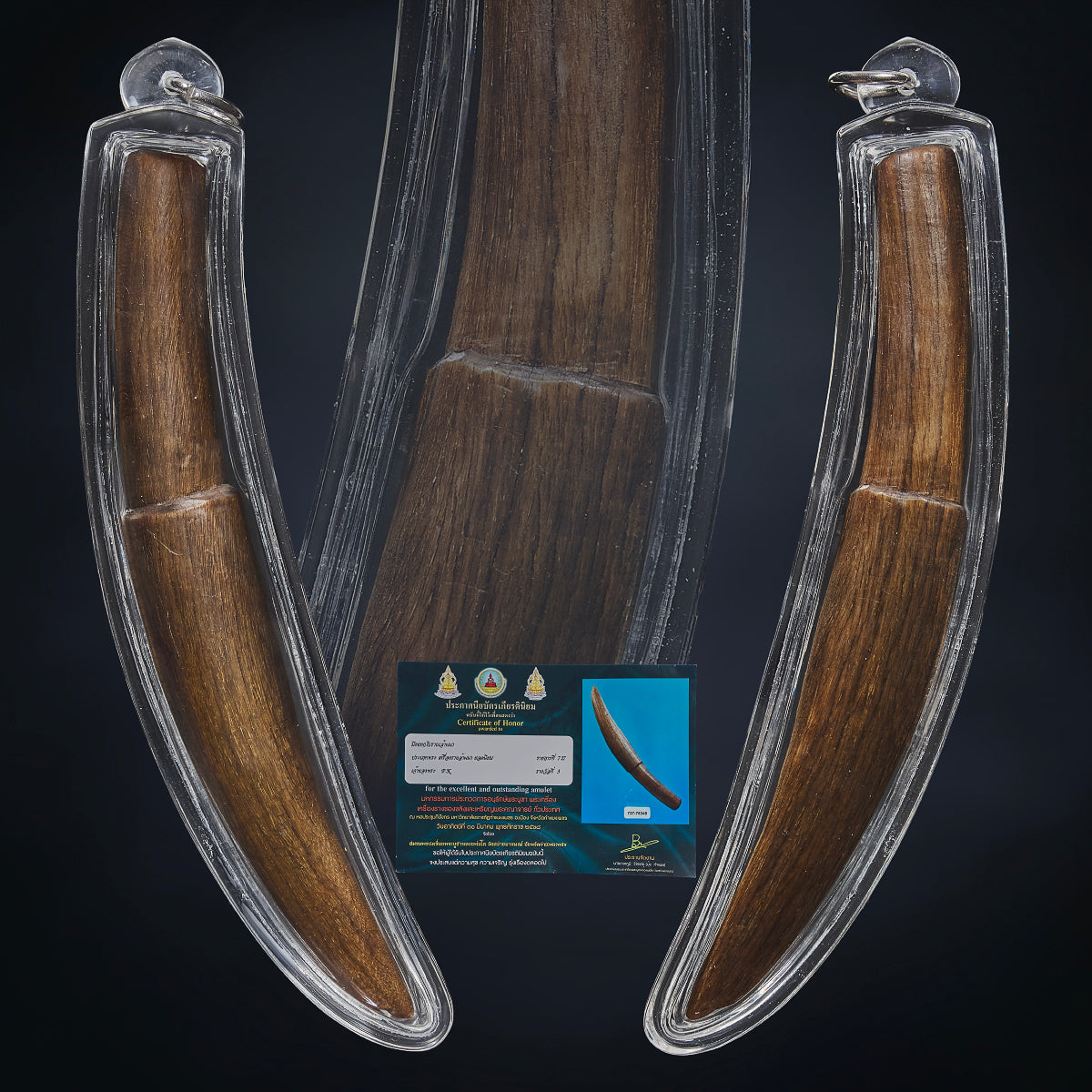
This example measures approximately 4.5 inches and is made from aged horn displaying a distinctive honey-brown surface.
Within traditional Lanna belief, white buffalo horn could be regarded as Khong Thon Sit — a naturally occurring sacred material believed to possess inherent qualities before additional ritual consecration.
The Meed Haek was traditionally associated with protection, clearing harmful influences and ritual healing. Its blade-like shape is symbolic: rather than functioning primarily as a weapon, it represents the ability to haek—to break through, open, separate or clear away something obstructive or harmful.
Historical Background
Northern Thai spiritual practice historically developed through an interaction between Buddhist observance, local spirit traditions, protective wicha and folk healing.
Within this environment, ritual specialists used a variety of sacred implements. Some were intended for chanting and blessing, while others were used symbolically to sweep away, cut through or expel harmful influences.
The Meed Haek belongs to this latter tradition.
The word meed means knife, while haek carries ideas of opening, breaking apart or forcing something away. Its ritual meaning therefore concerns breaking the hold of an unwanted influence rather than physically cutting the body.
Such implements became particularly associated with traditional masters who treated conditions understood within older belief systems as Khun Khon, Khun Pii or Khun Sai—harm attributed respectively to human ritual action, spirits or harmful magic.
Origins of the Materials
The most important feature of this artifact is its Khao Kwai Phueak — white buffalo horn.
White buffaloes are comparatively unusual, and their horns acquired a special place within regional sacred-material traditions. Old horn was valued for its hardness, durability and connection with an animal traditionally representing strength, endurance and agricultural life.
Certain pieces of horn were regarded as Khong Thon Sit.
In traditional terminology, this describes naturally occurring material believed already to possess unusual sacred qualities rather than receiving all of its significance through later consecration.
Particular importance could be attached to horn associated with unusual circumstances. Traditions sometimes speak of buffaloes that died naturally at an advanced age or animals killed by lightning or another exceptional event. Such provenance, however, should only be attributed to an individual artifact when its history is known.
For this piece, the significant documented characteristic is the old white buffalo horn itself, now displaying the deep honey colouring associated with aged material.
Ritual
The traditional use of a Meed Haek centred upon the act of clearing or breaking an unwanted spiritual influence.
A Pu Kru or ritual practitioner could hold the horn while reciting the appropriate kata and then gently draw, rub or sweep the Meed Haek across the part of the body where discomfort was experienced.
The movement symbolically cut through and opened away the affliction.
In traditional explanations, this could be performed where unexplained illness was believed to originate from khun saior black magic, spirit disturbance, an occult attack, or what northern traditions sometimes describe as Lom Phlem Phat—a mysterious affliction attributed to unseen causes.
The Meed Haek itself did not necessarily require an elaborate blade or sharp edge. It was the combination of its ritual form, naturally significant material, the practitioner's wicha and the accompanying kata that defined its purpose.
This belongs to traditional spiritual practice and should not replace appropriate medical diagnosis or treatment for physical illness.
Blessings and Effects
Traditional belief surrounding the Meed Haek extends beyond ritual healing.
Its principal qualities are associated with protection and the removal of harmful influences. It may be carried for Klaew Klaad, or avoidance of danger, and for protection against spirits, occult attack and places believed to carry unsettled energies.
White buffalo horn additionally carries traditional associations with strength, endurance and Kong Kraphan, while some lineages also connect the material with Metta Maha Niyom and Maha Saneh.
The symbolism of the artifact itself remains particularly important:
the horn provides endurance; the knife form cuts through; and the act of Haek clears the path.
For this reason, the Meed Haek can also be understood more broadly as an artifact for overcoming obstruction and moving safely through difficult circumstances.
Modern Application
Today, a Meed Haek of this size can be carried as a personal protective artifact rather than used as a practitioner's full ritual implement.
Its traditional meaning makes it particularly relevant to those who travel frequently, enter unfamiliar environments or work in remote places. Within Lanna belief, it may also be kept in a home, vehicle or personal sacred collection as a guardian against unwanted influences.
For collectors, however, much of its interest lies in the survival of an older northern concept: a ritual knife that does not depend upon a metal blade.
The power attributed to the object comes instead from its material, form and wicha.
Physical Details
This Meed Haek measures approximately 4.5 inches and is carved entirely from old white buffalo horn. The naturally curved profile follows the original growth of the horn, while the surface has matured to a warm honey-brown colour with darker grain running through it. The lower portion is shaped into a broader blade-like profile while the upper section remains narrower, preserving the characteristic appearance of the traditional Lanna ritual knife. The artifact is currently protected within a fitted clear casing for carrying and preservation.
Recommended Pairing
The Meed Haek may be carried alongside a mainstream Buddhist amulet or protective Buddha image.
A Buddha image can remain the principal devotional focus, while the Meed Haek represents the older Lanna protective tradition of clearing obstacles, guarding against harmful influences and safe passage.
It may also be kept with other northern Thai sacred objects where its distinctive role as a protective ritual implement complements rather than duplicates their purpose.
Personal Notes
What makes this artifact particularly interesting is the simplicity of its construction.
There is no elaborate metal blade and no need for excessive decoration. The entire form depends upon a carefully selected piece of old Khao Kwai Phueak, shaped into the unmistakable profile of the Meed Haek.
The aged honey-coloured horn also allows the natural material to remain clearly visible rather than being hidden beneath lacquer or ornamentation.
Within the old Lanna understanding of Khong Thon Sit, this simplicity is meaningful. The material was traditionally valued because its significance was considered to originate partly within the natural object itself, while the master's wicha and ritual use gave direction to that quality.
It is therefore best understood not simply as a miniature horn knife, but as a surviving expression of an older Lanna tradition of protection, ritual clearing and folk healing.
-
Free Shipping for Singapore| $15 Worldwide | $60 USA For Items Below $350