
OOBThaiAmulets
Kruba Pon
Kruba Pon
Couldn't load pickup availability
PST05
Mae Hong Prai
Kruba Pon
B.E. 2565 (2022)
Barang artifact
Rare Personally Received Batch
2 inches
The photographs are representative only. A piece will be selected at random, and the amulet supplied may differ from the exact piece shown in the images.
Sacred Craftsmanship
As these pieces were handmade rather than industrially produced, natural variations in the coffin wood, surface texture, bindings, embedded materials and finishing distinguish every example.
Personal Experiences Shared by Luksits
Early keepers of this batch have spoken particularly strongly about its Saneh and opportunity-drawing character.
Some described receiving noticeably greater attention from others, including people becoming unusually friendly, initiating conversations or showing personal interest without much prompting. Others associated the Mae Prai with unexpected introductions and opportunities appearing at particularly useful moments.
There were also accounts of Chok Lap, including unexpected monetary luck and lottery-related fortune. These remain personal experiences shared amongst keepers rather than guaranteed outcomes, but they contributed to the reputation surrounding the small batch.
The strongest recurring theme, however, has always been attraction. Keepers described an increased sense of social magnetism — being noticed more easily, receiving warmer responses and finding that interpersonal situations developed with less resistance than before.
This character closely reflects Kruba Pon's long-standing reputation for Metta and Maha Saneh wicha.
Summary
This Mae Hong Prai belongs to a very limited batch personally prepared and consecrated by Kruba Pon in B.E. 2565 (2022).
The figure is based upon coffin-lid wood and immersed within Nam Man Prai, forming a traditional spirit-associated construction centred upon Saneh, Metta, attraction, opportunity and Chok Lap.
The batch also carries unusual personal provenance.
I had not met Kruba Pon since 2014, when he participated in the blessing of a batch of Ngan together with Por Sala Tan. When I finally met him again in 2022, I was surprised that after so many years he still remembered me.
By coincidence, Kruba Pon had recently completed this Mae Prai batch around the period of my visit.
I initially mistook the figures for Guman when filming them because everything was happening quickly. Only afterwards did I learn that they were actually Mae Prai.
Almost the entire batch was subsequently given directly to me by Kruba Pon. He retained only one example for himself, making the surviving pieces from this group especially meaningful within my collection.
Historical Background
Kruba Pon is particularly associated with the Saneh branch of traditional wicha, but his output of amulets has remained comparatively limited.
Rather than continually producing objects, much of his time has been devoted to meditation and personal cultivation. Pieces therefore tended to appear when he considered the circumstances and materials appropriate rather than according to a regular commercial production schedule.
His connection with Por Sala Tan also forms an important part of the history surrounding these pieces.
In 2014, Kruba Pon joined Por Sala Tan in blessing a batch of Ngan. Both practitioners were deeply familiar with Saneh work, although each maintained his own methods and lineage.
Por Sala Tan once made a memorable remark about the strength of Kruba Pon's Saneh items, warning in characteristically direct language:
“Don't let Kruba Pon's items fall into the hands of married men or married women — they are family wreckers.”
The remark should be understood as an emphatic description of how strongly he regarded Kruba Pon's attraction wicha, rather than as the intended purpose of the artifacts themselves.
Origins of the Materials
Coffin-Lid Wood
The physical foundation of the Mae Hong Prai is wood taken from an old coffin lid.
Within Prai-oriented folk wicha, coffin-associated materials are traditionally regarded as particularly responsive because of their connection with death, transition and the spirit realm.
For Kruba Pon, however, the material was not used merely because it came from a coffin. Its importance depended upon ritual preparation and its suitability for the specific Mae Prai work being undertaken.
The wood provided the physical body through which the completed artifact could be established.
Nam Man Prai
A defining component of the piece is Nam Man Prai.
Within traditional Saneh practice, Nam Man Prai is associated with attraction, personal magnetism, emotional attention and the drawing of favourable encounters.
Here it also serves as a ritual medium surrounding and sustaining the Mae Prai construction.
Mae Prai
The spiritual identity of the artifact centres upon the Mae Prai.
According to the lineage account, these were not treated as random wandering spirits. Their preparation took place within Kruba Pon's own ritual discipline and meditative practice, establishing the relationship between practitioner, spiritual presence and physical vessel.
This distinction is important when understanding the piece: its character comes from the complete construction rather than from coffin wood or oil considered independently.
Ritual
The batch was prepared through Kruba Pon's specialised Prai and Saneh wicha.
The coffin-lid material provided the vessel, while Nam Man Prai formed part of the medium through which the attraction-oriented character of the piece was developed.
The Mae Prai presence was then established and brought under the ritual discipline of Kruba Pon's practice.
Rather than simply creating an image and blessing it afterwards, the different components were treated as parts of one spiritual construction — physical vessel, ritual medium, Mae Prai and kata working together.
The fact that Kruba Pon retained one example himself is also significant. He intended to keep it close during his solitary forest practice, both for companionship and as a form of spiritual protection.
Blessings and Effects
The dominant traditional quality of Mae Hong Prai is Maha Saneh — attraction and personal magnetism.
This is closely accompanied by Metta Maha Niyom, encouraging favourable attention, friendliness and greater receptiveness from those encountered by the keeper.
Its traditional applications extend to several areas:
- Maha Saneh — attraction, charm and personal magnetism.
- Metta Maha Niyom — goodwill, acceptance and favourable treatment.
- Opposite Attraction — increased romantic or personal attention.
- Jerajaa — smoother communication and persuasive interaction.
- Chok Lap — unexpected fortune and beneficial opportunities.
- Business & Customers — encouraging attention, enquiries and useful connections.
- Opportunity — drawing encounters or circumstances that may open new paths.
The central character remains Saneh. Wealth or opportunity effects are better understood as secondary expressions of the same drawing principle: attracting people, attention and circumstances towards the keeper.
Modern Application
Mae Hong Prai is particularly relevant to people whose livelihood depends upon visibility and interpersonal response.
Sales professionals, business owners, agents, entertainers and those regularly meeting new clients may relate naturally to its Metta and Saneh orientation.
In personal life, its traditional application concerns attraction, confidence, social presence and romantic attention.
As with any Saneh practice, it is better approached as a means of strengthening one's own presence and favourable relationships rather than as a method of overriding another person's choice.
For collectors, this batch carries another dimension altogether: it documents one of the comparatively uncommon periods in which Kruba Pon chose to produce a small group of spirit-associated artifacts.
Physical Details
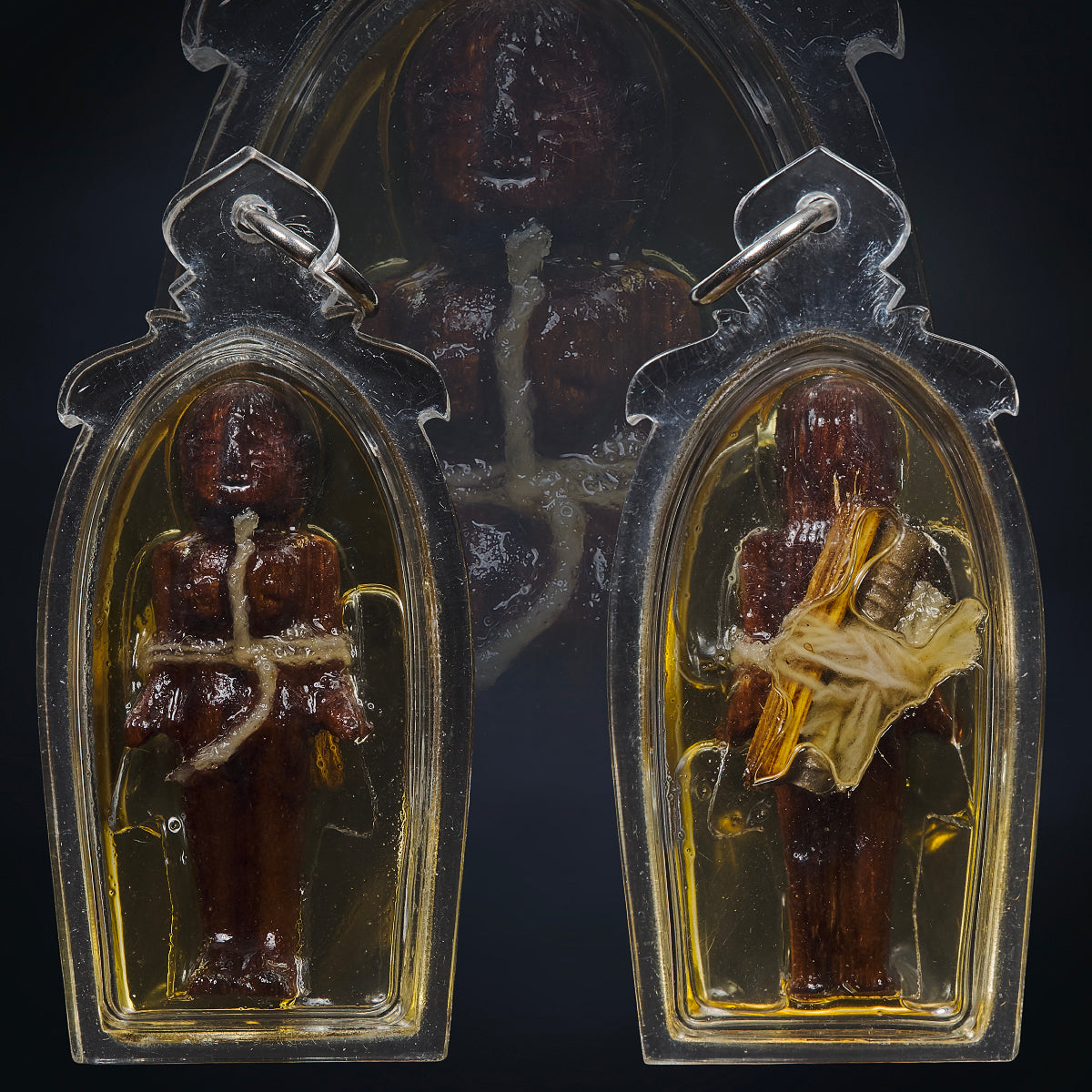
The Mae Hong Prai takes the form of a slender human figure fashioned from dark reddish-brown coffin-lid wood and preserved within a clear protective casing. The figure is surrounded by golden-toned Nam Man Prai, giving the entire interior a characteristic oil-filled appearance. Sacred bindings and additional ritual material remain visible around the body, particularly on the reverse. Natural differences in the wood, bindings and internal components reflect the individually prepared nature of the batch.
Recommended Pairing
Because Mae Hong Prai already carries a concentrated Saneh character, it pairs naturally with a mainstream Buddha-form amulet to provide a more balanced everyday arrangement.
For business use, it may be accompanied by Phra Sivali, Nang Kwak or another dedicated wealth piece. In such a pairing, Mae Hong Prai represents attraction, customer response and interpersonal opportunity, while the second amulet concentrates more directly upon livelihood and prosperity.
Those specifically pursuing attraction generally do not need to combine it with numerous other strong Saneh pieces; the Mae Prai already occupies that specialised role.
Personal Notes
This batch is particularly meaningful to me because of the circumstances through which I received it.
I had last seen Kruba Pon in 2014, during the period when he co-blessed a batch of Ngan with Por Sala Tan. At the time, very few outsiders travelled into that remote part of Thailand, and I was the only non-Thai who had visited Por Sala Tan there.
When I finally returned and met Kruba Pon again in 2022, I did not expect him to remember me after so many years.
He did.
By coincidence, he had also just completed this Mae Prai batch.
I was rushing when I recorded the pieces and initially described them as Guman. It was only afterwards that I properly understood what he had prepared: Mae Prai constructed from coffin-lid material and Nam Man Prai according to his Saneh lineage.
What makes the group even more unusual is its distribution. Kruba Pon did not release a large quantity into general circulation. He gave the batch directly to me, retaining only one piece for himself.
That single piece remained with him for his own forest practice and protection.
I subsequently kept the others with me for years. They were never deliberately withheld as part of a release strategy; I simply never found the time to properly photograph, document and present them.
For that reason, these Mae Hong Prai are more than a limited 2022 batch. They preserve a personal connection stretching from the 2014 Ngan consecration with Por Sala Tan to my reunion with Kruba Pon eight years later, when these pieces passed directly from the master into my care.
-
Free Shipping for Singapore| $15 Worldwide | $60 USA For Items Below $350