
OOBThaiAmulets
Kruba Kritsada - Wat Pa Yang
Kruba Kritsada - Wat Pa Yang
Couldn't load pickup availability
MS07
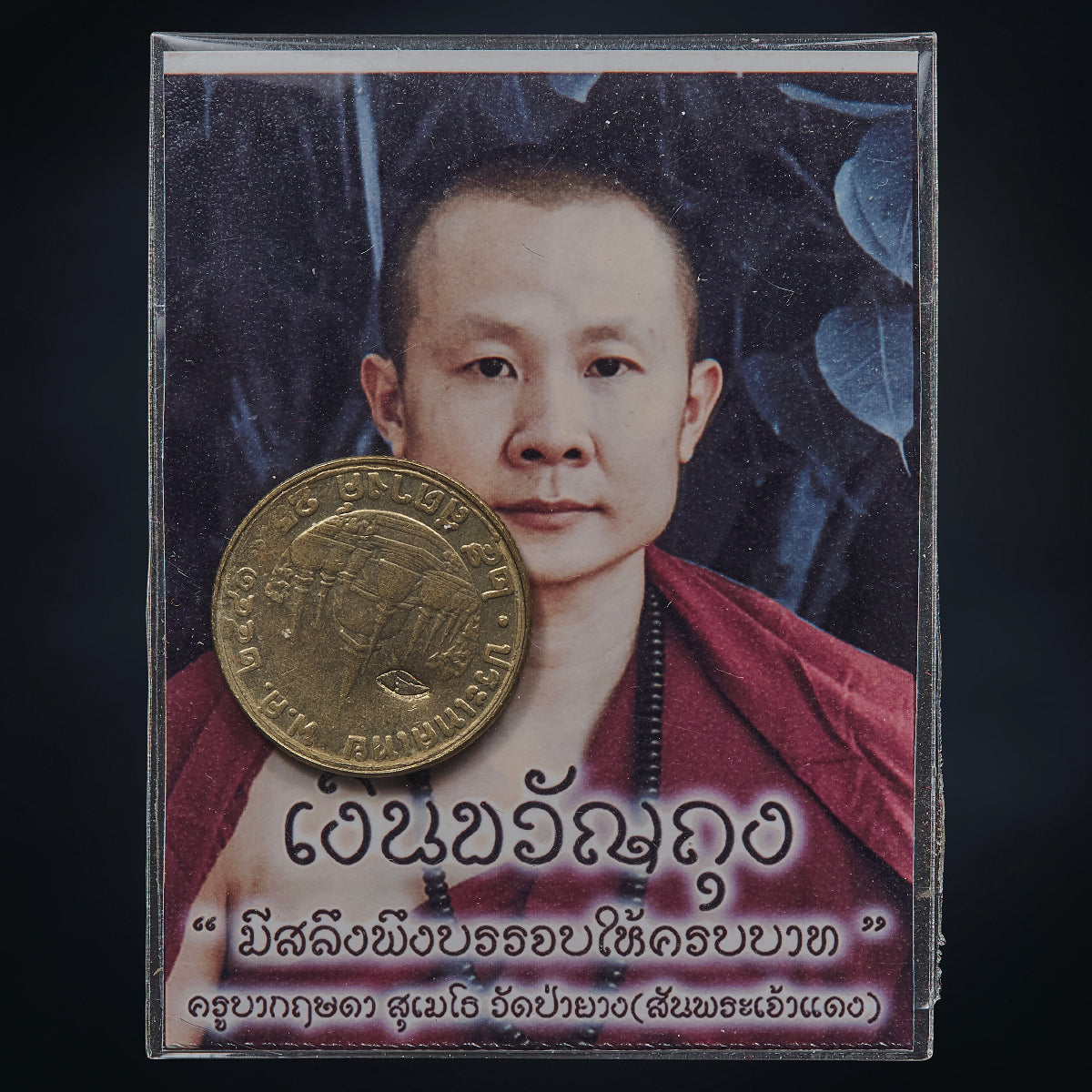
Ngern Khwan Thung
Kruba Kritsada Sumetho
Wat Pa Yang (Wat San Phra Chao Daeng), Lamphun
Mainstream Artifact
Individual Craftsmanship
Rather than creating an entirely new medal, an existing piece of Thai money was selected, blessed and transformed in purpose into Ngern Khwan Thung — literally money kept as an auspicious foundation for one's purse or savings.
The card bears the important phrase:
" If you have a Salung, continue accumulating until it becomes a full Baht "
The physical simplicity of the piece is intentional. Its meaning lies in the blessing placed upon real money and the financial principle represented by the coin itself.
Personal Experiences Shared by Luksits
Ngern Khwan Thung is traditionally kept rather than spent.
For devotees, this creates a different relationship with the sacred object compared with an ordinary wealth amulet. The coin itself represents the beginning of accumulation — money that remains with its owner and becomes the foundation for more money to follow.
Business owners may keep such a piece near their cash, while others place it inside a wallet or where savings are stored.
The image of Kruba Kritsada also carries personal meaning for his devotees. Rather than viewing the card merely as packaging for the coin, some preserve the portrait carefully as an image of their teacher.
The image may therefore be respectfully framed or placed within a suitable casing and carried as an expression of faith, remembrance and respect for Kruba Kritsada.
Summary
Ngern Khwan Thung may be understood as “auspicious purse money” or “lucky pocket money.”
Its traditional purpose is straightforward:
Keep money so that money continues to grow.
The blessed Salung is therefore not intended to be casually spent. It is traditionally retained in a wallet, purse, cash box, safe or other appropriate place connected with one's finances.
This particular example carries an especially fitting symbolism.
A Salung represents only one-quarter of a Baht. By itself it is a small amount, but four Salung become one complete Baht.
The accompanying phrase therefore transforms the sacred object into both a blessing for prosperity and a reminder that lasting wealth is built through accumulation rather than simply waiting for a sudden windfall.
Historical Background
Before Thailand's modern decimal currency became familiar in everyday life, Salung was an important monetary unit representing one-quarter of a Baht.
The saying teaches that even a small amount should be valued and gradually accumulated rather than dismissed as insignificant.
This principle fits naturally with the Thai tradition of Ngern Khwan Thung.
Within this practice, actual currency may be blessed by a respected monk and subsequently retained as auspicious money. Rather than functioning simply as something to purchase goods, the coin becomes a symbolic foundation of wealth.
The principle is therefore both spiritual and practical:
attract prosperity, but also learn to preserve it.
Origins of the Materials
The central sacred object is an authentic Thai circulation coin rather than a newly manufactured amulet medal.
The use of a Salung or 25-Satang coin is particularly appropriate because its denomination directly corresponds with the teaching printed on the accompanying card.
One side bears the portrait of King Rama IX, preserving its identity as genuine Thai currency.
The coin was subsequently selected for the Ngern Khwan Thung purpose and associated with Kruba Kritsada's blessing and temple.
The accompanying portrait identifies:
Kruba Kritsada Sumetho
Wat Pa Yang (Wat San Phra Chao Daeng)
Lamphun
The combination of monk, coin and teaching gives the object its complete meaning.
Ritual
The principle behind Ngern Khwan Thung differs from more elaborate sacred objects containing numerous powders, takruts or relic materials.
Here, money itself becomes the sacred material.
Once selected and blessed, the coin is no longer treated simply as everyday spending money. It is retained as the auspicious foundation of the owner's finances.
Traditionally, the owner keeps it rather than spending it.
This creates an important symbolic action: regardless of how money enters and leaves one's life, there is always something remaining.
The Salung therefore becomes the seed from which greater accumulation is encouraged.
Blessings and Effects
Within traditional belief, Ngern Khwan Thung is associated particularly with:
- Riak Sap — attracting and gathering wealth
- Choke Lap — fortunate opportunities
- Keeping money rather than allowing it to disappear quickly
- Business prosperity and steady cash flow
- Financial stability
- Savings and accumulation
- Support for livelihood
- Protection against financial hardship
Yet the wording on the card adds another important dimension.
It does not simply say, “become wealthy.”
It reminds the bearer to accumulate what they already possess.
The spiritual aspiration for prosperity is therefore balanced by the practical discipline of saving.
Modern Application
The Ngern Khwan Thung remains particularly easy to understand in modern life.
It may traditionally be kept inside a wallet, preferably in a compartment where it will not accidentally be spent.
A business owner may keep it inside a cash drawer, office safe or other place where business money is managed.
It can also accompany one's savings as a symbolic first coin — a reminder that every larger amount begins with something smaller.
For someone building a business, the message is especially relevant.
Good sales are important, but earning money is only one part of prosperity. Keeping, managing and gradually accumulating what has been earned is equally important.
In this way, the old Salung carries a lesson that remains practical today.
Physical Details
A traditional Ngern Khwan Thung set of Kruba Kritsada Sumetho, consisting of an old Thai Salung or 25-Satang circulation coin mounted against a portrait card of Kruba Kritsada of Wat Pa Yang (Wat San Phra Chao Daeng), Lamphun. One face of the coin bears the portrait of King Rama IX, while the opposite face retains the original circulation design together with the associated temple marking or code.
Recommended Pairing
This piece naturally pairs with sacred objects associated with Riak Sap, Choke Lap, Maha Pokasap and business prosperity.
A Metta Maha Niyom piece can also complement it well for someone in sales or business: Metta supports customers and favourable relationships, while Ngern Khwan Thung represents retaining and accumulating the resulting income.
It can equally be kept alone.
Its strength as a symbolic object comes precisely from its simplicity — one blessed piece of money kept permanently as the foundation of greater financial stability.
Personal Notes
What I particularly appreciate about this piece is that its teaching is not based entirely upon asking for sudden wealth.
The Salung itself teaches the lesson.
A quarter of a Baht appears insignificant when viewed alone. Yet continue gathering those small amounts and eventually they become something larger.
The blessing encourages prosperity, while the words encourage discipline.
The portrait of Kruba Kritsada Sumetho should also not be overlooked. For devotees who hold particular respect for Kruba, the image itself may be preserved, framed or placed within a suitable casing and carried respectfully as a remembrance of the teacher.
Together, the portrait and blessed Salung form a very simple but meaningful sacred object:
respect the teacher, value what you already have, keep something aside, and allow small beginnings to accumulate into lasting prosperity.
-
Free Shipping for Singapore| $15 Worldwide | $60 USA For Items Below $350