
OOBThaiAmulets
Ajarn Thong - Wat Sampaocher
Ajarn Thong - Wat Sampaocher
Couldn't load pickup availability
MS04
Rian Toh Hak
Ajarn Thong, Wat Sampaocher
B.E. 2529 (1986)
Samakom card
Sacred Craftsmanship
The first-batch Rian Toh Hak was created from a specially prepared mixed-metal composition under the direction of Ajarn Thong of Wat Sampaocher.
According to the traditional creation record, Ajarn Thong instructed his disciples to place a specially prepared sacred metal plate into the crucible together with the principal metal. The plate incorporated unusual traditional materials including natural unrefined gold, broken knife-tang iron, metal from a broken chedi finial and Lek Nam Phi.
Because these metals possess different characteristics and melting points, the resulting alloy naturally varies in hardness, colour and surface texture. This is one reason genuine mixed-copper examples can display different shades of reddish copper, brown and darker oxidation despite being produced from the same issue.
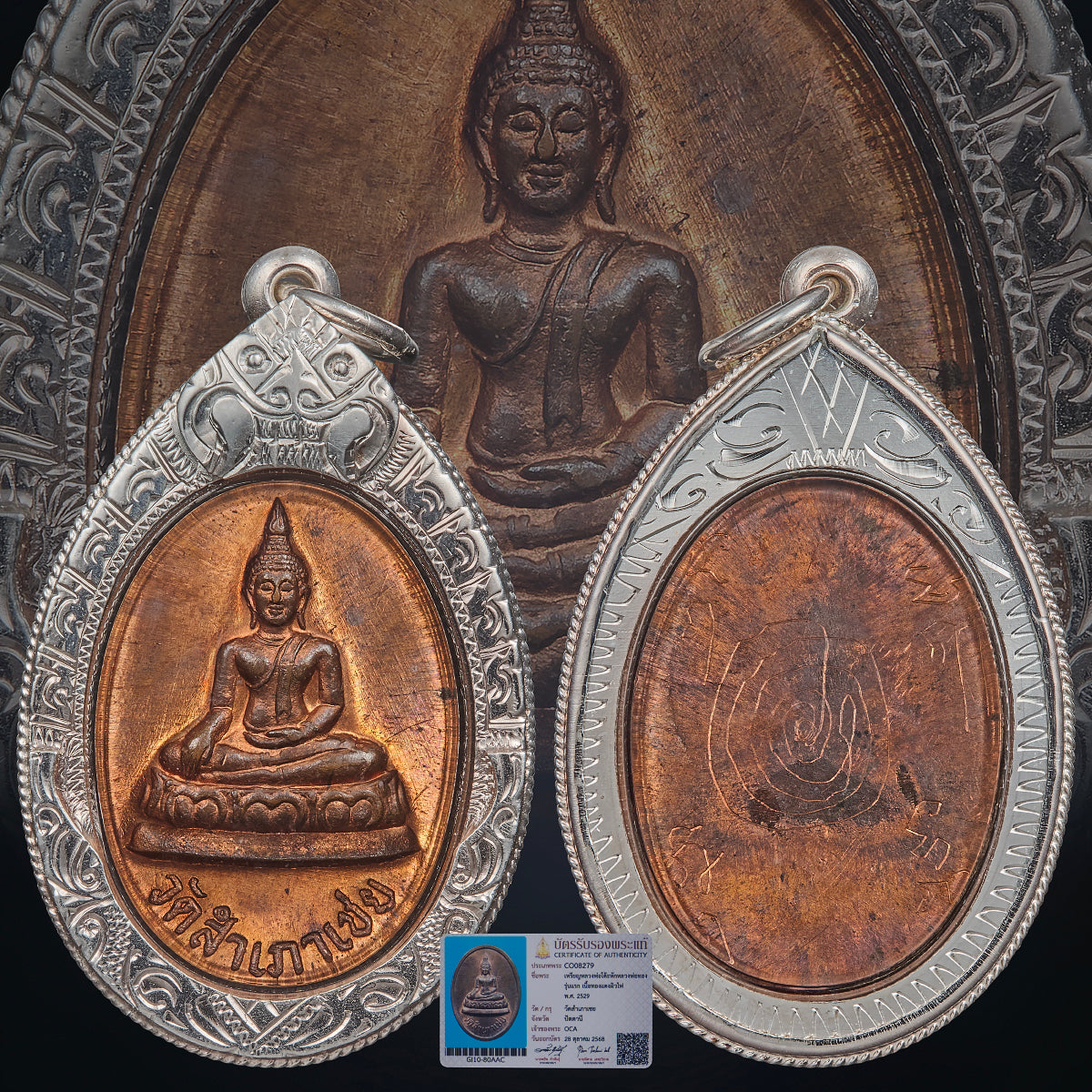
The present example is considerably more distinctive because its originally plain reverse has been individually inscribed with a handwritten yant. Standard first-batch medals were issued with plain reverses and without a stamped yantra; hand-yanted examples of the first batch are documented but are much less commonly encountered.
Each medal was individually struck from the prepared alloy, while a hand-inscribed example carries an additional element of individual ritual workmanship. Natural variations in alloy, striking, ageing and handwritten inscription ensure that no two such pieces are completely identical.
Personal Experiences Shared by Luksits
The Rian Toh Hak gradually developed a particularly strong reputation amongst Ajarn Thong's luksits throughout Pattani and the southern border provinces.
Traditional accounts associate the medal strongly with Metta Maha Niyom, Choke Lap, prosperity, successful commerce and Klaew Khlaad. Devotees have spoken of smoother dealings with customers, improved business opportunities, assistance from others and fortunate circumstances arising during difficult periods.
Protection became another important part of its reputation. Those travelling regularly or working in difficult environments traditionally carried Ajarn Thong's sacred objects for confidence, awareness and protection from unexpected danger.
Ajarn Thong's disciples also preserved unusual accounts concerning his consecration practice. One such account describes a disciple witnessing Ajarn Thong consecrating a Solos takrut. After several minutes, the takrut was said to move; when Ajarn Thong stopped chanting it stopped, and when he resumed it reportedly moved again.
Another account describes five metal Phra Pidta being placed upright before him. During his chanting, they reportedly fell one after another. They were reset and the practice repeated several times.
A later account describes stacks of folded pha yant falling while Ajarn Thong was performing his consecration.
Within the oral history surrounding Ajarn Thong, these incidents were remembered alongside something equally important: after such demonstrations, he would teach his disciples about Dhamma, morality and correct conduct. His practice was therefore remembered as being rooted in meditation and discipline rather than display alone.
Summary
The Rian Toh Hak First Batch, B.E. 2529 (1986) is one of the defining sacred medals associated with Ajarn Thong of Wat Sampaocher, Panare District, Pattani.
The obverse depicts the Buddha seated in Maravijaya posture upon a lotus pedestal, with the temple name beneath. The standard first-batch design is recognised by its plain reverse, unlike the later second batch which introduced a raised yantra to the reverse.
The present piece, however, carries an important additional feature: a handwritten yant has been inscribed directly onto the reverse. This should be distinguished from a moulded or stamped reverse yantra. Documented collector examples of first-batch B.E. 2529 medals with handwritten reverse yants are known, including mixed-copper examples.
The medal therefore combines the recognised first-batch issue with the individual character of a hand-inscribed sacred object.
Historical Background
Wat Sampaocher is situated in Panare District, Pattani Province. Its history dates to approximately B.E. 2444 (1901), when construction of the temple began.
Originally known as Wat Thung Sampao, the temple was subsequently relocated nearby and became known as Wat Sampaocher.
Among the temple's most important later masters was Ajarn Thong, whose monastic name was associated with the ecclesiastical title Phra Kru Phinit Naranyu and who was later elevated as Phra Silamongkhon.
Born on 5 April B.E. 2461 (1918), Ajarn Thong entered monastic life at a young age and received full ordination on 27 June B.E. 2482 (1939) at Wat Don Tawan Ok in Panare.
His reputation amongst disciples centred strongly upon Vipassana meditation and mental cultivation. This meditative foundation was considered essential to his practice of Buddhist incantation and the consecration of sacred objects.
Under his leadership, Wat Sampaocher also developed significantly in religious education, construction and public welfare, establishing Ajarn Thong as both a respected meditation master and an important figure within the surrounding community.
Origins of the Materials
The first Rian Toh Hak is particularly interesting because of the special metals incorporated into its alloy.
Ajarn Thong instructed his disciples to add a prepared sacred metal plate, described as approximately palm-sized and around one centimetre thick, into the melting crucible.
Traditional records identify several components:
- Thong Pen — natural gold in an unrefined state.
- Lek Kan Phra Hak — iron associated with a broken knife tang.
- Yot Chedi Hak — metal from a broken chedi finial.
- Lek Nam Phi — traditionally revered Nam Phi iron.
Recorded production numbers for the first batch include approximately 9 enamelled gold, 109 enamelled silver, 200 Nawa Loha, 7,000 mixed-copper and 300 chin/lead-alloy medals.
Among the mixed-copper production, 200 pieces were stamped with code “529” and reserved for committee members and those who assisted with the project.
The present example belongs to the mixed-copper family, its surface having developed the characteristic reddish-brown tones associated with the ageing alloy.
Ritual
Creation of the first Rian Toh Hak began in B.E. 2529.
According to the temple history, Ajarn Thong first had an astrologically knowledgeable disciple calculate an appropriate auspicious time for commencing the project. Two suitable timings were selected, both described as Bhumipalo auspicious occasions, traditionally favourable for establishing undertakings intended to endure and prosper.
The medals were then subjected to an unusually prolonged period of consecration.
Ajarn Thong continued blessing them from B.E. 2529 until April B.E. 2532, covering three rains-retreat periods, before allowing them to be distributed.
The first distribution took place during Ajarn Thong's sixth-cycle, 72nd-birthday celebration on 22 April B.E. 2532 (1989). The medals were initially given freely to devotees, regardless of whether they made a donation.
For the present example, the handwritten yant on the reverse represents an additional individual ritual feature beyond the standard production format. The standard first-batch reverse was deliberately plain; consequently, handwritten examples occupy a distinctive position amongst surviving medals. Collector records confirm the existence of B.E. 2529 first-batch copper examples specifically described as having a hand-inscribed reverse yant.
Blessings and Effects
The Rian Toh Hak became particularly respected for a broad combination of traditional qualities.
Metta Maha Niyom — goodwill, acceptance, popularity and receiving cooperation from those around the wearer.
Choke Lap — favourable opportunities, fortunate circumstances and unexpected openings.
Kha Khai and livelihood — traditionally associated with commerce, customer relationships, negotiations and maintaining steady income.
Khwam Charoen — gradual advancement in one's occupation, business and personal circumstances.
Klaew Khlaad — avoiding accidents, danger and serious misfortune.
Protection — particularly valued amongst those travelling frequently or working in unpredictable environments.
Baramee — strengthening personal presence, confidence and the respect received from others.
Contemporary historical accounts of the medal likewise record its reputation for Metta Maha Niyom, good fortune, advancement, successful business, smoother work and escaping danger.
Modern Application
For modern wearers, the Rian Toh Hak remains especially appropriate for those whose livelihood depends upon dealing with people.
Business owners, salespeople, professionals and those regularly involved in negotiation may appreciate its traditional association with Metta Maha Niyom, commerce and opportunity.
Those travelling regularly or working in demanding environments may instead emphasise its established Klaew Khlaad and protective qualities.
The hand-yanted reverse gives this particular example additional interest for a collector who values sacred objects showing evidence of individual ritual attention, rather than solely factory or mould production.
Above all, Ajarn Thong's tradition emphasised that sacred objects should accompany ethical behaviour, mindfulness and disciplined personal effort.
Physical Details
This first-batch medal is an oval mixed-copper Rian dated to B.E. 2529 (1986).
The obverse depicts a seated Buddha in Maravijaya posture upon an ornamental lotus pedestal, with the temple inscription positioned beneath the image.
The reverse began as the characteristic plain reverse of the first batch, but this particular example bears a clearly visible handwritten yant, individually scratched or inscribed into the copper surface. This is distinct from the second-batch medals, whose reverse yantra formed part of the produced design.
Mixed-copper first-batch examples are also known for concentric circular formations visible within the reverse metal. Traditional collectors compare these lines to growth rings in timber. Fine radial lines may also appear across the front and reverse surfaces.
The alloy was not originally given a conventional darkened finish, allowing ageing to produce characteristic combinations of reddish copper, warm brown and deeper brown tones. Small blue-toned specks are another surface characteristic recorded on genuine mixed-copper examples.
The present medal has subsequently been protected within an ornate silver casing.
Recommended Pairing
For business, customer relations and livelihood, the Rian Toh Hak pairs naturally with an established Metta Maha Niyom or Choke Lap amulet.
For travel and stronger emphasis upon protection, pairing it with LP Thuat creates a meaningful southern combination centred upon Klaew Khlaad, safe journeys and protection from unexpected danger.
For authority and professional advancement, it may also be paired with an amulet associated with Baramee and Maha Amnaj.
The Rian Toh Hak can equally stand alone. Its traditional reputation already encompasses Metta, livelihood, prosperity, opportunity and protection.
Personal Notes
The handwritten yant on the reverse is the most important individual characteristic of this particular medal.
The established first-batch Rian Toh Hak was produced with a plain reverse. A later second batch is distinguished by its raised reverse yantra. Therefore, a first-batch B.E. 2529 medal bearing a handwritten yant should be understood as a plain-reverse first-batch medal subsequently given an individual sacred inscription, rather than as a separate mould.
This distinction is important historically and for collectors.
Hand-yanted first-batch examples are documented in the collecting market, but they are encountered considerably less often than ordinary plain-reverse examples.
Combined with the medal's special mixed-metal composition, prolonged consecration from B.E. 2529 to 2532, naturally aged copper surface and southern provenance, the handwritten yant gives this example a particularly individual character within the Rian Toh Hak First Batch of Ajarn Thong, Wat Sampaocher.
-
Free Shipping for Singapore| $15 Worldwide | $60 USA For Items Below $350