
OOBThaiAmulets
Ajarn Nen Wisetsingkham - Wat Pa Sak
Ajarn Nen Wisetsingkham - Wat Pa Sak
Couldn't load pickup availability
MS05
Guman Thong – First Batch
Ajarn Nen Wisetsingkham , Wat Pa Sak
B.E.2520 (1977)
Barang Artifact
1 inch
Sacred Craftsmanship
Each amulet was individually pressed from a prepared sacred powder mixture. Differences in colour, surface, inclusions, pressing and ageing are therefore natural characteristics of surviving examples and give each piece its own individual appearance.
Personal Experiences Shared by Luksits
The reputation of Ajarn Nen's early Guman Thong grew largely through word of mouth. Older devotees commonly spoke of keeping the Guman in shops and businesses, particularly for customer attraction, smoother trade and financial opportunity.
Some collectors described periods in which customers seemed to arrive more consistently, negotiations became easier and previously quiet businesses experienced improved activity. Others associated the Guman with unexpected opportunities, small windfalls or assistance arriving at an appropriate moment.
Another recurring theme concerns warning and protection. Owners have traditionally described sudden intuition before an unfavourable situation, unusual dreams, or an unexplained feeling that encouraged them to delay a journey or reconsider a decision.
These experiences contributed greatly to the reputation of the B.E. 2520 issue. As older examples entered long-term collections, many were simply kept rather than circulated, helping explain why good surviving pieces are increasingly difficult to encounter.
Summary
The B.E. 2520 first-batch Guman Thong is regarded by collectors as one of Ajarn Nen Wisetsingkham's defining creations and an important Guman Thong within northern Thai amulet culture.
Ajarn Nen became known while still a young novice for a range of Lanna wicha, including Guman Thong, Wua Thanu, takruts and yantra cloths or shirts. His early Guman works developed a particularly strong following for their combination of Metta, commerce, fortune and protective qualities.
Among collectors, the B.E. 2520 powder issue is sometimes spoken of as one of the benchmark Guman Thong traditions of Northern Thailand, with its regional reputation occasionally compared with that of LP Tae's Guman Thong tradition in Central Thailand.
Historical Background
Ajarn Nen Wisetsingkham also encountered under the rendering Samanen Wiset Singkham — is associated with Wat Pa Sak / Wat San Pa Sak in San Pa Tong District, Chiang Mai.
His reputation developed unusually early. While still a novice, he became known among northern devotees for knowledge extending beyond conventional Buddhist amulet making into older Lanna systems of protective and spirit-related wicha.
His works from approximately the B.E. 2510s–2520s became particularly remembered. Guman Thong was among the most recognised, although his Wua Thanu, takruts and protective yantra works also acquired dedicated followings.
By the following decades, his reputation had travelled beyond northern Thailand. Collectors from elsewhere in Thailand and neighbouring Asian communities sought his pieces, contributing to the increasingly strong collector status of his earlier creations.
Origins of the Materials
Collector traditions surrounding the first batch describe an unusually broad gathering of sacred materials.
Pong Kraduk Phi is frequently cited as one of its defining ingredients. This was combined with prepared herbs and ritual powders according to Ajarn Nen's Guman Thong wicha.
Accounts also describe soils collected from seven cemeteries and seven abandoned temples, together with material from crossroads, river landings, ponds and other locations considered spiritually significant within older Lanna practice.
Such materials were not gathered merely to create an unusual powder mixture. Within the tradition, each represented a different ritual association — spirit presence, movement, crossroads of fortune, accumulated sacred activity or the relationship between the human and unseen worlds.
The completed powder therefore represented a carefully assembled ritual composition rather than a conventional temple-powder recipe.
Ritual
Ajarn Nen's method reflected the mixed character of older northern practice, where Buddhist chanting, yantra knowledge, herbal lore and local spirit traditions could exist within the same body of wicha.
After the materials had been gathered and prepared, they were combined into the sacred powder used to press the Guman figures. Consecration established the Guman principally as a supportive presence rather than simply an image of a child.
Its traditional functions were directed towards Metta, Maha Niyom, fortune, commerce, protection and responsiveness to the keeper's requests.
The reputation established by these early pieces subsequently became an important part of Ajarn Nen's identity as a maker.
Blessings and Effects
The B.E. 2520 Guman Thong is traditionally associated with several closely connected qualities:
- Metta & Maha Niyom — goodwill, friendliness and favourable treatment from others.
- Commerce & Customer Attraction — encouraging customer traffic, repeat business and smoother transactions.
- Maha Lap — opportunities, fortunate circumstances and unexpected gains.
- Wish Fulfilment — traditionally approached for reasonable requests concerning everyday life and livelihood.
- Protection & Klaew Klaad — avoidance of danger and assistance during uncertain situations.
- Sixth Sense & Warning — greater awareness, intuition and sensitivity towards approaching problems.
Its reputation therefore extends beyond wealth alone. Older devotees commonly regarded Guman Thong as a companion capable of assisting with both practical livelihood and household protection.
Modern Application
For contemporary owners, the Guman Thong remains particularly relevant to business, sales and customer-facing professions. Shopkeepers may keep it within the business, while others carry the amulet for meetings, negotiations and daily work.
Its Metta qualities also make it suitable for those whose livelihood depends upon maintaining good relationships with customers, colleagues or business partners.
Collectors who follow the traditional practice generally approach Guman Thong respectfully, making merit and treating the sacred image as a guardian or spiritual companion rather than merely as a tool for obtaining material results.
Physical Details
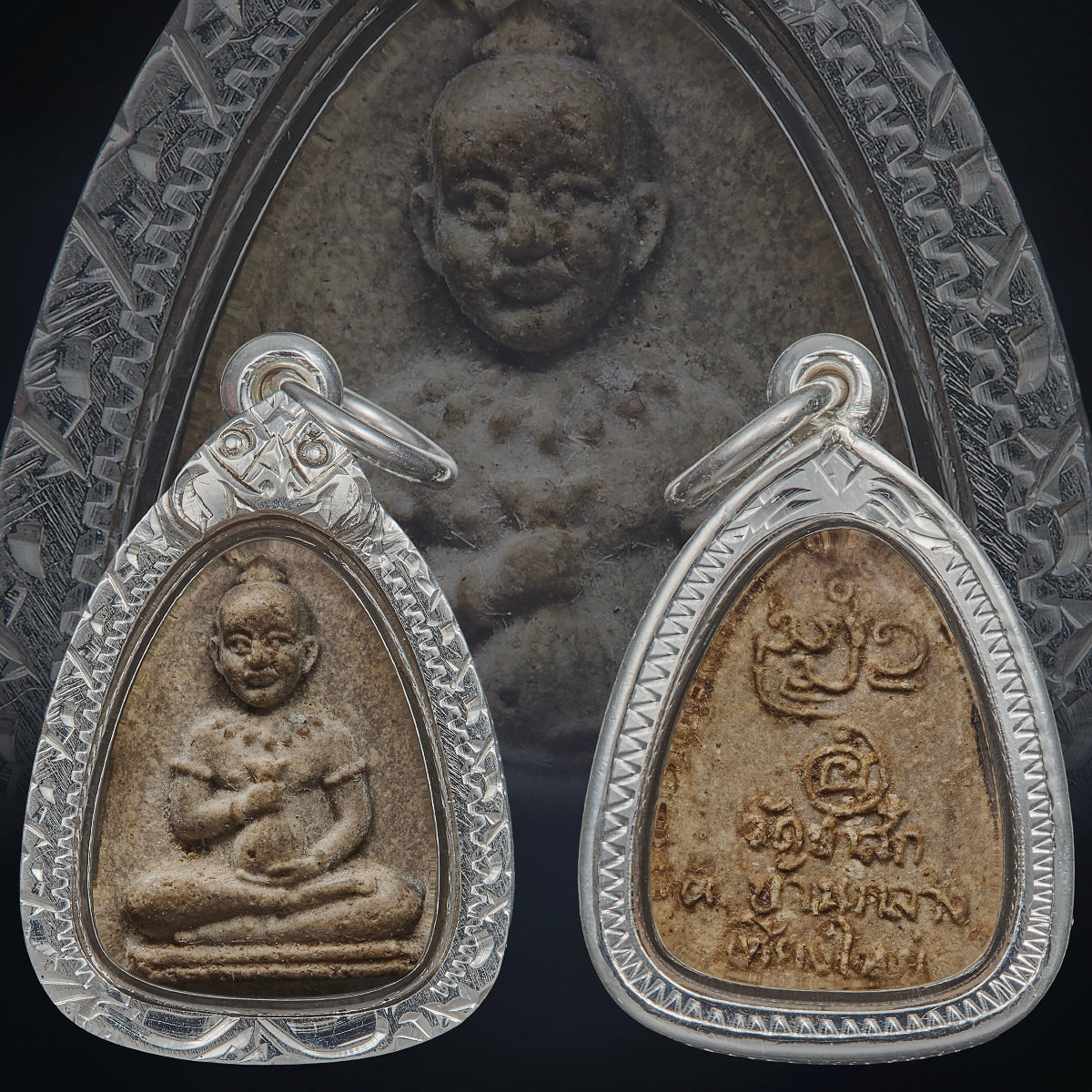
This example is a small powder amulet formed in a pointed, rounded mould. The front presents the Guman Thong seated cross-legged upon a tiered base, with a youthful face, topknot and hands positioned prominently before the torso.
The reverse is comparatively simple, carrying pressed sacred characters together with identifying inscriptions associated with the issue. Age has produced an attractive cream-to-earth-toned surface, with darker deposits visible within the deeper areas of the mould.
The amulet is presently housed in a custom silver casing, engraved around the perimeter while leaving both the front and reverse fully visible. The casing is later protective work and allows the original powder surface to remain largely untouched.
Recommended Pairing
The Guman Thong is sufficiently broad in character to be worn independently. For commerce, it pairs naturally with Nang Kwak or Phra Sivali, reinforcing the themes of customers, livelihood and abundance.
For those seeking a more traditional Buddhist balance, it may also be worn alongside a Somdej or another established Buddha amulet, combining the Guman's active Metta and fortune qualities with a calmer foundation of baramee and protection.
Personal Notes
The B.E. 2520 first batch is particularly interesting because it represents an early period in Ajarn Nen's development, when his reputation was still closely rooted in northern Lanna practice rather than the wider collector recognition that followed.
Over time, this particular Guman Thong became much more than another early powder amulet. Within collecting circles it came to represent one of the recognised forms of old Lanna magical culture, and it is often mentioned among the celebrated protective and auspicious objects traditionally associated with Northern Thailand.
What stands out to me is its combination of a relatively humble appearance with a disproportionately large reputation. The mould is simple, the material visibly traditional, yet stories surrounding these early pieces have continued for decades.
Today, original examples from the first batch are not commonly encountered. Many have remained with long-term owners, while surviving pieces with clear details and good overall condition have become increasingly appreciated by collectors of early Lanna wicha and historically important Guman Thong.
A Lanna Cultural Icon
This Kumarn Thong is officially recognized as part of the “Nine Auspicious Lanna Charms” — a set of iconic Northern Thai spiritual tools known for their power in protection, mercy (metta), charm (saneh), and escape from danger.
The complete “Nine Auspicious Lanna Charms” include:
-
Pha Mao Wat Ban Lao – Sacred headscarf
-
Takrut Hide, Wat Wang Mui – Scroll made from consecrated hide
-
Nine Beads, Wat Ban Den – Charm cluster
-
Kumarn Thong, Wat Pa Sak – Spirit child effigy
-
Luk Om, Wat Pak Kong – Magical bead for repelling spirits
-
Wua Klang, Wat Wang Hong – Supernaturally strong buffalo figure
-
Coconut Shell, Thung Man Tai – Top-ranked mystical coconut charm
-
Mercury Bead, Wat Banphot Sathit – Quicksilver relic
-
Payaong Kam, Wat Mai Hung – Spirit-cooked relic for powerful charm and protection
These nine sacred items were traditionally carried by Lanna locals for invincibility, protection, mercy, charm, and spiritual resilience.
-
Free Shipping for Singapore| $15 Worldwide | $60 USA For Items Below $350