
OOBThaiAmulets
Ajahn Plian Panyapatipo - Wat Aranyawiwek
Ajahn Plian Panyapatipo - Wat Aranyawiwek
Couldn't load pickup availability
MS05
Phathat Withat
Ajahn Plian Panyapatipo, Wat Aranyawiwek
Mainstream Artifact
1 inch
Sacred Craftsmanship
As a naturally occurring sacred material, each Phathat differs in shape, tone, translucency and surface formation. These variations are inherent to the material and make every surviving piece individually distinct.
Personal Experiences Shared by Luksits
Among devotees, sacred relics connected with accomplished meditation masters are often kept somewhat differently from ordinary charm-oriented amulets.
Rather than approaching the Phathat primarily for a single worldly request, practitioners commonly keep such pieces near their meditation area, Buddha altar or upon themselves as a reminder of Sati, concentration and continued cultivation of Baramee.
Collectors of Ajahn Plian's sacred objects have also traditionally associated them with a feeling of calmness and steadiness, particularly during periods when important decisions must be made.
For many keepers, however, the significance of this particular Phathat lies foremost in its provenance: a natural relic discovered by Ajahn Plian himself through circumstances connected directly with his meditation practice.
Summary
This Phathat Withat is a naturally formed sacred relic associated with Ajahn Plian Panyapatipo of Wat Aranyawiwek.
Its story originates from one of Ajahn Plian's meditation journeys to the Mekong River. During his practice there, he repeatedly experienced Nimit — meditative visions or signs — directing his attention towards a particular location near the river basin.
Upon entering deeper concentration, he perceived what he described as a glow or beam of light arising from that precise area.
Following the indication, he searched the location and discovered the Phathat Withat near the basin of the Mekong River.
Ajahn Plian subsequently collected the relic, kept it and personally blessed it.
Historical Background
Ajahn Plian Panyapatipo is closely associated with the Thai forest meditation tradition and Wat Aranyawiwek, where disciplined meditation, seclusion and direct contemplative practice formed an important part of monastic life.
Within forest practice, Nimit refers broadly to an image, sign or perception that may arise during concentrated meditation. Experienced practitioners traditionally treat such experiences carefully rather than automatically regarding every vision as spiritually significant.
The account surrounding this Phathat is therefore notable because the Nimit was said to have occurred repeatedly, directing Ajahn Plian towards a specific location.
While practising near the Mekong, Ajahn Plian eventually followed this recurring indication. During deeper concentration, he perceived a luminous presence associated with the location and subsequently discovered the natural relic there.
The Mekong itself has long occupied an important place in the religious landscape of Northern and Northeastern mainland Southeast Asia. Temples, old settlements and local traditions developed along its banks, and the river became intertwined with Buddhist, Naga and regional sacred geography.
Origins of the Materials
The Phathat was reportedly obtained directly from the Mekong River basin rather than being produced as an amulet material.
Ajahn Plian had travelled to the area for meditation practice. During this period, recurring Nimit repeatedly drew his attention towards one particular location near the river.
After concentrating upon the area, he perceived a glow of light and was led towards the place from which the relic was eventually retrieved.
The material was subsequently identified within the tradition as Phathat Withat.
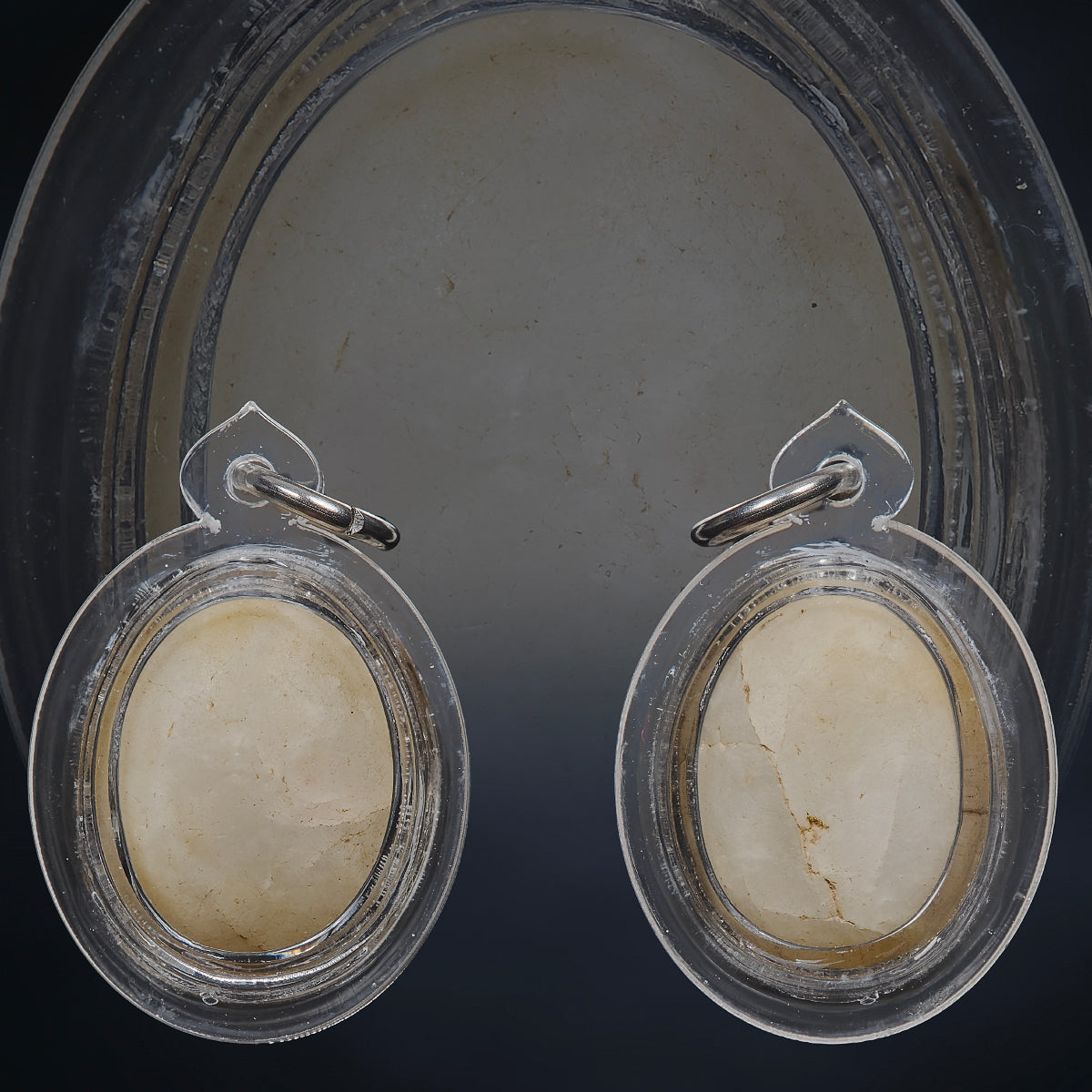
Its pale cream-white appearance is natural. The surviving piece has an irregular oval form with subtle tonal variations, internal-looking formations and fine age lines across its surface.
Most importantly, Ajahn Plian did not simply encounter the material casually. According to its provenance, meditative guidance preceded its discovery.
Ritual
The principal ritual significance occurred first through Ajahn Plian's meditation.
The recurring Nimit, the subsequent concentration upon the indicated location and the perception of light form the spiritual narrative surrounding the discovery.
After retrieving the Phathat, Ajahn Plian kept the relic and personally blessed it.
This makes the object fundamentally different from a mass-produced sacred item. There was no conventional production ceremony requiring a mould, sacred powder mixture or casting process.
The natural relic itself became the sacred object, while Ajahn Plian's blessing established its direct association with his practice and lineage.
Blessings and Effects
Phathat of this nature are traditionally associated primarily with Baramee, auspiciousness, protection and spiritual cultivation.
For meditation practitioners, the relic may serve as a focal reminder of mindfulness and disciplined practice. Its connection with Ajahn Plian also gives it particular significance for devotees who respect the Thai forest tradition.
Traditional keepers may further associate such relics with:
- strengthening Baramee and spiritual confidence;
- supporting meditation and clarity;
- auspiciousness within the household;
- protection and peacefulness;
- encouraging continued merit-making and Dhamma practice.
The emphasis is therefore considerably more contemplative than that of Metta, Saneh or wealth-specific charms.
Modern Application
The Phathat may be worn as a personal sacred object or kept respectfully at a home altar or meditation area.
For someone actively practising meditation, its strongest modern relevance is perhaps as a physical connection to the discipline represented by Ajahn Plian. The story of its discovery itself concerns stillness, repeated observation and sufficient concentration to recognise what appeared during practice.
It is equally suitable for collectors who prefer sacred objects with a direct connection to a respected practitioner rather than elaborate ritual construction.
Its simplicity is part of its character.
There is no elaborate image to interpret and no complex arrangement of embedded materials. The significance rests upon where it came from, how it was found and who subsequently kept and blessed it.
Physical Details
This Phathat Withat survives in its natural, uncarved form. It is broadly oval, with a pale ivory to cream-white colour and a smooth but naturally uneven surface. Subtle variations can be seen beneath the surface, together with fine lines, small inclusions and areas of warmer ageing.
There are no artificial inscriptions, carved yantras or applied decoration on either face. Both sides remain intentionally plain, allowing the original form of the relic to be preserved.
The piece is currently housed within a clear oval protective casing with a suspension ring for carrying or wearing. Viewed closely, the absence of deliberate ornamentation reinforces its identity as a natural sacred relic rather than a manufactured amulet.
Recommended Pairing
The Phathat Withat requires no particular pairing.
For Buddhist devotional use, it may naturally accompany a Buddha image, meditation-master amulet or other mainstream sacred object associated with Baramee and Dhamma practice.
Those who meditate may simply keep it separately near their practice area rather than combining it with numerous other pieces.
Its character is quiet and uncomplicated, and there is little need to add complexity to it.
Personal Notes
What makes this Phathat particularly meaningful is not an elaborate appearance but the story of its discovery.
Ajahn Plian had gone to the Mekong region specifically for meditation practice. During that period, the same indication appeared repeatedly in his Nimit, drawing him towards one precise area near the river basin.
Only after entering deeper concentration did he perceive the unusual glow associated with the location. Following what he had experienced, he eventually found the Phathat there.
He subsequently kept the relic and personally blessed it.
For me, this provenance is the heart of the piece. It remains almost completely plain — simply a naturally formed pale relic protected within a casing — yet its history connects it directly to Ajahn Plian's meditation practice and to the Mekong landscape where it was discovered.
Sometimes the most interesting sacred objects are also the least elaborate.
Nothing needed to be carved onto this Phathat to give it its identity; its origin is already its story.
-
Free Shipping for Singapore| $15 Worldwide | $60 USA For Items Below $350