
OOBThaiAmulets
Ajahn Plian Panyapatipo - Wat Aranyawiwek
Ajahn Plian Panyapatipo - Wat Aranyawiwek
Couldn't load pickup availability
MS07
Roop Tai
Ajahn Plian Panyapatipo · Wat Aranyawiwek · Chiang Mai
Before B.E. 2519
4.5cm
Mainstream Artifact
Individual Craftsmanship
Bio of Ajahn Plian Panyapatipo can be found here:
https://oobamulets.com/blogs/news/ajahn-plian-panyapatipo-wat-aranyawiwek
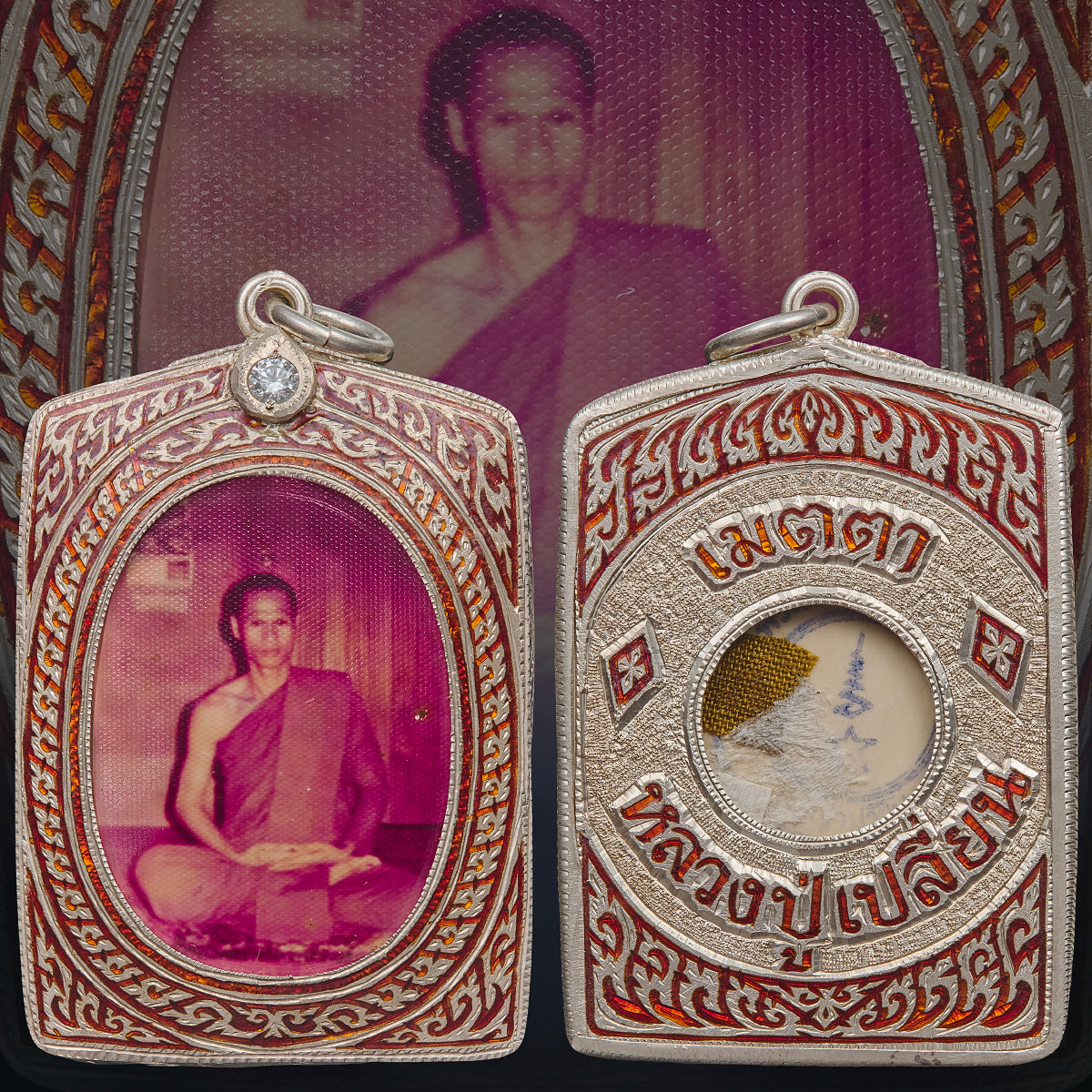
This particular example has subsequently been preserved in a finely worked silver casing with coloured enamel decoration. As these early photographs were individually printed, handled and distributed, differences in colour, texture, stamping and natural ageing are expected from one surviving example to another.
Personal Experiences Shared by Luksits
Early photographs of Ajahn Plian have a character quite different from the formal portraits produced after he became widely known.
This B.E. 2519 photograph captures him as a relatively young forest monk, seated simply in meditation. The original image itself is uncomplicated, reflecting the modest environment of the monastery during that period.
For collectors of Ajahn Plian, the early Samnak Song marking on the reverse is particularly meaningful. It connects the photograph to the formative period of the monastery rather than merely presenting a later reproduction of his image.
This particular photograph is also documented among the early images appearing in biographical material concerning Ajahn Plian, adding another layer of historical interest to an already uncommon early Roop Tai.
Summary
The B.E. 2519 Roop Tai of Ajahn Plian Panyapatipo is an early photographic devotional artifact from Wat Aranyawiwek's formative years.
Printed on traditional Kradas Nang Kai, the front depicts Ajahn Plian seated cross-legged in meditation. The reverse carries an early monastery stamp associated with Samnak Song Ban Pong Aranyawiwek.
The example shown remains in particularly attractive condition and has been protected within an elaborate silver casing decorated with red and amber enamel.
Its importance lies not in elaborate sacred materials, but in something simpler: it preserves the image of an important Thai Forest Tradition monk at an early stage of his teaching life.
Historical Background
Ajahn Plian Panyapatipo was born on 16 November 1933 in Ban Khok Kon, Sakon Nakhon.
His interest in monastic practice began while he was still young. Before ordination, he encountered forest monks and learned walking meditation from LP Phrom Jirapunyo, a disciple within the tradition associated with LP Mun Bhuridatta.
Ajahn Plian was ordained on 31 March 1959 at Wat That Michai and received the monastic name Panyapatipo. He subsequently devoted himself to the Dhammayuttika forest tradition, travelling and seeking instruction from accomplished meditation masters.
Among the important teachers associated with his development were LP Phrom Jirapunyo, LP Thet Thetsarangsi and LP Waen Sujino.
The Early Years of Wat Aranyawiwek
Ajahn Plian became abbot of Wat Aranyawiwek, Mae Taeng, Chiang Mai, in 1966.
The monastery of that period was considerably more modest than the institution later generations would know. Early material consequently sometimes carries references to Samnak Song Ban Pong Aranyawiwek, reflecting its earlier status and identity.
The B.E. 2519 photograph belongs to this important period.
Ajahn Plian would remain closely associated with Wat Aranyawiwek for the rest of his life, becoming widely respected for meditation practice, strict observance of monastic discipline and clear teachings centred upon the path towards liberation.
Origins of the Materials
The principal material is the Kradas Nang Kai photographic print.
This type of textured photographic paper is immediately recognisable by its fine raised surface. Rather than the smooth finish of modern photographic prints, it gives the image a distinctive patterned appearance when viewed closely.
Such photographs were practical devotional objects. They allowed disciples to keep an image of their teacher at home, on an altar or personally with them.
On this example, the reverse preserves part of the original paper surface together with the Samnak Song marking, while the photograph has later been protected inside its silver casing.
Unlike a conventional pressed powder or cast metal amulet, the importance of a Roop Tai lies primarily in the image, period, provenance and association with the monk represented.
Ritual
Within Thai Buddhist practice, portraits of respected teachers can serve as objects of Acariyanussati — recollection of one's teacher.
Ajahn Plian's own practice belonged firmly to the Kammatthana, or meditation, tradition. His teaching emphasised mindfulness, samadhi, observance of the precepts and investigation of the nature of mind and body.
The photograph therefore carries a different character from an artifact centred upon elaborate occult construction.
Its purpose is closely connected with remembrance: seeing the teacher and recalling the discipline and Dhamma for which he stood.
Blessings and Effects
For disciples, carrying the image of a respected forest master is traditionally associated with remembrance of the teacher, confidence in Dhamma and encouragement towards mindful conduct.
Ajahn Plian was particularly associated with disciplined meditation and steadiness of mind. His Roop Tai can therefore be understood as a reminder of:
- mindfulness and composure
- steadiness during uncertainty
- discipline and right conduct
- faith in the Triple Gem
- recollection of one's teacher and practice
Rather than being centred upon promises of immediate worldly results, its significance is grounded in the relationship between teacher, disciple and Dhamma.
Modern Application
The photograph may be worn as a personal devotional artifact or preserved as part of a collection devoted to Ajahn Plian and the Thai Forest Tradition.
Its B.E. 2519 dating makes it especially interesting beside later photographs and amulets, where it helps illustrate how devotional objects associated with Ajahn Plian developed as his reputation expanded.
The substantial silver-and-enamel casing also allows the fragile early photograph to be worn while keeping the original paper protected.
Physical Details
The artifact contains an early B.E. 2519 Kradas Nang Kai photographic portrait of Ajahn Plian seated in meditation. Its characteristic magenta colouring and textured paper surface remain clearly visible. The reverse carries the early Samnak Song marking associated with the monastery's formative period. This example is housed in a substantial hand-worked silver casing decorated with red and amber enamel, with a circular viewing window at the reverse retaining visibility of the original backing and stamp.
Recommended Pairing
An appropriate pairing would be an early Buddha image or an artifact connected with the LP Mun Kammatthana lineage.
Pieces associated with LP Mun, LP Phrom, LP Thet or LP Waen are particularly relevant because they place Ajahn Plian within the broader forest tradition in which he trained and practised.
The Roop Tai itself, however, is already complete as a personal remembrance of the teacher and does not require another artifact to give it meaning.
Personal Notes
Ajahn Plian passed away peacefully on 15 February 2018, aged 84, after 59 rains retreats. His royal cremation ceremony was held at Wat Aranyawiwek on 16 February 2019.
Among the many later photographs and sacred objects connected with him, early Roop Tai such as this preserve something that cannot easily be recreated: Ajahn Plian as he appeared during the formative years of Wat Aranyawiwek.
The B.E. 2519 date, Kradas Nang Kai photographic paper and early Samnak Song marking place the piece firmly within that period.
The elaborate silver enamel casing came later, but at its centre remains a remarkably simple object — an early photograph of a forest monk seated quietly in meditation, long before his name became familiar to disciples throughout Thailand.
-
SG: Free | Worldwide except USA: $20 Registered | USA: $25 Registered / $100 Courier (SGD)