

OOBThaiAmulets
AJ Pleng Boonyuen
AJ Pleng Boonyuen
Couldn't load pickup availability
MS06
Phra Rahu - Roon Uthai Pleng Ratsami
AJ Pleng Boonyuen
B.E. 2543
3cm
Barang Artifact
Individual Craftsmanship
Each powder artifact naturally shows differences in surface, texture and pressing. These variations are characteristic of individually prepared sacred-material pieces and give each example its own character.
Personal Experiences Shared by Luksits
Rahu is often chosen during periods when life feels blocked, uncertain or repeatedly disrupted.
Rather than being viewed only as protection against misfortune, luksits frequently approach Rahu when they need circumstances to change direction — a stalled business beginning to move, a difficult negotiation finding an opening, or an unexpected opportunity appearing during an uncertain period.
For those in business, Rahu is also traditionally associated with strategic awareness and recognising changes before others do. This can be particularly meaningful when dealing with competition, negotiations or circumstances that cannot be completely controlled.
The presence of Saneh-oriented Wahn and Prai materials gives this particular batch another dimension, connecting its Rahu foundation with attraction, interpersonal influence and favourable reception.
Its character is therefore not simply defensive. It combines Rahu's transformation symbolism with metta, Saneh and opportunity-oriented wiccha.
Summary
Phra Rahu Roon Uthai Pleng Ratsami, B.E. 2543, is a distinctive Rahu preparation whose material history is closely connected with Ajarn Pleng Boonyuen, a lay occult practitioner from Tha Tum district in Surin.
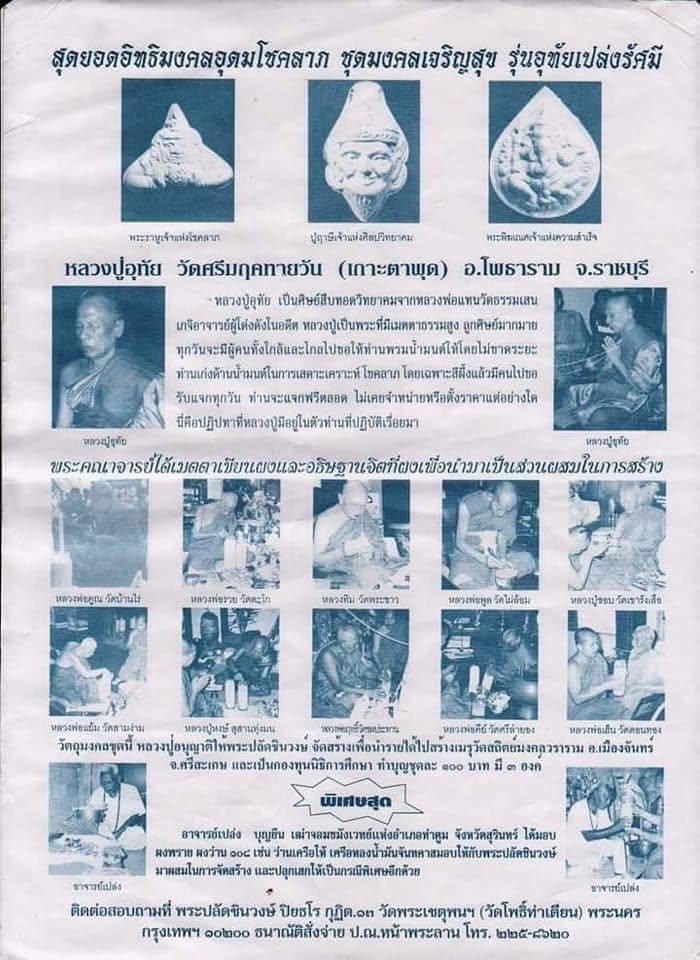
Ajarn Pleng contributed Prai powder, 108 Wahn and eclipse-associated oil for the creation of the batch. These materials were given to Phra Palat Chinawong for inclusion in the sacred mixture.
The batch is also recorded as having received blessings from several recognised masters of the period, with Ajarn Pleng performing a special consecration specifically for this edition.
Its name, Uthai Pleng Ratsami, carries the auspicious imagery of light beginning to emerge and radiate after darkness — an appropriate expression of Rahu's traditional association with change, reversal and emerging from difficult circumstances.
Historical Background
Phra Rahu originates from the wider Indian tradition of Rahu, the celestial being associated with eclipses.
In the familiar mythology, Rahu secretly consumes the nectar of immortality. After being discovered by the Sun and Moon, Vishnu severs his body, but Rahu survives because he has already tasted the nectar.
Rahu thereafter pursues and temporarily swallows the Sun or Moon, providing the mythological explanation for eclipses.
Within Thai sacred traditions, this imagery developed into something particularly meaningful. Rahu represents periods when light becomes temporarily obscured — uncertainty, disruption, sudden change and circumstances that appear beyond one's control.
Yet an eclipse always passes.
For this reason, Rahu gradually became associated not only with difficult periods but with surviving them and turning changing circumstances towards a more favourable direction.
Origins of the Materials
An important feature of Roon Uthai Pleng Ratsami is the material contribution from Ajarn Pleng Boonyuen, remembered within the lineage as an experienced lay practitioner from Tha Tum, Surin.
The mixture reportedly included Prai powder and 108 types of Wahn.
Several herbs are specifically named in the traditional account, including Wahn Khruea Hai, Khruea Khao Long, Wahn Rak Son and Wahn Wua Luem Khok.
These belong to the wider tradition of herbal wiccha in which different Wahn are selected according to their ritual associations, particularly attraction, metta, influence and the drawing of favourable circumstances.
Also incorporated was Nam Man Chanthakhrat, an eclipse-associated ritual oil particularly appropriate to Rahu.
Ajarn Pleng entrusted these materials to Phra Palat Chinawong, who incorporated them into the mixture used for the batch.
Ritual
The significance of this edition lies not only in its ingredients but also in the combination of monastic blessing and lay wiccha associated with its preparation.
According to the information preserved with the batch, masters participating in its consecration included LP Uthai, LP Koon of Wat Ban Rai, LP Ruay of Wat Tako, LP Tim of Wat Phra Khao, LP Pool of Wat Phai Lom, LP Chob of Wat Khao Wang Suea, LP Yaem of Wat Sam Ngam, LP Hong of Thung Mon Cemetery, LP Rit of Wat Chonlaprathan, LP Key of Wat Si Lam Yong and LP Hen of Wat Don Thong.
Ajarn Pleng Boonyuen also participated as the principal lay wiccha practitioner associated with the materials and performed a special consecration for Roon Uthai Pleng Ratsami.
This combination gives the batch an interesting character: Rahu symbolism supported by herbal, Prai and eclipse-related materials, followed by a broad consecration involving different masters.
Blessings and Effects
The traditional purpose centres upon Rahu's ability to transform difficult circumstances.
Rahu is commonly approached for Sado Kroh, or the easing and turning away of misfortune, particularly during periods marked by repeated obstacles, uncertainty or major change.
Protection forms another important aspect — traditionally extending towards hostile intentions, troublesome people and circumstances that develop unexpectedly.
The 108 Wahn and Prai powder introduce a complementary emphasis upon metta and Saneh, supporting personal attraction, favourable reception and influence in dealings with others.
For livelihood, the combination is traditionally associated with Choke Lap and changing fortune — finding opportunity where circumstances previously appeared blocked.
The character of the batch can therefore be summarised as turning obstacles, protection, attraction, opportunity and renewed momentum.
Modern Application
Roon Uthai Pleng Ratsami is particularly relevant during periods of transition.
It may be carried when changing employment, beginning a new business, rebuilding after financial difficulty or entering an environment where competition and uncertainty are unavoidable.
Business owners may appreciate the combination of Rahu and Saneh-oriented materials: Rahu for navigating change and obstacles, with the herbal wiccha supporting relationships, negotiations and favourable reception.
It also suits those beginning again after a difficult period. This reflects the meaning behind Uthai Pleng Ratsamiparticularly well — darkness is temporary, and opportunity begins when light becomes visible again.
Physical Details
This is a triangular Phra Rahu powder artifact from Roon Uthai Pleng Ratsami, B.E. 2543. The front depicts Rahu in a powerful frontal form, while the reverse carries sacred inscriptions and identifying details associated with the batch.
Its sacred-material mixture is recorded as containing Prai powder, 108 varieties of Wahn and eclipse-associated oil contributed by Ajarn Pleng Boonyuen. The naturally textured powder surface and variations in pressing are characteristic of this type of individually produced artifact.
The key traditional emphasis is turning misfortune, protection, Saneh, metta, opportunity and changing fortune.
Recommended Pairing
This Phra Rahu can be worn independently, particularly when the principal intention concerns overcoming obstacles, navigating change or reversing an unfavourable period.
For business use, it pairs naturally with a wealth or baramee artifact. Rahu traditionally helps negotiate changing circumstances and remove obstacles, while the accompanying piece provides a complementary emphasis upon prosperity, stability or authority.
It may also be paired with a Buddha or monk amulet for those who prefer a more balanced everyday arrangement centred upon baramee, protection and steady progress.
Personal Notes
What makes Roon Uthai Pleng Ratsami particularly interesting is the involvement of Ajarn Pleng Boonyuen.
His contribution was not limited to attending the blessing. He supplied the distinctive Prai powders, 108 Wahn and eclipse-associated oil that became part of the physical substance of the batch, before undertaking a special consecration for the edition.
This creates a direct connection between the materials, the wiccha practitioner who prepared them and the Rahu symbolism for which they were selected.
For collectors interested in older Barang-influenced Rahu pieces, that material and ritual connection is an important part of the character of this B.E. 2543 batch.

-
Free Shipping for Singapore| $15 Worldwide | $60 USA For Items Below $350