
OOBThaiAmulets
AJ Kump - Wat Chai Pheri
AJ Kump - Wat Chai Pheri
Couldn't load pickup availability
MS05
Flying Rahu
AJ Kump · Wat Chai Pheri · Suphanburi
B.E. 2562 · Nawat
Mainstream Artifact
1 Inch
Sacred Craftsmanship
Each Flying Rahu was individually produced in Nawat, a traditional sacred mixed-metal composition valued in Thai amulet making for its distinctive depth of colour and character. Natural variations in casting, surface tone, patina and finishing give every artifact its own individual appearance.
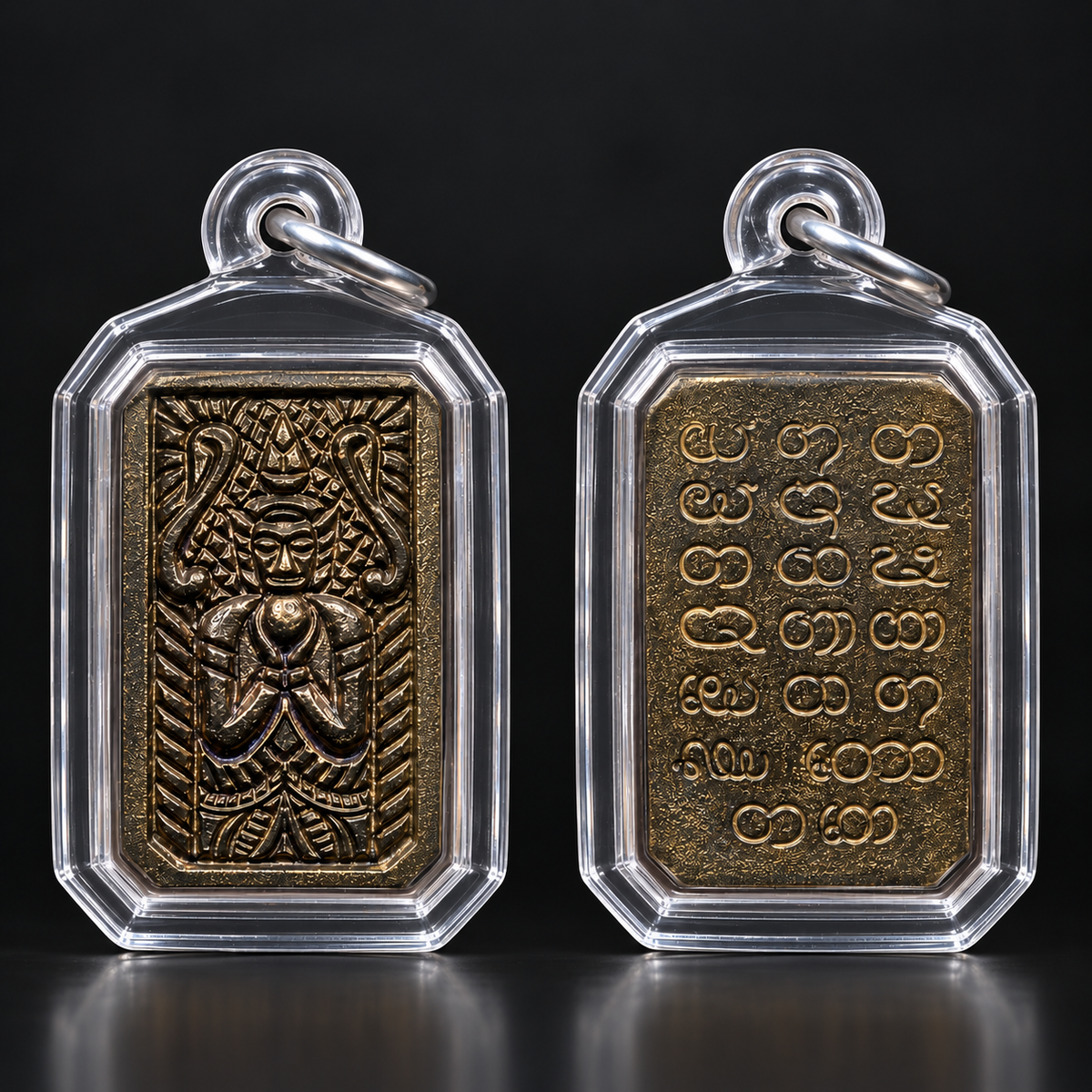
This example is sealed within a clear waterproof acrylic casing, protecting the original Nawat surface while allowing both the front and reverse to remain fully visible.
Personal Experiences Shared by Luksits
I was particularly excited when Arjan Kump released this batch because genuinely accessible Rahu amulets from a respected lineage are not always easy to find.
Older Rahu pieces associated with famous masters such as LP Pin, LP Noi and Kruba Nanta have become increasingly expensive, while finding examples with provenance that one can personally be comfortable with can also be difficult.
For this reason, I travelled directly to obtain the B.E. 2562 batch from Arjan Kump himself.
I collected well over 100 pieces directly from him.
What happened during the collection remains one of the more memorable experiences I have personally witnessed with amulets.
While the Rahu pieces were together on the tray, several began jumping and moving almost like popcorn, without Arjan Kump physically touching them. I had previously witnessed a similar occurrence with LP Lum in Bangkok, so seeing it happen again left a strong impression on me.
Word of the incident quickly generated considerable interest. Many people wanted Arjan Kump's Rahu, and the original release subsequently sold out.
Over approximately five years of distributing this batch, another pattern became apparent. A number of customers who initially obtained one later returned to purchase additional examples for their partners, family members or loved ones.
Some spoke of difficult situations gradually settling down, troublesome people distancing themselves, workplace politics becoming less disruptive and periods of persistent bad luck beginning to stabilise.
After distributing most of the original quantity, only a small number remained aside from pieces retained for my own collection.
An important part of the appeal for me has always been the provenance: these pieces were obtained directly from Arjan Kump rather than subsequently sourced through the dealer market.
Summary
The Flying Rahu B.E. 2562 is a Nawat Rahu amulet created by Arjan Kump of Wat Chai Pheri, Suphanburi.
The front presents Rahu in a distinctive standing form surrounded by sacred ornamentation, while the reverse carries rows of sacred characters. The darker mixed-metal character of Nawat gives the relief considerable visual depth, particularly as the raised details develop contrast against the recessed surfaces.
The series became especially memorable because of the unusual movement I personally witnessed while collecting more than 100 pieces directly from Arjan Kump. Together with subsequent experiences shared by wearers, the batch quickly developed a following and eventually sold out from its original release.
Its traditional emphasis centres upon reversing unfavourable circumstances, protection from hidden opposition, clearing persistent obstacles and restoring stability during difficult periods.
This particular example is now preserved within a clear waterproof acrylic casing, providing practical protection for everyday wear without concealing the original Nawat artifact.
Historical Background
Phra Rahu represents the celestial force associated with eclipses in the traditional cosmology shared across Thailand and neighbouring Buddhist cultures.
Although Rahu is often associated with darkness, disruption and sudden changes of fortune, Thai spiritual traditions also approach him from another perspective: the force capable of consuming adversity itself.
For this reason, Rahu amulets became particularly associated with periods when circumstances appear to turn against a person — unexpected obstacles, hostile competition, gossip, betrayal, financial instability or repeated setbacks.
The underlying symbolism is transformation.
Just as an eclipse eventually passes and light returns, Rahu represents the ability to endure an unfavourable cycle and emerge from it with circumstances changed.
This made Rahu particularly popular among businesspeople and those regularly exposed to competitive or politically complicated environments.
Origins of the Materials
This B.E. 2562 example was produced in Nawat, a traditional mixed-metal composition used in Thai sacred-object and amulet making.
Rather than presenting the bright appearance of pure silver, Nawat typically develops a deeper metallic character, with shades ranging through bronze, brown and darker tones according to the particular alloy, casting and subsequent ageing of the surface.
This darker character complements the Rahu imagery particularly well. Light catches the raised facial features, body, surrounding ornamentation and sacred characters while the recessed areas remain comparatively dark, increasing the visual depth of the small design.
The original Nawat surface has been left visible beneath a transparent waterproof acrylic casing, allowing its natural metallic character and patina to remain an important part of the artifact's appearance.
Ritual
The Flying Rahu was consecrated under Arjan Kump's lineage and practice at Wat Chai Pheri.
Its ritual purpose follows the traditional Rahu principle of confronting unfavourable influences and changing their direction, particularly circumstances involving hidden opposition, recurring obstacles and periods in which one's fortune appears unstable.
My own encounter with the batch occurred when I collected the amulets directly from Arjan Kump. During that occasion, several pieces appeared to jump or move on the tray without being physically handled.
Whether understood spiritually or simply preserved as a personal observation, the incident became closely associated with the story of this particular release and was the reason I began referring to the series as “Flying Rahu.”
Blessings and Effects
The traditional purpose of this Rahu centres upon protection, reversal of adversity and restoration of stability.
Wearers have particularly sought the piece when experiencing persistent workplace politics, backstabbing, troublesome competitors or situations where difficulties appear repeatedly without an obvious reason.
It is also traditionally carried for clearing periods of bad luck, reducing obstacles, strengthening one's position and helping circumstances return to a more stable direction.
For businesspeople, Rahu's protective aspect may be particularly relevant where competition and interpersonal politics cannot easily be avoided.
The emphasis is not simply upon wealth. It is first concerned with removing or overcoming the conditions that prevent progress, allowing stability and opportunity to return.
Modern Application
The Flying Rahu is particularly suitable for those passing through a difficult or uncertain period, whether involving career, business, colleagues, competition or general instability.
Its compact dimensions make it practical for everyday wear, while the waterproof acrylic casing protects the Nawat surface from direct handling, moisture and normal daily exposure.
For someone entering a new workplace, dealing with complicated business relationships or experiencing repeated obstacles, Rahu traditionally represents the determination to pass through the difficult cycle rather than remain trapped within it.
This is one reason the B.E. 2562 batch developed repeat demand, with some owners later returning for additional pieces for people close to them.
Physical Details
The Flying Rahu was created by Arjan Kump of Wat Chai Pheri, Suphanburi, in B.E. 2562 (2019).
The amulet measures approximately 1 inch and is produced in Nawat mixed metal. The front depicts the distinctive standing Rahu figure surrounded by detailed sacred ornamentation, while the reverse carries multiple rows of raised sacred characters.
The naturally darker Nawat surface gives the piece a warm bronze-toned appearance, with highlights forming across the raised details and deeper patination visible within the recessed areas.
This example is sealed within a clear waterproof acrylic casing. Unlike a decorative metal casing, the transparent enclosure leaves the original Nawat artifact clearly visible from both sides while providing practical protection for everyday wear.
Key points: B.E. 2562 issue · approximately 1 inch · Nawat mixed-metal construction · standing Rahu image · sacred inscriptions on reverse · clear waterproof acrylic casing · direct provenance from Arjan Kump.
Recommended Pairing
The Flying Rahu can comfortably be worn on its own for protection and reversal of difficult circumstances.
For business use, it pairs naturally with a Metta or wealth-oriented artifact. Rahu addresses obstacles and opposition, while the accompanying artifact may concentrate more strongly upon customers, opportunities and financial movement.
It may also be paired with Tao Wessuwan when a stronger protective arrangement is desired, particularly for those who travel frequently or work in demanding and competitive environments.
Personal Notes
What makes this batch memorable to me is the combination of direct provenance, accessibility and the experience surrounding its original collection.
I took well over 100 pieces directly from Arjan Kump. Seeing several of the amulets unexpectedly jumping and moving on the tray was something I remembered immediately because I had encountered a similar phenomenon previously with LP Lum.
The incident created considerable interest at the time, but the longer-term response became equally meaningful. Over the following years, I saw customers return for additional pieces after wearing their first — often not for themselves, but for partners, family members and loved ones.
Today, only a small number remain from what I originally collected, with several pieces kept aside for my own collection.
The Nawat version has a particularly traditional appearance, its darker mixed-metal surface bringing out the depth of the standing Rahu design. The clear waterproof acrylic casing also allows this character to remain visible while providing practical protection for the artifact.
For those seeking a Rahu with a clear origin, this batch has always held one particularly important advantage for me:
it came directly from Arjan Kump — from the original source rather than through the secondary dealer market.
-
Free Shipping for Singapore| $15 Worldwide | $60 USA For Items Below $350