
OOBThaiAmulets
AJ Bed
AJ Bed
Couldn't load pickup availability
MS05
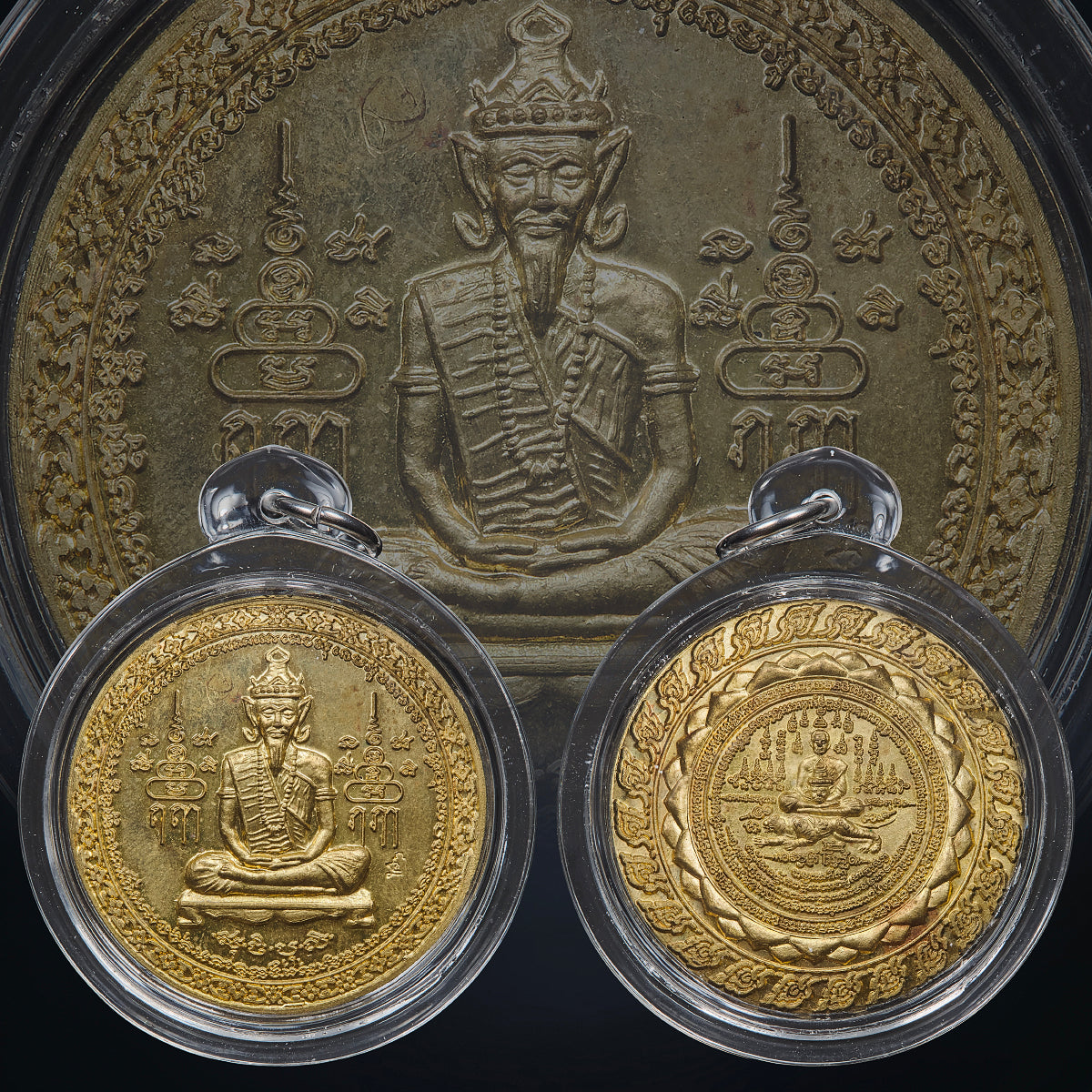
Rian Roon 3 Lang Lersi
Ajarn Bed
Mainstream Artifact
Sacred Craftsmanship
Each medal was individually produced from the prepared sacred metal, and natural differences in tone, patina, surface and finishing make every surviving example slightly unique.
Personal Experiences Shared by Luksits
Ajarn Bed's reputation among his luksits was built not only upon his amulets, but also upon unusual events they claimed to have witnessed around their young teacher.
One of the best-known accounts concerns a Wai Kru ceremony when approaching rain threatened the proceedings. Ajarn Bed was said to have performed his wicha and held back or stopped the rainfall around the ceremonial area in front of numerous witnesses.
Another account describes him controlling or herding buffalo through concentrated mental command rather than ordinary physical handling.
Ajarn Bed was also remembered as a highly capable Prai practitioner. He was said to understand methods for communicating with and pacifying troubled earthbound spirits, particularly Phi Tai Hong, spirits traditionally associated with sudden, violent or traumatic death.
Rather than simply provoking such entities, his students described his practice as one of bringing difficult spiritual forces under control through incantation, discipline and Buddhist moral principles.
These accounts belong to the oral tradition surrounding Ajarn Bed and are presented as experiences and beliefs preserved among his luksits rather than independently verified historical events.
Summary
The Rian Roon 3 Lang Lersi is especially significant within Ajarn Bed's amulet lineage because Roon 3 is remembered as the final medal series designed and blessed by him before his untimely passing at only 22 years of age.
The principal imagery combines Ajarn Bed's own tiger-associated lineage with Boromakru Phu Lersi, the Great Hermit Teacher.
The Lersi is not treated merely as decorative imagery. Within Thai occult traditions, Lersi represents the lineage of teachers — Kru — and embodies accumulated knowledge, meditation, discipline, wicha and the transmission of sacred teachings from master to student.
For this reason, the Lang Lersi version is particularly connected with Kru Baramee: the protective and guiding authority of the teacher.
Historical Background
Ajarn Bed became known among followers as Ajarn Bed Khee Suea — “Ajarn Bed Riding the Tiger.” Despite his exceptionally young age, he developed a strong reputation within the Fang region of Chiang Mai for Lanna occult knowledge.
Tiger symbolism occupied an important position within his identity. In traditional wicha, the tiger represents courage, command, survival and formidable power. The practitioner capable of riding the tiger symbolically demonstrates something greater: the ability to govern power rather than become governed by it.
His knowledge was also said to extend into Prai practices and the pacification of difficult spiritual forces.
Because Ajarn Bed died at such a young age, the Roon 3 occupies a poignant position within his lineage. What was originally another sacred medal project subsequently became remembered by followers as his last series.
Origins of the Materials
A defining feature of this edition is the use of Thong Fah Baht.
The material is traditionally described as brass originating from monks' alms-bowl lids. Within Thai sacred-object culture, old monastic metals are valued because of their previous association with the Sangha and Buddhist religious practice.
The Roon 3 therefore combines several layers of sacred symbolism:
Thong Fah Baht provides the monastic foundation.
Lek Lai forms part of the consecration tradition.
Ajarn Bed's wicha provides the master's ritual transmission.
Boromakru Phu Lersi represents the lineage of the Kru.
Together they give the medal a character quite distinct from Ajarn Bed's spirit-related Prai works.
Ritual
The medals underwent an important consecration associated with Wai Kru — the ceremony of paying respect to one's teachers and lineage.
During the ceremony, the Roon 3 medals were reportedly immersed in sacred water together with Lek Lai, a substance surrounded by longstanding mystical traditions in Thailand and particularly associated with protection and supernatural potency.
Ajarn Bed then performed the appropriate kata and wicha over the series.
Importantly, the Lang Lersi medal is traditionally understood not as a spirit-bearing amulet. Its emphasis is instead upon the ritual baramee and wicha of Ajarn Bed together with the sacred lineage represented by his Hermit teacher.
This distinction places the medal closer to Kru wicha and protective baramee than to a spirit-dependent Prai object.
Blessings and Effects
The Roon 3 Lang Lersi is traditionally associated with removing obstacles and strengthening the wearer when confronting difficult circumstances.
Its traditional qualities include protection against physical and spiritual danger, dispelling fear, resisting harmful occult influences and strengthening personal confidence.
Through Boromakru Phu Lersi, devotees additionally associate the medal with baramee, authority, advancement, prestige, attraction, opportunity and success in one's chosen undertaking.
The Lersi aspect is particularly appropriate for those seeking knowledge or advancement under the guidance of a Kru. Rather than representing uncontrolled power, it emphasises wisdom, discipline and knowing how to apply one's abilities correctly.
Modern Application
For the modern wearer, the Lang Lersi version is particularly suited to circumstances where knowledge, authority and personal advancement must work together.
It may be meaningful for business owners, managers, teachers, practitioners, salespeople or those seeking promotion and greater responsibility. It can equally serve as a reminder to remain composed when encountering rivalry, uncertainty or difficult decisions.
Traditional devotees may pray to Boromakru Phu Lersi before important undertakings, asking for guidance and the opening of a suitable path.
As with many Kru-based traditions, respectful conduct is considered important. Ajarn Bed's followers maintained that the relationship between student and teacher did not end with the physical amulet; some even spoke of receiving correction or guidance through unusually vivid dreams when their behaviour departed from the principles expected by the Kru.
Physical Details
Type: Rian / sacred medal
Edition: Roon 3 – Third Edition
Master: Ajarn Bed Khee Suea
Origin: Fang, Chiang Mai, Northern Thailand
Material: Thong Fah Baht sacred brass
Consecration: Wai Kru ceremony; traditionally associated with immersion alongside Lek Lai
Spirit contained: None; regarded as a Kru-wicha and baramee amulet
Ajarn Bed side:
Portrait of Ajarn Bed seated in meditation, surrounded by sacred inscriptions and yantric forms.
Lersi side:
Ajarn Bed's tiger-riding imagery appears within the central medallion, surrounded by an elaborate lotus-like border and sacred script, linking the piece to the broader Boromakru Phu Lersi lineage represented within the Roon 3 tradition.
Recommended Pairing
The Lang Lersi Roon 3 is already a strong standalone piece because its traditional purpose combines Kru Baramee, protection, authority and obstacle-clearing.
It may nevertheless pair naturally with Phra Somdej for Buddhist baramee and stability, Phra Sivali for opportunity and abundance, or another Lersi-related piece for practitioners wishing to place greater emphasis upon Kru, knowledge and spiritual discipline.
Personal Notes
Among Ajarn Bed's surviving medals, the Roon 3 carries particular historical weight because it became his final series.
His passing at only 22 makes the achievement behind these medals all the more striking. Whatever interpretation one places upon the extraordinary accounts surrounding his life, he left behind a distinctive lineage remembered strongly enough that his name continues to circulate among collectors and students of northern Thai wicha.
The Lang Lersi version expresses perhaps the most important principle behind that lineage: before there is power, there is the Kru.
The tiger represents power.
The Lersi represents knowledge.
The master is the bridge between the two.
-
Free Shipping for Singapore| $15 Worldwide | $60 USA For Items Below $350